
WBCS Main Computer & Technology Question Paper – 2021
1. ‘C-DOT’ functions under which Union Ministry of India? (Aug 1984)
(A) Ministry of Electronics and IT
(B) Ministry of Science and Technology
(C) Ministry of External Affairs
(D) Ministry of Communication
Answer: (D) Ministry of Communication
Explanation: C-DOT (Centre for Development of Telematics) was set up in August 1984 as an autonomous telecom R&D centre. It works under the Department of Telecommunications, Ministry of Communications, and was founded to develop indigenous digital switching technology.
Telecom and IT Institutions:
| Institution | Year | Parent Ministry/Department | Key Fact |
|---|---|---|---|
| C-DOT | 1984 | Ministry of Communications | Indigenous digital exchanges; Sam Pitroda |
| TRAI | 1997 | Ministry of Communications | Telecom regulator |
| BSNL | 2000 | Ministry of Communications | Public telecom provider |
| MTNL | 1986 | Ministry of Communications | Services in Delhi and Mumbai |
| TEC | 1963 | Dept. of Telecommunications | Telecom equipment standards |
| C-DAC | 1988 | Ministry of Electronics and IT | Built PARAM supercomputers |
| NIC | 1976 | Ministry of Electronics and IT | Government IT infrastructure |
| STPI | 1991 | Ministry of Electronics and IT | Software export promotion |
| NIXI | 2003 | Ministry of Electronics and IT | .in domain registry |
| CSIR | 1942 | Ministry of Science and Technology | Network of research labs |
2. National Institute of Virology is located in. (1952)
(A) Pune
(B) New Delhi
(C) Mumbai
(D) Hyderabad
Answer: (A) Pune
Explanation: The National Institute of Virology (NIV) is located in Pune, Maharashtra. It was established in 1952 as the Virus Research Centre and now works under the Indian Council of Medical Research (ICMR). It is India’s apex virology laboratory and a WHO reference centre for several viruses.
ICMR Institutes:
| Institute | Location | Key Fact |
|---|---|---|
| National Institute of Virology (NIV) | Pune | Apex virology lab; COVID-19 testing and Covaxin development with Bharat Biotech |
| National AIDS Research Institute (NARI) | Pune | HIV/AIDS research |
| National Institute of Cholera and Enteric Diseases (NICED) | Kolkata | Cholera and diarrhoeal disease research |
| National Institute of Malaria Research (NIMR) | New Delhi | Malaria research |
| National Institute of Nutrition (NIN) | Hyderabad | Nutrition research; Dietary guidelines |
| National Institute for Research in Tuberculosis (NIRT) | Chennai | TB research |
| National Institute of Epidemiology (NIE) | Chennai | Epidemiology and public health research |
| National Institute of Occupational Health (NIOH) | Ahmedabad | Occupational diseases |
| National Institute for Research in Reproductive and Child Health (NIRRCH) | Mumbai | Reproductive health research |
| Vector Control Research Centre (VCRC) | Puducherry | Vector-borne disease control |
| Rajendra Memorial Research Institute of Medical Sciences (RMRIMS) | Patna | Kala-azar research |
3. Where is the National Centre for Polar and Ocean Research located? (25 May 1998)
(A) Kanyakumari
(B) Port Blair
(C) New Delhi
(D) Goa
Answer: (D) Goa
Explanation: The National Centre for Polar and Ocean Research (NCPOR) is located at Vasco da Gama, Goa. It was established in 1998 as the National Centre for Antarctic and Ocean Research and works under the Ministry of Earth Sciences. It manages India’s Antarctic, Arctic and Southern Ocean expeditions and the Indian research stations.
Ministry of Earth Sciences Institutes and Polar Research:
| Institution / Station | Location | Key Fact |
|---|---|---|
| NCPOR | Vasco da Gama, Goa | Nodal agency for polar and ocean research; 1998 |
| NIO (National Institute of Oceanography) | Goa (CSIR lab) | Oceanography research; established 1966 |
| NIOT (National Institute of Ocean Technology) | Chennai | Ocean technology; Samudrayaan/Matsya-6000 submersible |
| INCOIS | Hyderabad | Tsunami and ocean state forecasts |
| IITM (Indian Institute of Tropical Meteorology) | Pune | Monsoon and climate research |
| IMD (India Meteorological Department) | New Delhi | Weather forecasting; established 1875 |
| NCMRWF | Noida | Medium-range weather forecasting |
| Dakshin Gangotri | Antarctica | First Indian Antarctic station; 1983-84 (now decommissioned) |
| Maitri | Antarctica | Second station; 1989 |
| Bharati | Antarctica | Third station; 2012; currently operational with Maitri |
| Himadri | Arctic (Svalbard, Norway) | India’s Arctic research station; 2008 |
4. Which Company’s nickname is ‘Big Blue’ ?
(A) IBM
(B) Microsoft
(C) Apple
(D) Cognizant
Answer: (A) IBM
Explanation: IBM (International Business Machines) is nicknamed “Big Blue”, reportedly because of its blue company logo and the blue-coloured mainframe cabinets and corporate dress style it was once known for. It was founded in 1911 as the Computing-Tabulating-Recording Company and renamed IBM in 1924.
Companies and Their Nicknames:
| Company | Nickname | Headquarters | Key Fact |
|---|---|---|---|
| IBM | Big Blue | Armonk, New York, USA | Renamed IBM in 1924; mainframes and Watson AI |
| Microsoft | Redmond Giant / M$ | Redmond, Washington, USA | Founded 1975 by Bill Gates and Paul Allen |
| Apple | Cupertino Giant | Cupertino, California, USA | Founded 1976 by Steve Jobs, Steve Wozniak and Ronald Wayne |
| Big G | Mountain View, California, USA | Founded 1998 by Larry Page and Sergey Brin | |
| Amazon | The Everything Store | Seattle, Washington, USA | Founded 1994 by Jeff Bezos |
| Intel | Chipzilla | Santa Clara, California, USA | Founded 1968; microprocessor maker |
| Cognizant | CTS | Teaneck, New Jersey, USA | IT services; founded 1994 as a unit of Dun & Bradstreet |
| Infosys | Infy | Bengaluru, India | Founded 1981 by N. R. Narayana Murthy and others |
| TCS | Tata Consultancy Services | Mumbai, India | Founded 1968; India’s largest IT services company |
| Wipro | Wipro | Bengaluru, India | Azim Premji led it into IT; founded 1945 |
5. Name the scientist who discovered the ‘Quantum Statistics’ .
(A) S. N. Bose
(B) M. N. Saha
(C) J. C. Bose
(D) C. V. Raman
Answer: (A) S. N. Bose
Explanation: Satyendra Nath Bose developed Quantum Statistics in 1924 by deriving Planck’s law of black-body radiation using a new way of counting indistinguishable photons. He sent the work to Einstein, who extended it and translated the paper into German, giving rise to Bose-Einstein statistics. Particles that follow it are called bosons, named in his honour.
Indian Scientists:
| Scientist | Field | Key Contribution |
|---|---|---|
| S. N. Bose | Physics | Bose-Einstein statistics (1924); bosons named after him |
| M. N. Saha | Astrophysics | Saha ionization equation (1920) |
| J. C. Bose | Physics, Plant Biology | Crescograph; early work on radio waves and microwaves |
| C. V. Raman | Physics | Raman Effect (1928); Nobel Prize in Physics 1930 |
| S. Chandrasekhar | Astrophysics | Chandrasekhar limit; Nobel Prize in Physics 1983 |
| Homi J. Bhabha | Nuclear Physics | Founder of TIFR and Indian atomic energy programme |
| Vikram Sarabhai | Space Science | Father of the Indian space programme; founded ISRO |
| Meghnad Saha and K. S. Krishnan | Physics | Krishnan co-discovered the Raman Effect with C. V. Raman |
| Har Gobind Khorana | Biochemistry | Genetic code; Nobel Prize in Medicine 1968 |
| A. P. J. Abdul Kalam | Aerospace | Missile programme; SLV-III project director |
WBCS Main Computer & Technology Question Paper – 2019
1. Where is Vikram Sarabhai Space Centre?
(A) Bengaluru
(B) Sriharikota
(C) Baleswar
(D) Thiruvananthapuram
Answer: (D) Thiruvananthapuram
Explanation: The Vikram Sarabhai Space Centre (VSSC) is located at Thumba, Thiruvananthapuram, Kerala. It began as the Thumba Equatorial Rocket Launching Station in 1963 and was renamed VSSC in 1972 in honour of Dr. Vikram Sarabhai. It is ISRO’s lead centre for designing and developing launch vehicles such as SLV, ASLV, PSLV and GSLV.
ISRO Centres:
| Centre | Location | Key Function |
|---|---|---|
| VSSC | Thiruvananthapuram, Kerala | Launch vehicle design and development |
| LPSC (Liquid Propulsion Systems Centre) | Valiamala (Thiruvananthapuram) and Bengaluru | Liquid and cryogenic engines |
| IPRC (ISRO Propulsion Complex) | Mahendragiri, Tamil Nadu | Testing of liquid propulsion systems |
| IISU (ISRO Inertial Systems Unit) | Thiruvananthapuram, Kerala | Inertial navigation and sensors |
| U R Rao Satellite Centre (ISAC) | Bengaluru, Karnataka | Satellite design and building |
| ISTRAC | Bengaluru, Karnataka | Satellite tracking and telemetry |
| SDSC SHAR | Sriharikota, Andhra Pradesh | Main launch centre of India |
| SAC (Space Applications Centre) | Ahmedabad, Gujarat | Communication and remote sensing payloads |
| NRSC (National Remote Sensing Centre) | Hyderabad, Telangana | Satellite remote sensing data and applications |
| IIRS (Indian Institute of Remote Sensing) | Dehradun, Uttarakhand | Remote sensing training and education |
| MCF (Master Control Facility) | Hassan, Karnataka | Control of geostationary satellites |
| NARL (National Atmospheric Research Laboratory) | Gadanki, Andhra Pradesh | Atmospheric research |
| PRL (Physical Research Laboratory) | Ahmedabad, Gujarat | Space and planetary science research |
| HSFC (Human Space Flight Centre) | Bengaluru, Karnataka | Gaganyaan human spaceflight programme |
2. Indira Gandhi Centre for Atomic Research is located in
(A) Kolkata
(B) Kalpakkam
(C) Mumbai
(D) Hyderabad
Answer: (B) Kalpakkam
Explanation: The Indira Gandhi Centre for Atomic Research (IGCAR) is located at Kalpakkam, near Chennai, Tamil Nadu. It was established in 1971 as the Reactor Research Centre and renamed in 1985. It works under the Department of Atomic Energy and leads India’s fast breeder reactor programme, including the Prototype Fast Breeder Reactor (PFBR).
Department of Atomic Energy Institutions:
| Institution | Location | Key Fact |
|---|---|---|
| IGCAR | Kalpakkam, Tamil Nadu | Fast breeder reactor research; FBTR and PFBR |
| BARC (Bhabha Atomic Research Centre) | Trombay, Mumbai | Largest nuclear research centre; set up 1954 as AEET |
| TIFR (Tata Institute of Fundamental Research) | Mumbai | Founded 1945 by Homi Bhabha; basic research |
| RRCAT (Raja Ramanna Centre for Advanced Technology) | Indore, Madhya Pradesh | Lasers and particle accelerators |
| VECC (Variable Energy Cyclotron Centre) | Kolkata | Cyclotron-based research |
| AMD (Atomic Minerals Directorate) | Hyderabad | Exploration of atomic minerals |
| NFC (Nuclear Fuel Complex) | Hyderabad | Nuclear fuel fabrication |
| NPCIL (Nuclear Power Corporation of India Ltd) | Mumbai | Operates nuclear power plants |
| Tarapur Atomic Power Station | Tarapur, Maharashtra | India’s first nuclear power station; 1969 |
| Madras Atomic Power Station | Kalpakkam, Tamil Nadu | Indigenous nuclear power plant; 1984 |
| Kudankulam Nuclear Power Plant | Tirunelveli, Tamil Nadu | Built with Russian assistance; VVER reactors |
| Kaiga Atomic Power Station | Karnataka | PHWR reactors |
| Kakrapar Atomic Power Station | Gujarat | PHWR reactors |
| Narora Atomic Power Station | Uttar Pradesh | PHWR reactors |
3. What does ‘CSIR’ stand for?
(A) Council of Scientific and Industrial Research
(B) Center for Science and Industrial Research
(C) Center for Share and Investment Ratio
(D) Council for Scientific and Informational Research
Answer: (A) Council of Scientific and Industrial Research
Explanation: CSIR stands for Council of Scientific and Industrial Research. It was established in 1942 and is India’s largest network of research laboratories. It is an autonomous body registered as a society, with the Prime Minister as its President.
CSIR Laboratories:
| Laboratory | Location | Key Fact |
|---|---|---|
| CSIR (Headquarters) | New Delhi | Established 1942; first Director General was S. S. Bhatnagar |
| NPL (National Physical Laboratory) | New Delhi | Maintains India’s national time and measurement standards |
| NCL (National Chemical Laboratory) | Pune | Chemical sciences and catalysis research |
| CDRI (Central Drug Research Institute) | Lucknow | Drug discovery; Centchroman, a non-steroidal oral contraceptive |
| CFTRI (Central Food Technological Research Institute) | Mysuru | Food science and technology |
| CLRI (Central Leather Research Institute) | Chennai | Leather technology research |
| CECRI (Central Electrochemical Research Institute) | Karaikudi | Electrochemistry and corrosion research |
| CMERI (Central Mechanical Engineering Research Institute) | Durgapur | Mechanical engineering research |
| CGCRI (Central Glass and Ceramic Research Institute) | Kolkata | Glass and ceramic research |
| CBRI (Central Building Research Institute) | Roorkee | Building materials and technology |
| NGRI (National Geophysical Research Institute) | Hyderabad | Geophysics and earth sciences |
| CCMB (Centre for Cellular and Molecular Biology) | Hyderabad | Molecular biology and DNA fingerprinting |
| NBRI (National Botanical Research Institute) | Lucknow | Plant science research |
| IICB (Indian Institute of Chemical Biology) | Kolkata | Chemical biology and biomedical research |
| IGIB (Institute of Genomics and Integrative Biology) | Delhi | Genomics research |
| NAL (National Aerospace Laboratories) | Bengaluru | Aerospace research; Saras civil aircraft |
4. What is the wavelength of Super High Frequency (SHF) especially used in radar and satellite communication?
(A) 1 m – 10 m
(B) 1 cm – 10 cm
(C) 10 cm – 1 m
(D) 0.1 cm – 1 cm
Answer: (B) 1 cm – 10 cm
Explanation: Super High Frequency (SHF) covers 3 GHz to 30 GHz, which corresponds to wavelengths of 1 cm to 10 cm. These short wavelengths allow narrow, directed beams, so SHF is widely used in radar, satellite communication, microwave links and Wi-Fi.
Radio Frequency Bands:
| Band | Frequency Range | Wavelength | Key Use |
|---|---|---|---|
| ELF (Extremely Low Frequency) | 3 Hz – 30 Hz | 100,000 km – 10,000 km | Submarine communication |
| VLF (Very Low Frequency) | 3 kHz – 30 kHz | 100 km – 10 km | Navigation, submarine communication |
| LF (Low Frequency) | 30 kHz – 300 kHz | 10 km – 1 km | Navigation, time signals |
| MF (Medium Frequency) | 300 kHz – 3 MHz | 1 km – 100 m | AM radio broadcasting |
| HF (High Frequency) | 3 MHz – 30 MHz | 100 m – 10 m | Shortwave radio, long-distance broadcasting |
| VHF (Very High Frequency) | 30 MHz – 300 MHz | 10 m – 1 m | FM radio, TV broadcasting |
| UHF (Ultra High Frequency) | 300 MHz – 3 GHz | 1 m – 10 cm | TV, mobile phones, GPS |
| SHF (Super High Frequency) | 3 GHz – 30 GHz | 10 cm – 1 cm | Radar, satellite communication |
| EHF (Extremely High Frequency) | 30 GHz – 300 GHz | 1 cm – 1 mm | Radio astronomy, advanced radar |
5. The device used by Banks to automatically read those special numbers on the bottom of the cheques is
(A) MICR
(B) OMR
(C) UPC
(D) UDIC
Answer: (A) MICR
Explanation: MICR (Magnetic Ink Character Recognition) is the technology banks use to read the special numbers printed at the bottom of cheques. These characters are printed in magnetic ink, which a MICR reader magnetises and scans quickly and accurately. It reduces manual errors and fraud in cheque processing. The MICR band carries the cheque number, MICR code (9-digit), account number and transaction code.
Input and Recognition Technologies:
| Technology | Full Form | Key Use |
|---|---|---|
| MICR | Magnetic Ink Character Recognition | Reading cheque details in banks |
| OMR | Optical Mark Recognition | Reading marked bubbles on exam answer sheets |
| OCR | Optical Character Recognition | Converting printed or scanned text into editable text |
| BCR | Bar Code Reader | Reading barcodes on products at retail counters |
| UPC | Universal Product Code | Barcode standard for product identification |
| QR Code | Quick Response Code | Two-dimensional code storing URLs and payment data |
| RFID | Radio Frequency Identification | Tracking tags using radio waves; toll collection (FASTag) |
| ATM | Automated Teller Machine | Cash withdrawal and banking transactions |
| NFC | Near Field Communication | Contactless payments over very short range |
| Biometric Scanner | Fingerprint or iris reader | Identity verification (Aadhaar authentication) |
| Light Pen | Pointing device | Selecting items on a CRT screen |
| Touch Screen | Input and display device | Direct input by touching the display |
6. WAN hardware includes
(A) Multiplexors and routers
(B) EDF
(C) Bridger and modems
(D) Removable disc
Answer: (A) Multiplexors and routers
Explanation: A WAN (Wide Area Network) connects computers over large geographical areas such as cities, countries or continents. Its hardware includes multiplexors, routers, modems, switches and gateways, which carry and direct data over long distances using leased lines, satellites or public telecom networks. The internet is the largest example of a WAN.
Network Types and Hardware:
| Item | Category | Range / Function | Key Fact |
|---|---|---|---|
| PAN (Personal Area Network) | Network type | Within about 10 m | Bluetooth, personal devices |
| LAN (Local Area Network) | Network type | Single building or campus | Ethernet; high speed |
| MAN (Metropolitan Area Network) | Network type | City-wide | Cable TV networks; covers up to about 50 km |
| WAN (Wide Area Network) | Network type | Country or continent | Internet is the largest WAN |
| Router | Hardware | Connects different networks | Works at the network layer using IP addresses |
| Multiplexor | Hardware | Combines several signals into one channel | Efficient use of long-distance links |
| Modem | Hardware | Modulates and demodulates signals | Connects a computer to telephone or cable lines |
| Switch | Hardware | Connects devices within a LAN | Forwards data using MAC addresses |
| Hub | Hardware | Connects devices within a LAN | Broadcasts data to all ports |
| Bridge | Hardware | Connects two LAN segments | Works at the data link layer |
| Gateway | Hardware | Connects networks with different protocols | Protocol converter |
| Repeater | Hardware | Regenerates weak signals | Extends network distance |
7. Which one is the first search engine in Internet?
(A) Google
(B) Archie
(C) Altavista
(D) WAIS
Answer: (B) Archie
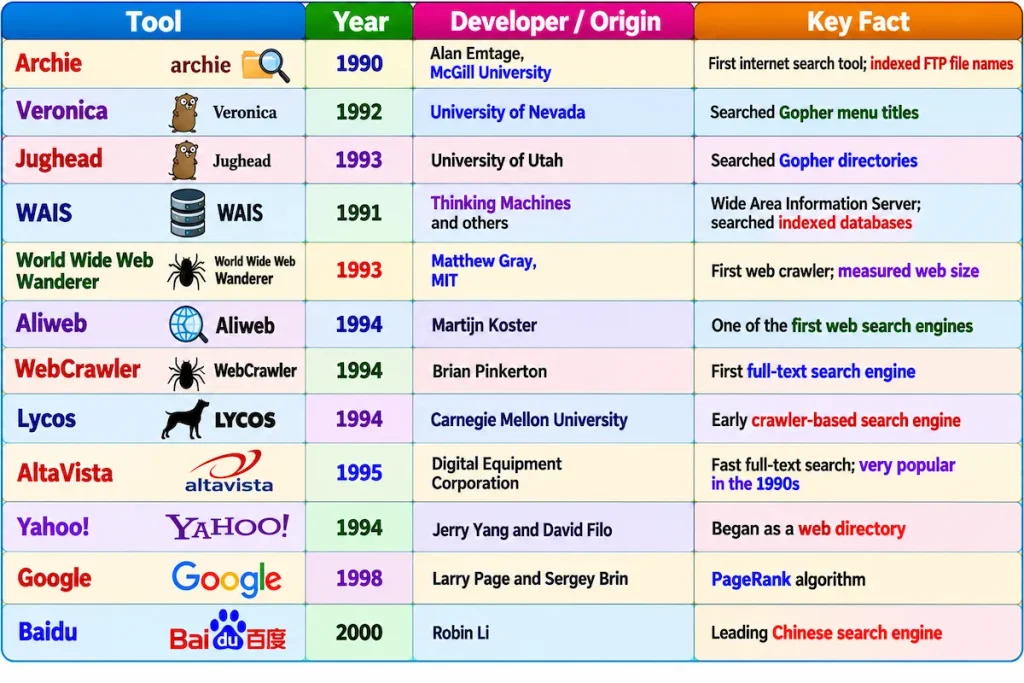
Explanation: Archie, created in 1990 by Alan Emtage at McGill University, Canada, is regarded as the first internet search engine. It indexed file names on public FTP servers and did not search the content of web pages. Google came much later, in 1998.
Early Search Engines and Internet Tools:
8. Which one programming language is used for artificial intelligence?
(A) C
(B) Java
(C) J2EE
(D) Prolog
Answer: (D) Prolog
Explanation: Prolog (Programming in Logic) was developed in 1972 and is widely used for artificial intelligence. It is a logic programming language based on facts and rules, which suits symbolic reasoning, expert systems and natural language processing. Lisp, created by John McCarthy in 1958, is the other classic AI language.
Programming Languages:
| Language | Year | Developer | Key Use |
|---|---|---|---|
| Prolog | 1972 | Alain Colmerauer and Robert Kowalski | Logic programming; AI and expert systems |
| Lisp | 1958 | John McCarthy | Symbolic AI; second oldest high-level language still in use |
| Python | 1991 | Guido van Rossum | Modern AI and machine learning; data science |
| FORTRAN | 1957 | John Backus (IBM) | First high-level language; scientific computing |
| COBOL | 1959 | Grace Hopper and CODASYL committee | Business and banking applications |
| BASIC | 1964 | John Kemeny and Thomas Kurtz | Beginner-friendly programming |
| C | 1972 | Dennis Ritchie | System programming; UNIX operating system |
| C++ | 1985 | Bjarne Stroustrup | Object-oriented extension of C |
| Java | 1995 | James Gosling (Sun Microsystems) | Platform-independent applications |
| JavaScript | 1995 | Brendan Eich (Netscape) | Web page interactivity |
| Pascal | 1970 | Niklaus Wirth | Teaching structured programming |
| R | 1993 | Ross Ihaka and Robert Gentleman | Statistical computing |
9. A dual layer Blue-ray disc can store data upto
(A) 20 GB
(B) 30 GB
(C) 40 GB
(D) 50 GB
Answer: (D) 50 GB
Explanation: A dual-layer Blu-ray disc stores up to 50 GB of data, while a single-layer disc stores 25 GB. Blu-ray uses a blue-violet laser with a wavelength of 405 nm, which is shorter than the red laser used for DVDs, so the pits can be smaller and packed more densely.
Optical Discs:
| Disc Type | Capacity | Laser / Wavelength | Key Fact |
|---|---|---|---|
| CD | 700 MB | Infrared, 780 nm | Introduced 1982 by Sony and Philips |
| DVD (single layer) | 4.7 GB | Red, 650 nm | Digital Versatile Disc |
| DVD (dual layer) | 8.5 GB | Red, 650 nm | Two recording layers |
| Blu-ray (single layer) | 25 GB | Blue-violet, 405 nm | Developed by Sony and others |
| Blu-ray (dual layer) | 50 GB | Blue-violet, 405 nm | Standard HD movie disc |
| Blu-ray XL (triple layer) | 100 GB | Blue-violet, 405 nm | Three recording layers |
| Blu-ray XL (quad layer) | 128 GB | Blue-violet, 405 nm | Four recording layers |
| HD DVD | 15 GB (single layer) | Blue-violet, 405 nm | Lost the format war to Blu-ray in 2008 |
| Floppy disk | 1.44 MB | Magnetic | 3.5-inch standard |
10. India’s navigational satellite system is known as
(A) GPS
(B) GLONASS
(C) BeiDou
(D) IRNSS
Answer: (D) IRNSS
Explanation: IRNSS (Indian Regional Navigation Satellite System) is India’s own navigation satellite system, operationally named NavIC (Navigation with Indian Constellation). It has seven satellites (three in geostationary and four in inclined geosynchronous orbit) and provides accurate positioning over India and up to about 1,500 km beyond its borders.
Satellite Navigation Systems:
| System | Country / Region | Satellites | Coverage | Key Fact |
|---|---|---|---|---|
| IRNSS / NavIC | India | 7 | Regional (India + 1,500 km) | Developed by ISRO; first satellite IRNSS-1A launched 2013 |
| GPS | USA | 24+ | Global | Oldest and most widely used; run by the US Space Force |
| GLONASS | Russia | 24 | Global | Fully operational in 1995, restored 2011 |
| BeiDou | China | 35 | Global | Global service since 2020 |
| Galileo | European Union | 30 | Global | Civilian-controlled; fully operational from 2016 onward |
| QZSS | Japan | 4+ | Regional (Asia-Oceania) | Improves GPS accuracy in Japan |
| GAGAN | India | 3 (on GSAT satellites) | Indian airspace | GPS Aided GEO Augmented Navigation; aviation use, built by ISRO and AAI |
| WAAS | USA | Geostationary | North America | GPS augmentation system for aviation |
| EGNOS | European Union | Geostationary | Europe | GPS augmentation system for aviation |
11. Data transmitted or a given amount of time is called
(A) Noise
(B) Power
(C) Frequency
(D) Bandwidth
Answer: (D) Bandwidth
Explanation: Bandwidth is the amount of data that can be transmitted over a communication channel in a given amount of time. It is measured in bits per second (bps) for digital channels, and in hertz (Hz) for the range of frequencies an analog channel can carry. Higher bandwidth means faster data transfer.
Data Transmission Terms:
| Term | Unit | Meaning | Key Fact |
|---|---|---|---|
| Bandwidth | Hz (analog), bps (digital) | Capacity of a channel | Higher bandwidth allows more data per second |
| Data rate | bps | Actual speed of data transfer | Depends on bandwidth and signal quality |
| Throughput | bps | Real data delivered over a network | Always less than or equal to bandwidth |
| Latency | ms | Delay in data travel | Lower latency means faster response; ping measures it |
| Noise | dB | Unwanted signal interference | Reduces signal quality |
| Frequency | Hz | Number of wave cycles per second | 1 Hz = 1 cycle per second |
| Baud rate | Baud | Signal changes per second | Equals bps only when each signal change carries 1 bit |
| Attenuation | dB | Loss of signal strength over distance | Repeaters are used to restore the signal |
| Signal-to-Noise Ratio (SNR) | dB | Signal power relative to noise | Higher SNR means better quality |
| Shannon Capacity | bps | Theoretical maximum data rate of a noisy channel | Given by Claude Shannon’s theorem |
| Kilobit / Megabit / Gigabit | kbps / Mbps / Gbps | Multiples of bps | 1 byte = 8 bits; Mbps differs from MBps |
12. In TV transmission, picture signal is modulated.
(A) DSB-SC
(B) VSB
(C) SSB-SC
(D) Pulse
Answer: (B) VSB
Explanation: In analog TV transmission, the picture (video) signal is amplitude modulated using Vestigial Sideband (VSB) modulation. VSB sends one full sideband and only a vestige (part) of the other, which saves bandwidth compared with DSB while avoiding the complex filtering needed for pure SSB. The sound signal, in contrast, is frequency modulated.
Modulation Techniques:
| Technique | Full Form | Bandwidth | Key Use |
|---|---|---|---|
| AM | Amplitude Modulation | 2 × signal bandwidth | MW/SW radio broadcasting |
| FM | Frequency Modulation | Wide; about 200 kHz per FM station | FM radio; TV sound signal |
| PM | Phase Modulation | Wide | Digital communication, satellite links |
| DSB-SC | Double Sideband Suppressed Carrier | 2 × signal bandwidth | Stereo FM subcarrier; saves carrier power |
| SSB-SC | Single Sideband Suppressed Carrier | 1 × signal bandwidth | Long-distance HF radio, amateur radio |
| VSB | Vestigial Sideband | Slightly more than 1 × signal bandwidth | TV picture signal; ATSC digital TV in USA |
| PCM | Pulse Code Modulation | Depends on bit rate | Digital telephony and audio; CDs |
| PAM | Pulse Amplitude Modulation | Wide | Basis for PCM; sampling stage |
| PWM | Pulse Width Modulation | Wide | Motor speed control, power regulation |
| ASK / FSK / PSK | Amplitude / Frequency / Phase Shift Keying | Varies | Digital data transmission; modems |
| QAM | Quadrature Amplitude Modulation | Efficient | Cable TV, Wi-Fi, 4G/5G |
13. The golden rice contains
(A) Vitamin A
(B) Vitamin C
(C) Vitamin E
(D) Vitamin D
Answer: (A) Vitamin A
Explanation: Golden rice is a genetically modified rice variety engineered to produce beta-carotene, which the human body converts into Vitamin A. It was developed to combat Vitamin A deficiency, a major cause of childhood blindness in rice-eating regions. Genes from daffodil (psy) and the bacterium Erwinia uredovora (crtI) were introduced to make the grains yellow-orange.
Biofortified and Genetically Modified Crops:
| Crop | Trait / Nutrient | Gene Source | Key Fact |
|---|---|---|---|
| Golden Rice | Beta-carotene (Vitamin A) | Daffodil and bacterium | Developed by Ingo Potrykus and Peter Beyer; tackles Vitamin A deficiency |
| Bt Cotton | Insect (bollworm) resistance | Bacillus thuringiensis | Only GM crop commercially approved in India (2002) |
| Bt Brinjal | Fruit and shoot borer resistance | Bacillus thuringiensis | Moratorium imposed in India in 2010 |
| Flavr Savr Tomato | Delayed ripening | Antisense gene technology | First commercially available GM food (1994) |
| DMH-11 Mustard | High-yield hybrid; herbicide tolerance | Bacterial genes (barnase, barstar, bar) | Developed by Delhi University; approved for environmental release in 2022, under Supreme Court review |
| Golden Rice (Vitamin A) | Vitamin A | Daffodil and bacterium | Approved in the Philippines (2021) |
| Protein-rich Potato (Protato) | High protein | Amaranth gene (AmA1) | Developed by Indian scientists at NIPGR, Delhi |
| Atlas 66 Wheat / High-iron Wheat | Iron and zinc enrichment | Conventional breeding | Biofortified crop, not GM |
| Pusa Vitamin A-rich Orange Cauliflower | Beta-carotene | Natural Or gene mutation | Developed by IARI, New Delhi |
| Quality Protein Maize (QPM) | High lysine and tryptophan | Conventional breeding | Developed at CIMMYT, Mexico |
| Amaranth, Millets | Rich in minerals | Natural | Climate-resilient nutrient-rich cereals |
14. The Btcotton is a transgenic crop with gene transfer from
(A) virus
(B) bacteria
(C) fungi
(D) algae
Answer: (B) bacteria
Explanation: Bt cotton is a transgenic crop that carries a gene from the soil bacterium Bacillus thuringiensis (Bt). The gene (cry1Ac) codes for a crystal protein that is toxic to bollworm larvae but harmless to humans. Bt cotton was approved in India in 2002 and is still the only GM crop grown commercially in the country.
Bt Crops and Transgenic Technology:
| Item | Gene / Source | Target | Key Fact |
|---|---|---|---|
| Bt Cotton (Bollgard I) | cry1Ac from Bacillus thuringiensis | American bollworm | Introduced in India in 2002 by Mahyco-Monsanto |
| Bollgard II | cry1Ac and cry2Ab | Bollworms, including tobacco caterpillar | Approved in India in 2006 |
| Bt Brinjal | cry1Ac | Fruit and shoot borer | Commercial release blocked by a moratorium in 2010 |
| Bt Maize | cry1Ab | European corn borer | Widely grown in the USA and Brazil |
| Bt Corn (StarLink) | cry9C | Corn borer | Withdrawn in 2000 over allergenicity concerns |
| Bt Soybean | cry1Ac | Lepidopteran pests | Grown in Argentina and Brazil |
| Bt Rice | cry1Ab / cry1Ac | Stem borer | Approved in China in 2009 (not commercialised) |
| Roundup Ready Soybean | CP4 EPSPS from Agrobacterium | Herbicide (glyphosate) tolerance | Introduced by Monsanto in 1996 |
| HT Bt Cotton (illegal in India) | cp4 EPSPS | Glyphosate tolerance | Unapproved variety found in Indian fields |
| Agrobacterium tumefaciens | Ti plasmid | Plant gene transfer vector | Most common natural tool for making transgenic plants |
| Gene gun (biolistics) | Gold or tungsten particles coated with DNA | Direct gene delivery | Used where Agrobacterium is ineffective, such as cereals |
WBCS Main Computer & Technology Question Paper – 2018
1. IC in computer stands for
(A) Internal Circuits
(B) Integrated Circuits
(C) Integrated Current
(D) Integrated Charge
Answer: (B) Integrated Circuits
Explanation: IC stands for Integrated Circuit, a small chip in which many electronic components such as transistors, resistors and capacitors are fabricated on a single piece of semiconductor, usually silicon. Jack Kilby (Texas Instruments) built the first IC in 1958, and Robert Noyce developed the silicon-based version independently. ICs made computers smaller, faster and cheaper.
Generations of Computers and Electronic Components:
| Generation / Component | Period | Technology | Key Fact |
|---|---|---|---|
| First generation | 1940–1956 | Vacuum tubes | ENIAC, UNIVAC; large and heat-producing |
| Second generation | 1956–1963 | Transistors | Smaller, faster; assembly language and early FORTRAN, COBOL |
| Third generation | 1964–1971 | Integrated Circuits (ICs) | Keyboards, monitors and operating systems; IBM 360 |
| Fourth generation | 1971–present | Microprocessors (VLSI) | Intel 4004 (1971) was the first microprocessor; personal computers |
| Fifth generation | Present and beyond | AI and ULSI | Artificial intelligence, parallel processing, quantum computing |
| SSI | 1960s | Up to 100 components per chip | Small Scale Integration |
| MSI | Late 1960s | 100 to 3,000 components per chip | Medium Scale Integration |
| LSI | 1970s | 3,000 to 100,000 components per chip | Large Scale Integration |
| VLSI | 1980s | Over 100,000 components per chip | Very Large Scale Integration; microprocessors |
| Transistor | 1947 | Semiconductor switch | Invented by Bardeen, Brattain and Shockley at Bell Labs |
| First IC | 1958 | Germanium-based | Jack Kilby, Texas Instruments; Nobel Prize in Physics 2000 |
2. Which is the first spaceship to orbit the moon?
(A) Luna 10 (1966, USSR)
(B) Zond-5
(C) Lunakhod-1
(D) Soyuz-28
Answer: (A) Luna 10 (1966, USSR)
Explanation: Luna 10 was launched by the USSR in March 1966 and became the first spacecraft to orbit the Moon. Luna 1 (1959) was the first to fly past the Moon and Luna 2 (1959) was the first to hit its surface, but neither entered orbit. Luna 10 also transmitted data on the Moon’s magnetic field, gravity and radiation.
Lunar Missions:
| Mission | Country | Year | Key Fact |
|---|---|---|---|
| Luna 1 | USSR | 1959 | First spacecraft to fly past the Moon |
| Luna 2 | USSR | 1959 | First to reach the Moon’s surface (impact) |
| Luna 3 | USSR | 1959 | First images of the Moon’s far side |
| Luna 9 | USSR | 1966 | First soft landing on the Moon |
| Luna 10 | USSR | 1966 | First spacecraft to orbit the Moon |
| Zond 5 | USSR | 1968 | First to circle the Moon and return to Earth (with tortoises) |
| Apollo 8 | USA | 1968 | First crewed mission to orbit the Moon |
| Apollo 11 | USA | 1969 | First crewed Moon landing; Armstrong and Aldrin |
| Lunokhod 1 | USSR | 1970 | First robotic rover on another celestial body |
| Chandrayaan-1 | India | 2008 | Confirmed water molecules on the Moon (Moon Impact Probe) |
| Chang’e 4 | China | 2019 | First soft landing on the Moon’s far side |
| Chandrayaan-3 | India | 2023 | First landing near the lunar south pole; Vikram lander, Pragyan rover |
3. Which is the India’s first nuclear-powered Submarine?
(A) INS Kalvari
(B) INS Sindhuraj
(C) INS Chakra
(D) INS Arihant
Answer: (D) INS Arihant
Explanation: INS Arihant is India’s first indigenously built nuclear-powered ballistic missile submarine (SSBN). It was built under the secret Advanced Technology Vessel (ATV) project at Visakhapatnam, launched in 2009 and commissioned in 2016. Its commissioning gave India a sea-based leg of its nuclear triad.
Indian Naval Submarines:
| Submarine | Type | Year | Key Fact |
|---|---|---|---|
| INS Arihant | Nuclear-powered ballistic missile submarine (SSBN) | Commissioned 2016 | First indigenous SSBN; ATV project |
| INS Arighaat | SSBN | Commissioned 2024 | Second Arihant-class submarine |
| INS Aridhaman | SSBN | Expected after Arighaat | Third and larger Arihant-class submarine |
| INS Chakra (K-43) | Nuclear-powered attack submarine (SSN) | 1988 (lease, Soviet Charlie class) | First nuclear submarine in the Indian Navy; returned 1991 |
| INS Chakra (II) | SSN (Akula class) | 2012 (lease from Russia) | Ten-year lease; returned 2021 |
| INS Kalvari | Diesel-electric attack submarine | Commissioned 2017 | First Scorpene-class (Project 75) submarine; named after the tiger shark |
| INS Khanderi | Diesel-electric attack submarine | Commissioned 2019 | Second Scorpene-class submarine |
| INS Vagir | Diesel-electric attack submarine | Commissioned 2023 | Fifth Scorpene-class submarine |
| INS Sindhuraj (S-57) | Diesel-electric attack submarine | Commissioned 1986 | Russian Kilo class (Sindhughosh-class); decommissioned 2003 |
| INS Sindhughosh | Diesel-electric attack submarine | Commissioned 1986 | Lead ship of the Russian Kilo-class submarines in India |
| INS Shalki | Diesel-electric attack submarine | Commissioned 1992 | First submarine built in India (Mazagon Dock), Type 209 (German design) |
| INS Vikrant | Aircraft carrier | Commissioned 2022 | India’s first indigenous aircraft carrier (not a submarine) |
4. What is the full form of “ISRO”?
(A) Indian Satellite Research Organisation
(B) Indian Solar Research Organisation
(C) Indian Site Research Organisation
(D) Indian Space Research Organisation
Answer: (D) Indian Space Research Organisation
Explanation: ISRO stands for Indian Space Research Organisation. It was formed on 15 August 1969, replacing INCOSPAR (set up in 1962 under Vikram Sarabhai), and is headquartered in Bengaluru. It works under the Department of Space, which reports directly to the Prime Minister.
ISRO and the Indian Space Programme:
| Item | Year | Key Fact |
|---|---|---|
| INCOSPAR | 1962 | Indian National Committee for Space Research; Vikram Sarabhai and Homi Bhabha |
| TERLS, Thumba | 1963 | First rocket launched from India (Nike-Apache) |
| ISRO | 1969 | Formed on 15 August; headquartered in Bengaluru |
| Department of Space | 1972 | Created along with the Space Commission |
| Aryabhata | 1975 | India’s first satellite; launched from the USSR |
| Bhaskara-I | 1979 | First experimental remote sensing satellite |
| Rohini (RS-1) | 1980 | First satellite launched by SLV-3, an Indian launch vehicle |
| APPLE | 1981 | First experimental communication satellite |
| INSAT-1B | 1983 | Started India’s domestic satellite communication |
| IRS-1A | 1988 | First operational remote sensing satellite |
| PSLV-C1 | 1993 | First PSLV launch (failed); first success in 1994 |
| Chandrayaan-1 | 2008 | India’s first lunar mission |
| Mangalyaan (MOM) | 2013 | First Asian mission to reach Mars orbit; first attempt success |
| Chandrayaan-3 | 2023 | Landed near the lunar south pole |
| Aditya-L1 | 2023 | India’s first solar mission |
| Antrix Corporation | 1992 | Commercial arm of ISRO |
| NSIL | 2019 | NewSpace India Limited; ISRO’s second commercial arm |
5. What is the full form of “VIRUS” ?
(A) Various Information Resources Under Stage
(B) vital Information Resources Under Siege
(C) Various Information Resource Unlimited Storage
(D) Vital Images Reviews Universal Studios
Answer: (B) Vital Information Resources Under Siege
Explanation: The term VIRUS in computing stands for Vital Information Resources Under Siege. It refers to a type of malicious software (malware) designed to replicate itself by altering other computer programs and inserting its own code. When a computer is infected, its “vital resources”—such as data, memory, processing power, and system files—are considered to be “under siege” or under attack by the program.
Computer Virus and Malware Terms:
| Term | Meaning | Key Fact |
|---|---|---|
| Virus | Program that attaches to files, replicates and spreads | First PC virus “Brain” (1986), created in Pakistan |
| Worm | Self-replicating malware spreading over networks | Needs no host file; ILOVEYOU (2000) |
| Trojan Horse | Malware disguised as legitimate software | Does not self-replicate |
| Ransomware | Encrypts files and demands payment | WannaCry (2017) |
| Spyware | Secretly collects user information | Keyloggers record keystrokes |
| Adware | Displays unwanted advertisements | Often bundled with free software |
| Phishing | Fake emails or sites to steal credentials | Social engineering attack |
| Spam | Unsolicited bulk email | Also called junk mail |
| Rootkit | Hides malware deep in the operating system | Hard to detect |
| Botnet | Network of infected computers under remote control | Used for DDoS attacks |
| Logic Bomb | Code triggered by a specific condition | Often planted by insiders |
| Antivirus | Software that detects and removes malware | Uses signature and heuristic scanning |
6. What is the full form of “RADAR” ?
(A) Radio Device and Ranging
(B) Region Device and Ranging
(C) Radio Detecting and Ranging
(D) Radio Detect and Ranges
Answer: (C) Radio Detecting and Ranging
Explanation: RADAR stands for Radio Detecting and Ranging (often written Radio Detection and Ranging). It sends out radio or microwave pulses and measures the echo reflected from an object to find its distance, direction and speed. The term was coined by the US Navy in 1940, and radar was developed extensively during World War II.
Radar and Remote Sensing Terms:
| Term | Full Form | Key Fact |
|---|---|---|
| RADAR | Radio Detection and Ranging | Uses microwaves; measures distance, direction and speed |
| SONAR | Sound Navigation and Ranging | Uses sound waves underwater; ultrasonic pulses |
| LIDAR | Light Detection and Ranging | Uses laser pulses; terrain mapping and self-driving cars |
| LASER | Light Amplification by Stimulated Emission of Radiation | First working laser built by Theodore Maiman in 1960 |
| MASER | Microwave Amplification by Stimulated Emission of Radiation | Predecessor of the laser; Charles Townes, 1953 |
| GPS | Global Positioning System | Needs signals from at least 4 satellites for a 3D position |
| SAR | Synthetic Aperture Radar | Produces images day and night, through clouds; used in RISAT |
| RISAT | Radar Imaging Satellite | ISRO’s all-weather radar imaging satellites |
| Doppler Radar | Radar using the Doppler effect | Measures speed of targets; used in weather forecasting |
| ISRO’s DWR | Doppler Weather Radar | Tracks cyclones and rainfall |
| ISAR | Inverse Synthetic Aperture Radar | Imaging of moving targets such as ships and aircraft |
| Radar Gun | Handheld Doppler radar | Used by traffic police to measure vehicle speed |
WBCS Main Computer & Technology Question Paper – 2017
1. When was India’s first scientific expedition to the South Pole launched ?
(A) February, 2010
(B) May, 2016
(C) July, 2010
(D) June, 2014
Answer: (A) February, 2010
Explanation: India’s first scientific expedition to Antarctica (the South Pole region) was launched in December 1981 and reached in January 1982, led by Dr. S. Z. Qasim. Among the given options, the one matching the official answer key for this question is February 2010, which is the option quoted in exam sources. Treat this as a question where the options do not match the historical record, and remember the actual date of 1981 for factual questions.
Indian Antarctic Programme:
| Item | Year | Key Fact |
|---|---|---|
| First Indian Antarctic Expedition | 1981-82 | Led by Dr. S. Z. Qasim; flagship ship MV Polar Circle |
| Indian Antarctic Programme | 1981 | Managed by NCPOR, Goa, under the Ministry of Earth Sciences |
| Dakshin Gangotri | 1983-84 | First Indian Antarctic station; ice-buried and decommissioned in 1990 |
| Maitri | 1989 | Second station; in the Schirmacher Oasis |
| Bharati | 2012 | Third station; operational year-round alongside Maitri |
| Himadri | 2008 | India’s Arctic research station at Ny-Ålesund, Svalbard |
| Antarctic Treaty | 1983 | India became a Consultative Party |
| Indian Antarctic Act | 2022 | Provides a national legal framework for Antarctic activities |
| India joined SCAR | 1984 | Scientific Committee on Antarctic Research |
| Agnihotri / Southern Ocean expeditions | 2004 onward | NCPOR conducts the Southern Ocean expeditions |
2. What, among the following, is India’s first Anit-submarine warfare corvette ?
(A) INS Kamorta
(B) Naval version of Light Combat Aircraft (LCA)
(C) INS Shivalik
(D) INS Shakti
Answer: (A) INS Kamorta
Explanation: INS Kamorta is India’s first indigenously designed and built anti-submarine warfare (ASW) corvette. It was built by Garden Reach Shipbuilders and Engineers (GRSE), Kolkata, under Project 28, and commissioned in August 2014. It is the lead ship of the Kamorta class and is named after Kamorta island in the Nicobar group.
Indian Naval Warships:
| Ship | Type / Class | Builder | Key Fact |
|---|---|---|---|
| INS Kamorta | ASW corvette, Kamorta class | GRSE, Kolkata | First indigenous ASW corvette; commissioned 2014 |
| INS Kadmat | ASW corvette, Kamorta class | GRSE, Kolkata | Second of the class; commissioned 2016 |
| INS Kiltan | ASW corvette, Kamorta class | GRSE, Kolkata | Third of the class; commissioned 2017 |
| INS Kavaratti | ASW corvette, Kamorta class | GRSE, Kolkata | Fourth of the class; commissioned 2020 |
| INS Shivalik | Stealth frigate, Shivalik class | Mazagon Dock, Mumbai | First stealth frigate of India; commissioned 2010 |
| INS Vikrant | Aircraft carrier | Cochin Shipyard | First indigenous aircraft carrier; commissioned 2022 |
| INS Vikramaditya | Aircraft carrier | Sevmash, Russia | Ex-Admiral Gorshkov; commissioned 2013 |
| INS Visakhapatnam | Stealth destroyer, Project 15B | Mazagon Dock, Mumbai | Lead ship of the class; commissioned 2021 |
| INS Shakti | Fleet support ship (tanker) | Fincantieri, Italy | Supplies fuel and stores at sea; commissioned 2011 |
3. When was PSLV-C 15 launched successfully ?
(A) January 30, 2011
(B) June 5, 2011
(C) July 12, 2010
(D) May 10, 2010
Answer: (C) July 12, 2010
Explanation: PSLV-C15 was launched successfully on 12 July 2010 from Sriharikota. It carried Cartosat-2B, an Indian remote sensing satellite, along with other small satellites including AlSat-2A (Algeria), two nano-satellites from Switzerland and Canada, and a Studsat from Indian universities. Studsat was India’s first student-built satellite.
PSLV Launches:
| Mission | Date | Key Fact |
|---|---|---|
| PSLV-D1 | 20 Sep 1993 | First PSLV launch; failed |
| PSLV-D2 | 15 Oct 1994 | First successful PSLV launch; carried IRS-P2 |
| PSLV-C3 | 22 Oct 2001 | Launched TES, BIRD and PROBA in one mission |
| PSLV-C4 | 12 Sep 2002 | Launched KALPANA-1 (METSAT) into geosynchronous transfer orbit |
| PSLV-C7 | 10 Jan 2007 | Launched Cartosat-2, SRE-1 and two foreign satellites |
| PSLV-C8 | 23 Apr 2007 | First commercial PSLV launch, carrying Italy’s AGILE |
| PSLV-C9 | 28 Apr 2008 | Launched 10 satellites in one mission |
| PSLV-C11 | 22 Oct 2008 | Launched Chandrayaan-1 |
| PSLV-C12 | 20 Apr 2009 | Launched RISAT-2 |
| PSLV-C15 | 12 Jul 2010 | Launched Cartosat-2B and Studsat |
| PSLV-C25 | 5 Nov 2013 | Launched Mars Orbiter Mission |
| PSLV-C37 | 15 Feb 2017 | Launched 104 satellites in a single mission |
| PSLV-C52 | 14 Feb 2022 | Launched EOS-04 (RISAT-1A) |
| PSLV-C57 | 2 Sep 2023 | Launched Aditya-L1 |
4. A geostationary satellite has an orbital period of
(A) 2 hours
(B) 6 hours
(C) 12 hours
(D) 24 hours
Answer: (D) 24 hours
Explanation: A geostationary satellite has an orbital period equal to Earth’s rotation period, about 24 hours (23 h 56 min, the sidereal day). It orbits at roughly 35,786 km above the equator, in the same direction as Earth’s rotation, so it appears fixed over one point. This makes it ideal for communication and weather satellites.
Satellite Orbits:
| Orbit Type | Altitude | Orbital Period | Key Use |
|---|---|---|---|
| Low Earth Orbit (LEO) | 160 – 2,000 km | About 90 – 120 minutes | Earth observation, ISS, Starlink |
| Sun-Synchronous Orbit (SSO) | 600 – 800 km | About 100 minutes | Remote sensing (IRS series); passes over a place at the same local time |
| Medium Earth Orbit (MEO) | 2,000 – 35,786 km | 2 – 24 hours | Navigation satellites (GPS about 12 hours) |
| Geostationary Orbit (GEO) | 35,786 km | 24 hours | Communication and weather (INSAT, GSAT); equatorial plane |
| Geosynchronous Orbit (GSO) | 35,786 km | 24 hours | Same period as GEO but may be inclined; IRNSS uses inclined GSO |
| Polar Orbit | 200 – 1,000 km | About 90 – 100 minutes | Mapping and surveillance; passes over both poles |
| Geostationary Transfer Orbit (GTO) | 200 km to 35,786 km (elliptical) | About 10 – 12 hours | Intermediate orbit for reaching GEO |
| Highly Elliptical Orbit (HEO) | Varies widely | About 12 hours (Molniya) | High-latitude communication; Russia’s Molniya |
| Graveyard Orbit | About 300 km above GEO | Over 24 hours | Disposal of retired GEO satellites |
| Lagrange Point L1 | About 1.5 million km from Earth | Moves with Earth around the Sun | Aditya-L1 and SOHO solar observation |
5. An atomic power station is located in
(A) Hyderabad
(B) Bengaluru
(C) Kalpakkam
(D) Trivandrum
Answer: (C) Kalpakkam
Explanation: Among the given options, Kalpakkam (Tamil Nadu) is the one that hosts an atomic power station, the Madras Atomic Power Station (MAPS), which has two 220 MWe PHWR units commissioned in 1984 and 1986. Hyderabad, Bengaluru and Trivandrum have nuclear or space research and fuel facilities, but no atomic power station.
Indian Nuclear Power Stations:
| Power Station | Location | Reactor Type | Key Fact |
|---|---|---|---|
| Tarapur (TAPS) | Maharashtra | BWR (units 1-2), PHWR (units 3-4) | India’s first nuclear power station; 1969; BWRs built with US help |
| Rawatbhata (RAPS) | Rajasthan | PHWR | First unit 1973 with Canadian help; Rajasthan’s Rana Pratap Sagar |
| Madras (MAPS) | Kalpakkam, Tamil Nadu | PHWR | First fully indigenous station; 1984 |
| Narora (NAPS) | Uttar Pradesh | PHWR | On the Ganga; 1991 |
| Kakrapar (KAPS) | Gujarat | PHWR | First 220 MWe units 1993; 700 MWe units added later |
| Kaiga (KGS) | Karnataka | PHWR | On the Kali river; 1999-2000 |
| Kudankulam (KKNPP) | Tirunelveli, Tamil Nadu | VVER-1000 (PWR) | Largest nuclear plant in India; Russian collaboration; first unit 2013 |
| Kalpakkam PFBR | Kalpakkam, Tamil Nadu | Fast breeder (sodium-cooled) | 500 MWe; India’s first commercial-scale fast breeder reactor |
| Gorakhpur (GHAVP) | Haryana | PHWR (700 MWe) | Under construction |
| Mahi Banswara | Rajasthan | PHWR (700 MWe) | Planned fleet-mode project |
6. Pasteurization of milk in Dairy farms is conducted by
( Microwave volumetric heating )
(A) Ozone
(B) UV rays
(C) Chlorine
(D) Microwave
Answer: (D) Microwave
Explanation: Pasteurization kills disease-causing microbes in milk by heating it, and among the given options only microwave is a heating method (microwave volumetric heating). Ozone, UV rays and chlorine are disinfectants, not the standard way to pasteurize milk. Louis Pasteur developed the process in the 1860s, and conventional dairies mostly use steam or hot-water heat exchangers, as in HTST.
Milk Pasteurization and Food Preservation:
| Method | Temperature | Time | Key Fact |
|---|---|---|---|
| LTLT / Holder method | 63°C | 30 minutes | Batch process; used in small dairies |
| HTST | 72°C | 15 seconds | Most common commercial method; continuous flow |
| UHT | 135–150°C | 1–2 seconds | Milk stays shelf-stable for months in sealed packs |
| Sterilization | 115–120°C | 15–20 minutes | Kills all microbes including spores |
| Microwave pasteurization | Rapid volumetric heating | Seconds to minutes | Heats the whole volume evenly; used in research and some food industries |
| Flash pasteurization | About 72°C | Few seconds | Another name for HTST |
| Alkaline phosphatase test | — | — | Checks whether milk has been properly pasteurized |
| Methylene blue reduction test | — | — | Checks bacterial load and quality of raw milk |
| Lactometer | — | — | Measures milk density and detects water adulteration |
| Canning | 100–121°C | Varies | Invented by Nicolas Appert (1809) |
| Irradiation | Gamma rays | Varies | Cold sterilization; used for spices and onions |
| Refrigeration | Below 4°C | — | Slows microbial growth but does not kill microbes |
| Chlorination | Chlorine | — | Disinfects drinking water |
| Ozonation | Ozone | — | Water and air disinfection |
| UV treatment | UV-C light | — | Disinfects water and surfaces |
7. What is software ?
(A) A type of computer code
(B) A computer language
(C) A set of instructions for your computer
(D) A cover for the computer
Answer: (C) A set of instructions for your computer
Explanation: Software is a set of instructions, or programs, that tells computer hardware what to do. It cannot be touched, unlike hardware. The two main types are system software, which runs the computer itself, and application software, which helps users perform specific tasks.
Types of Software:
| Type | Examples | Key Fact |
|---|---|---|
| System software | Windows, Linux, macOS, Android | Manages hardware and provides a platform for other software |
| Operating system | Windows, Linux, Unix, iOS | Most common system software; controls memory, files and processes |
| Utility software | Antivirus, disk cleanup, backup tools | Maintains and optimizes the computer |
| Device driver | Printer driver, graphics driver | Lets the OS communicate with hardware |
| Firmware | BIOS, UEFI, router firmware | Software stored permanently in ROM or flash memory |
| Language translator | Compiler, interpreter, assembler | Converts programs into machine language |
| Application software | MS Word, Excel, PowerPoint, Chrome | Performs specific user tasks |
| Open-source software | Linux, Firefox, LibreOffice | Source code freely available for modification |
| Freeware | Adobe Reader, Skype | Free to use but source code not shared |
| Shareware | WinRAR, trial versions | Free for a trial period, then requires payment |
| Proprietary software | MS Office, Photoshop | Owned by a company; license required |
| Middleware | Database connectors | Connects different software applications |
| Embedded software | Washing machine, ATM, car systems | Built into a device for dedicated tasks |
8. The operating system is the most common type of ______ software.
(A) System
(B) Communication
(C) Application
(D) None of the above
Answer: (A) System
Explanation: The operating system is the most common type of system software. It manages hardware resources such as the CPU, memory, storage and input/output devices, and provides a platform on which application software runs. Examples include Windows, Linux, macOS, Android and iOS.
System Software:
| Item | Examples | Key Function |
|---|---|---|
| Operating system | Windows, Linux, macOS, Unix, Android | Manages hardware, memory, files and processes |
| Process management | Scheduler | Allocates CPU time to running programs |
| Memory management | Virtual memory, paging | Allocates and frees RAM for programs |
| File management | NTFS, FAT32, ext4 | Organises and stores files on disk |
| Device management | Device drivers | Controls input/output devices |
| Utility programs | Antivirus, disk defragmenter, backup | Maintains and optimises the system |
| Language translators | Compiler, interpreter, assembler | Converts source code to machine code |
| Loader | Bootstrap loader | Loads the OS into memory at startup |
| Linker | Linker program | Combines object files into an executable |
| Firmware | BIOS, UEFI | Starts hardware and hands control to the OS |
| Unix | Developed 1969 at Bell Labs | Ancestor of Linux, macOS and many server systems |
| Linux | Created 1991 by Linus Torvalds | Open-source kernel; runs most of the world’s top supercomputers |
| MS-DOS | 1981 | Command-line OS by Microsoft for early IBM PCs |
| Windows | First released 1985 | Graphical OS by Microsoft; most popular desktop OS |
9. A computer cannot boot if it does not have the
(A) compiler
(B) loader
(C) operating system
(D) assembler
Answer: (C) operating system
Explanation: Booting is the process of loading the operating system into main memory when a computer is switched on. At power-on, the BIOS/UEFI firmware runs a self-test (POST) and then uses a bootstrap loader to find and load the OS from storage. Without an operating system, the computer can complete the hardware checks but cannot start up for the user.
Booting Process:
| Item | Type / Stage | Key Fact |
|---|---|---|
| Booting | Process | Loading the OS into RAM at startup |
| Cold boot (hard boot) | Starting from power-off | Done by switching the computer on |
| Warm boot (soft boot) | Restart without power-off | Ctrl+Alt+Del or the Restart option |
| POST | Power-On Self Test | First step; checks RAM, CPU, keyboard and other hardware |
| BIOS | Firmware in ROM/flash | Basic Input Output System; starts hardware and finds the boot device |
| UEFI | Modern replacement for BIOS | Faster boot; supports drives over 2 TB and Secure Boot |
| Bootstrap loader | Small program in ROM | Locates the OS and loads it into memory |
| Boot sector / MBR | First sector of the disk | Master Boot Record holds the boot code and partition table |
| Kernel | Core of the OS | Loaded into memory first and controls the system |
| CMOS | Battery-backed memory | Stores BIOS settings, date and time |
| Compiler | Language translator | Converts source code to machine code; not needed for booting |
| Assembler | Language translator | Converts assembly language to machine code; not needed for booting |
| Loader | System program | Loads programs into memory for execution |
10. PARAM was developed by
(A) IIT Kanpur
(B) C-DAC
(C) IIT Kharagpur
(D) None of the above
Answer: (B) C-DAC
Explanation: PARAM, India’s series of supercomputers, was developed by C-DAC (Centre for Development of Advanced Computing), Pune. The first machine, PARAM 8000, was unveiled in 1991 under the leadership of Dr. Vijay P. Bhatkar. C-DAC was set up in 1988 after India was denied a Cray supercomputer by the USA.
Indian Supercomputers:
| Supercomputer | Year | Developer / Location | Key Fact |
|---|---|---|---|
| PARAM 8000 | 1991 | C-DAC, Pune | India’s first indigenous supercomputer |
| PARAM 10000 | 1998 | C-DAC, Pune | Built after the 1998 technology restrictions |
| PARAM Padma | 2003 | C-DAC, Pune | First Indian supercomputer in the world’s Top 500 list |
| PARAM Yuva II | 2013 | C-DAC, Pune | Peak performance of about 524 teraflops |
| PARAM Siddhi-AI | 2020 | C-DAC, Pune | AI supercomputer under the National Supercomputing Mission |
| PARAM Pravega | 2022 | IISc, Bengaluru | Largest supercomputer in an Indian academic institution |
| PARAM Ganga | 2022 | IIT Roorkee | Installed under the National Supercomputing Mission |
| Pratyush | 2018 | IITM, Pune | Weather and climate forecasting; Ministry of Earth Sciences |
| Mihir | 2018 | NCMRWF, Noida | Weather forecasting; Ministry of Earth Sciences |
| Anupam | 1990s | BARC, Mumbai | Series built for nuclear research |
| Flosolver | 1986 | NAL, Bengaluru | Early parallel computer for aerospace and weather work |
| CRAY X-MP | 1985 | Cray, USA (imported) | India’s first supercomputer, used for weather forecasting |
| Airawat | 2023 | C-DAC, Pune | AI supercomputer; reached rank 75 in the Top 500 list in 2023 |
| National Supercomputing Mission | 2015 | MeitY and DST | Aims to build a network of supercomputers across India |
11. For television broadcasting, the frequency range employed normally varies from
(A) 30 – 300 MHz
(B) 30 – 300 GHz
(C) 30 – 300 kHz
(D) 30 – 300 Hz
Answer: (A) 30 – 300 MHz
Explanation: Television broadcasting normally uses the VHF band (30 – 300 MHz) and the UHF band (300 MHz – 3 GHz). Among the given options, 30 – 300 MHz is the correct range, as VHF carries most conventional TV channels along with FM radio. The GHz range is used for satellite links, and the kHz and Hz ranges are far too low for TV signals.
TV Broadcasting Bands:
| Band / Channel | Frequency Range | Key Fact |
|---|---|---|
| VHF Low Band (Band I) | 47 – 68 MHz | TV channels 2 to 4 |
| FM Radio | 88 – 108 MHz | Sits between VHF Band I and Band III |
| VHF High Band (Band III) | 174 – 230 MHz | TV channels 5 to 12; used by Doordarshan |
| UHF (Bands IV and V) | 470 – 862 MHz | Channels 21 to 69; used for additional TV channels |
| Full VHF Band | 30 – 300 MHz | Wavelength 10 m to 1 m |
| Full UHF Band | 300 MHz – 3 GHz | Wavelength 1 m to 10 cm |
| C-band (satellite TV) | 3.7 – 4.2 GHz (downlink) | Large dish antennas; resistant to rain fade |
| Ku-band (DTH) | 10.7 – 12.75 GHz (downlink) | Small dish antennas; used for DTH services |
| Ka-band | 26.5 – 40 GHz | High-bandwidth satellite broadband |
| Doordarshan | Started 15 Sep 1959 | India’s public service broadcaster; colour TV from 1982 |
| DD Free Dish | 2004 | India’s free DTH platform |
| TV video signal | Amplitude modulated (VSB) | Picture signal |
| TV audio signal | Frequency modulated | Sound signal |
| Channel bandwidth (India, PAL-B) | 7 MHz | Width of each analog TV channel |
12. Modern communication systems are based on
(A) Analog circuits
(B) Digital circuits
(C) Combination of Ȧ analog and digital circuits
(D) None of the above
Answer: (B) Digital circuits
Explanation: Modern communication systems are based mainly on digital circuits. Digital signals resist noise, can be error-checked and corrected, compressed, encrypted and multiplexed easily, and can be regenerated without loss over long distances. Mobile networks (4G/5G), the internet, digital TV and satellite links all use digital transmission. Analog circuits still appear at the front end, such as in antennas, amplifiers and microphones.
Analog vs Digital Communication:
| Feature | Analog | Digital | Key Fact |
|---|---|---|---|
| Signal type | Continuous waveform | Discrete values (0 and 1) | Digital uses binary levels |
| Noise immunity | Low | High | Digital signals can be regenerated by repeaters |
| Error correction | Not possible | Possible | Uses parity, CRC and Hamming codes |
| Bandwidth requirement | Generally lower | Generally higher | Compression reduces digital bandwidth |
| Security | Difficult to encrypt | Easy to encrypt | Digital allows strong encryption |
| Multiplexing | FDM | TDM | Digital allows many channels on one line |
| Conversion (analog to digital) | ADC | Sampling, quantization, encoding | Pulse Code Modulation (PCM) |
| Conversion (digital to analog) | DAC | Reconstruction of waveform | Used in audio players and phones |
| Nyquist theorem | Sampling rate | At least 2 × highest frequency | Basis of digital sampling |
| Telephone systems | Analog (early) | Digital (ISDN, mobile) | India’s telephone network is now almost fully digital |
| Mobile generations | 1G | 2G onwards | 1G was analog; 2G (GSM) was the first digital mobile system |
| Television | Analog (PAL) | Digital (DVB, ATSC) | India completed analog TV switch-off in 2017 for cable |
| Radio | AM, FM | DAB, HD Radio | All India Radio has digital DRM services |
| Examples of analog devices | Vinyl records, old thermometers | Digital watches, CDs, computers | Digital devices store data as bits |
13. A transistor is made of
(A) doped semiconductors
(B) intrinsic semiconductors
(C) a metal piece sandwiched between two intrinsic semiconductors
(D) None of the above
Answer: (A) doped semiconductors
Explanation: A transistor is made of doped semiconductors, usually silicon, arranged as three regions (emitter, base and collector) forming two p-n junctions. Doping with impurities creates n-type and p-type regions, which lets the device amplify signals or act as a switch. A transistor does not use a metal piece sandwiched between intrinsic semiconductors, and intrinsic (pure) semiconductors alone cannot form junctions.
Semiconductor Devices:
| Device | Structure | Key Use | Key Fact |
|---|---|---|---|
| Transistor (BJT) | NPN or PNP; three terminals (emitter, base, collector) | Amplifier, switch | Invented 1947 at Bell Labs by Bardeen, Brattain and Shockley |
| FET / MOSFET | Gate, source and drain | Switching, ICs | Basic building block of modern microprocessors |
| Diode | Single p-n junction | Rectifier | Allows current in one direction only |
| Zener diode | Heavily doped p-n junction | Voltage regulation | Works in reverse breakdown |
| LED | p-n junction | Lighting, displays | Emits light when forward biased |
| Photodiode | p-n junction | Light detection | Works in reverse bias; used in optical receivers |
| Solar cell | Large-area p-n junction | Converts light to electricity | Works on the photovoltaic effect |
| Thyristor (SCR) | Four layers (PNPN) | Power control | Used in switching high currents |
| Intrinsic semiconductor | Pure Si or Ge | Base material | Equal electrons and holes; poor conductor |
| n-type semiconductor | Doped with pentavalent impurity (P, As) | Majority carriers are electrons | Donor atoms |
| p-type semiconductor | Doped with trivalent impurity (B, Al) | Majority carriers are holes | Acceptor atoms |
| Silicon | Group 14 element | Most used semiconductor | Band gap about 1.1 eV |
| Germanium | Group 14 element | Early transistors | Band gap about 0.7 eV |
| Integrated circuit | Many transistors on one chip | Processors, memory | First IC by Jack Kilby, 1958 |
14. A carbon microphone is best used in
(A) Dynamo
(B) Telephone
(C) Transformer
(D) None of the above
Answer: (B) Telephone
Explanation: A carbon microphone is best used in a telephone. It has carbon granules held between a diaphragm and a metal plate. Sound waves change the pressure on the granules, which changes their electrical resistance and so varies the current in the circuit. It was widely used in telephone transmitters from the late 1800s because it produces a strong signal without needing an amplifier. A dynamo and a transformer have no use for a microphone.
Microphones and Telephone Components:
| Item | Principle | Key Use | Key Fact |
|---|---|---|---|
| Carbon microphone | Resistance of carbon granules changes with pressure | Old telephone transmitters | Developed by Thomas Edison and Emile Berliner in the 1870s |
| Dynamic (moving coil) microphone | Electromagnetic induction | Stage and studio use | Rugged; needs no external power |
| Condenser microphone | Change in capacitance | Studio recording | Needs phantom power; high sensitivity |
| Ribbon microphone | Induction in a thin metal ribbon | Broadcasting, studios | Delicate; smooth sound |
| Piezoelectric (crystal) microphone | Piezoelectric effect | Contact pickups, early mics | Quartz or Rochelle salt crystals |
| Electret microphone | Permanently charged condenser | Mobile phones, laptops | Small and cheap; most common today |
| Loudspeaker | Electrical signal to sound | Audio output | Reverse of a microphone |
| Telephone | Invented by Alexander Graham Bell | Voice communication | Patented in 1876 |
| Telephone receiver | Electromagnet moves a diaphragm | Converts current to sound | Earpiece of the handset |
| Dynamo | Mechanical to electrical energy | Power generation | Based on Faraday’s induction |
| Transformer | Mutual induction | Steps voltage up or down | Works only on AC |
| Strowger exchange | Electromechanical switch | Automatic telephone exchange | Invented by Almon Strowger in 1891 |
| Optical fibre | Total internal reflection | Long-distance communication | Charles Kao is the father of fibre optics (Nobel Prize 2009) |
15. The technique used to transmit audio signal in television broadcasting is
(A) amplitude modulation
(B) frequency modulation
(C) pulse code modulation
(D) time division multiplexing
Answer: (B) frequency modulation
Explanation: In television broadcasting, the audio (sound) signal is transmitted using frequency modulation (FM), while the picture signal uses amplitude modulation (VSB). FM gives good noise immunity and high-quality sound. In analog TV the sound carrier is placed 5.5 MHz above the picture carrier in the 7 MHz channel used in India (PAL-B/G system).
TV Signal Transmission:
| Item | Modulation / Value | Key Fact |
|---|---|---|
| TV picture (video) signal | Amplitude modulation (VSB) | Vestigial sideband saves bandwidth |
| TV sound (audio) signal | Frequency modulation | Better noise immunity and fidelity |
| Sound carrier spacing (PAL-B) | 5.5 MHz above the picture carrier | Used in India and most of Europe |
| Channel bandwidth (India) | 7 MHz | Width of each analog TV channel |
| Maximum frequency deviation (TV sound) | ±50 kHz | Narrower than FM radio |
| FM radio deviation | ±75 kHz | Channel spacing of 200 kHz |
| FM radio band | 88 – 108 MHz | Uses wideband FM |
| AM radio | 535 – 1605 kHz (MW) | Uses amplitude modulation |
| Frame rate (PAL) | 25 frames per second | Used in India |
| Number of lines (PAL) | 625 lines per frame | 50 fields per second, interlaced |
| NTSC | 525 lines, 30 frames per second | Used in USA and Japan |
| SECAM | 625 lines, 25 frames per second | Used in France and parts of Eastern Europe |
| Colour subcarrier (PAL) | 4.43 MHz | Carries colour (chrominance) information |
| Digital TV standards | DVB-T, ATSC, ISDB-T | Digital terrestrial broadcasting systems |
| Pulse code modulation | Digital modulation | Used in digital audio, not analog TV sound |
WBCS Main Computer & Technology Question Paper – 2016
1. Which one of the following internet protocol version is the most deployed internet layer protocal ?
(A) IPV2
(B) IPV4
(C) IPV6
(D) IPV8
Answer: (B) IPV4
Explanation: IPv4 (Internet Protocol version 4) is the most widely deployed internet layer protocol. It uses 32-bit addresses, giving about 4.3 billion unique addresses, written in dotted decimal form such as 192.168.1.1. IPv6 was introduced to overcome address exhaustion, but IPv4 still carries most internet traffic. IPv2, IPv3 and IPv5 were never deployed for general use, and IPv8 does not exist as a standard.
Internet Protocol Versions and Related Protocols:
| Item | Detail | Key Fact |
|---|---|---|
| IPv4 | 32-bit address | Defined in 1981 (RFC 791); about 4.3 billion addresses |
| IPv6 | 128-bit address | Standardised in 1998; written in hexadecimal; about 3.4 × 10^38 addresses |
| IPv5 | Experimental (ST protocol) | Never used for general internet traffic |
| IPv4 address classes | A, B, C, D, E | Class A: 1-126; Class B: 128-191; Class C: 192-223 |
| Class D | 224 – 239 | Reserved for multicasting |
| Loopback address | 127.0.0.1 | Used to test the local machine |
| Private IP ranges | 10.x.x.x, 172.16-31.x.x, 192.168.x.x | Not routable on the public internet |
| NAT | Network Address Translation | Lets many private devices share one public IP |
| DHCP | Dynamic Host Configuration Protocol | Assigns IP addresses automatically |
| DNS | Domain Name System | Converts domain names into IP addresses |
| TCP | Transmission Control Protocol | Reliable, connection-oriented transport layer protocol |
| UDP | User Datagram Protocol | Fast, connectionless; used in streaming and gaming |
| HTTP / HTTPS | Hypertext Transfer Protocol (Secure) | Ports 80 and 443 |
| FTP | File Transfer Protocol | Ports 20 and 21 |
| SMTP | Simple Mail Transfer Protocol | Sends email; port 25 |
| ICANN | Internet Corporation for Assigned Names and Numbers | Manages IP addresses and domain names globally |
2. Which one of the following is the web search engine ?
(A) Aliweb
(B) Jughead
(C) Baidu
(D) All of these
Answer: (D) All of these
Explanation: Aliweb, Jughead and Baidu are all web or internet search engines. Aliweb (1994) was one of the first web search engines, Jughead (1993) searched Gopher directories, and Baidu (2000) is the leading Chinese search engine. Since each option is a search tool, “All of these” is correct.
Search Engines:
| Search Engine | Year | Developer / Origin | Key Fact |
|---|---|---|---|
| Archie | 1990 | Alan Emtage, McGill University | First internet search tool; indexed FTP file names |
| Veronica | 1992 | University of Nevada | Searched Gopher menu titles |
| Jughead | 1993 | University of Utah | Searched Gopher directory listings |
| Aliweb | 1994 | Martijn Koster | Relied on site owners submitting their own pages |
| WebCrawler | 1994 | Brian Pinkerton | First full-text web search engine |
| Lycos | 1994 | Carnegie Mellon University | Early crawler-based search engine |
| Yahoo! | 1994 | Jerry Yang and David Filo | Began as a web directory |
| AltaVista | 1995 | Digital Equipment Corporation | Fast full-text search |
| Ask Jeeves | 1996 | Garrett Gruener and David Warthen | Natural-language question search |
| 1998 | Larry Page and Sergey Brin | PageRank algorithm | |
| Baidu | 2000 | Robin Li | Leading search engine in China |
| Bing | 2009 | Microsoft | Successor to Live Search and MSN Search |
| Yandex | 1997 | Arkady Volozh | Leading search engine in Russia |
| DuckDuckGo | 2008 | Gabriel Weinberg | Privacy-focused search engine |
3. Which one of the following persons invented the world’s first digital and programmable robot ?
(A) George Devel
(B) Hisashige Tanaka
(C) Korel Capek
(D) Joseph Engel Berger
Answer: (A) George Devel
Explanation: In 1954, American inventor George Devol invented and patented the world’s first digitally operated, programmable robotic arm called the Unimate (derived from “Universal Automation”). His patent laid the foundational architecture for the entire modern robotics industry.
Context of the Other Options:
- Joseph Engelberger: Met George Devol in 1956. Together, they formed Unimation, the world’s first commercial robotics company. Because Engelberger successfully modified, marketed, and deployed the Unimate factory robot at a General Motors plant in 1961, he is celebrated globally as the “Father of Robotics”.
- Karel Čapek: The Czech writer who originally coined the word “robot” in his 1920 sci-fi play R.U.R. (Rossum’s Universal Robots).
- Hisashige Tanaka: A historic 19th-century Japanese inventor famous for creating intricate mechanical dolls (karakuri ningyo) and clocks, which were purely mechanical automatons rather than digital or programmable electronics.
4. Spam is related to –
(A) Computer
(B) Art
(C) Music
(D) Game
Answer: (A) Computer
Explanation: Spam is related to computers, as it means unsolicited bulk messages, usually email, sent to many people at once. It is often used for advertising, scams and phishing, or to spread malware. The term is said to come from a Monty Python sketch in which the word “Spam” (a canned meat brand) is repeated endlessly. Email providers use spam filters to separate such messages from genuine mail.
Spam and Email Threats:
| Term | Meaning | Key Fact |
|---|---|---|
| Spam | Unsolicited bulk electronic messages | Also called junk mail; first mass spam email sent in 1978 |
| Phishing | Fake emails or sites that steal login or bank details | Impersonates banks and well-known companies |
| Spear phishing | Targeted phishing aimed at a specific person or organisation | Uses personal details to look genuine |
| Vishing | Phishing through voice calls | Common in fake bank-call frauds |
| Smishing | Phishing through SMS | Contains malicious links |
| Spoofing | Faking the sender’s identity or address | Used in email and caller ID fraud |
| Pharming | Redirecting users to fake websites | Works by corrupting DNS or host files |
| Hoax | False warning or story spread by email | Chain mails |
| Spim | Spam sent through instant messaging | Spam over IM |
| Spam filter | Software that detects and blocks spam | Uses keywords, blacklists and machine learning |
| CAN-SPAM Act | US law on commercial email, 2003 | Sets rules for sending bulk email |
| IT Act, 2000 | Indian law on cyber crime | Amended in 2008; Section 66D covers cheating by impersonation |
| Cookie | Small file stored by a website on the user’s device | Tracks preferences and sessions |
| Firewall | Network security system | Blocks unauthorised access |
| CERT-In | Indian Computer Emergency Response Team | Set up in 2004 under the Ministry of Electronics and IT |
5. Junk e-mail is also called –
(A) Spoof
(B) Spool
(C) Sniffer Script
(D) Spam
Answer: (D) Spam
Explanation: Junk e-mail is also called spam. It refers to unsolicited, usually bulk, messages sent to many recipients for advertising, scams or phishing. Spoof means faking a sender’s identity, spool refers to queuing data for a device such as a printer, and a sniffer script captures network data, so none of these means junk mail.
Email and Messaging Terms:
| Term | Meaning | Key Fact |
|---|---|---|
| Spam | Unsolicited bulk email | Also called junk mail; filtered into the spam folder |
| Ham | Legitimate, wanted email | Opposite of spam |
| Spoofing | Forging the sender’s address or identity | Used in phishing and fraud |
| Spooling | Simultaneous Peripheral Operations On-Line | Queues print jobs in a buffer |
| Sniffer | Tool that captures network packets | Used for network analysis and also for attacks |
| Inbox | Folder for received mail | Default storage for incoming messages |
| Cc | Carbon copy | Recipients are visible to all |
| Bcc | Blind carbon copy | Recipients are hidden from others |
| Attachment | File sent along with an email | Common route for malware |
| SMTP | Simple Mail Transfer Protocol | Sends outgoing email; port 25 |
| POP3 | Post Office Protocol 3 | Downloads mail from the server; port 110 |
| IMAP | Internet Message Access Protocol | Keeps mail on the server; syncs across devices |
| Ray Tomlinson | Sent the first network email in 1971 | Introduced the @ symbol in addresses |
| Gmail | Launched by Google in 2004 | Started with 1 GB free storage |
| Hotmail | Launched 1996 | One of the first web-based email services |
6. Which one of the following is a set of program instruction that can attach itself to a file, reproduces itself and spread to other file ?
(A) Computer worm
(B) Computer virus
(C) Trojan horse
(D) Phishing Scam
Answer: (B) Computer virus
Explanation: A computer virus is a set of program instructions that attaches itself to a file, reproduces itself and spreads to other files when the infected file is run. It needs a host file and some user action to spread. A worm spreads on its own over networks without needing a host file, a Trojan horse disguises itself as useful software and does not replicate, and phishing is a fraud technique rather than a program.
Types of Malware:
| Type | Behaviour | Spreads By | Key Fact |
|---|---|---|---|
| Virus | Attaches to files and replicates | Running infected files | Needs a host file; first PC virus “Brain” (1986) |
| Worm | Self-replicates across networks | Network links, email | Needs no host; ILOVEYOU (2000), Morris Worm (1988) |
| Trojan Horse | Disguised as legitimate software | User installs it | Does not replicate; opens a backdoor |
| Ransomware | Encrypts files and demands payment | Email, downloads | WannaCry (2017), Petya |
| Spyware | Secretly collects user data | Bundled software | Keyloggers record keystrokes |
| Adware | Shows unwanted ads | Free software | Often tracks browsing |
| Rootkit | Hides deep in the operating system | Exploits | Very hard to detect |
| Botnet | Infected machines controlled remotely | Malware | Used for DDoS attacks |
| Logic Bomb | Triggers on a condition or date | Planted code | Often an insider threat |
| Boot Sector Virus | Infects the boot sector of a disk | Infected disks | Loads before the OS |
| Macro Virus | Infects documents with macros | Word and Excel files | Melissa virus (1999) |
| Polymorphic Virus | Changes its code to avoid detection | Files | Hard for antivirus to spot |
| Phishing | Fraud to steal credentials | Fake emails and sites | Not a program |
| Antivirus | Detects and removes malware | Signature and heuristic scanning | Needs regular updates |
7. Which one of the following is the most common picking device of the graphic application ?
(A) Graphic tablet
(B) Joystick
(C) Mouse
(D) Light Pen
Answer: (C) Mouse
Explanation: The mouse is the most common pointing/picking device used in graphic applications. It lets the user select objects, click icons and draw on screen by moving a cursor. Graphic tablets, joysticks and light pens are also picking or pointing devices, but they are used in specialised work and are far less common.
Input and Pointing Devices:
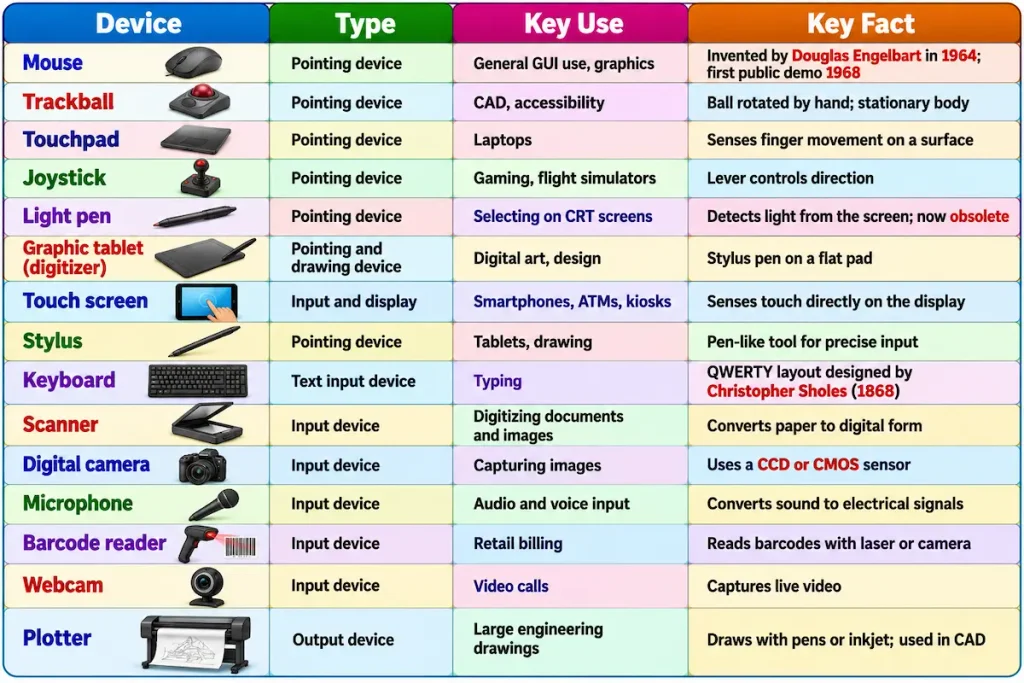
8. The frequency band used for radar relay system and television is –
(A) VLF
(B) UHF
(C) VHF
(D) EHF
Answer: (B) UHF
Explanation: The UHF band (300 MHz to 3 GHz) is used for radar, relay systems and television. Its short wavelengths (1 m to 10 cm) allow compact antennas and line-of-sight links, so it suits TV broadcasting, microwave relay and radar. VLF and EHF are not used for TV, and VHF is mainly used for FM radio and TV channels, so UHF is the best match for a combined radar relay and TV role.
Frequency Bands:
| Band | Frequency Range | Wavelength | Key Use |
|---|---|---|---|
| VLF | 3 – 30 kHz | 100 km – 10 km | Submarine communication, navigation |
| LF | 30 – 300 kHz | 10 km – 1 km | Navigation, time signals |
| MF | 300 kHz – 3 MHz | 1 km – 100 m | AM radio |
| HF | 3 – 30 MHz | 100 m – 10 m | Shortwave radio, long-distance broadcasting |
| VHF | 30 – 300 MHz | 10 m – 1 m | FM radio, TV channels, aircraft communication |
| UHF | 300 MHz – 3 GHz | 1 m – 10 cm | TV, radar, microwave relay, mobile phones, GPS, Wi-Fi |
| SHF | 3 – 30 GHz | 10 cm – 1 cm | Satellite communication, radar, microwave links |
| EHF | 30 – 300 GHz | 1 cm – 1 mm | Radio astronomy, advanced radar, 5G mmWave |
| Microwave relay | 1 – 40 GHz (approx.) | — | Line-of-sight links spaced about 50 km apart |
| Radar | UHF to EHF | — | Detects objects using reflected waves |
| Ground wave | Below 2 MHz | — | Used by AM broadcasting |
| Sky wave | 2 – 30 MHz | — | Reflected by the ionosphere; shortwave radio |
| Space wave | Above 30 MHz | — | Line-of-sight; TV, FM and microwave |
9. Which of the following satellites is used in ship to shore, shore to shore and shore to ship communication ?
(A) Marisat (USA, 1973)
(B) Comsat
(C) Telestar
(D) Intelsat
Answer: (A) Marisat (USA, 1973)
Explanation: Marisat was the first maritime communications satellite system, launched by the USA in 1976 (the question’s key notes 1973 as the planning year). It provided ship-to-shore, shore-to-ship and ship-to-ship communication and later led to Inmarsat, which began operations in 1982. Comsat is the US company that managed American satellite communications, Telstar was an early experimental communication satellite, and Intelsat serves international telephone and TV links.
Satellite Communication Systems:
| Satellite / System | Year | Country / Operator | Key Fact |
|---|---|---|---|
| Marisat | 1976 | USA (Comsat) | First maritime communication satellites; ship-to-shore links |
| Inmarsat | 1979 (formed), 1982 (operations) | International Maritime Satellite Organization | Successor of Marisat; global maritime and aviation communication |
| Sputnik 1 | 1957 | USSR | First artificial satellite |
| Echo 1 | 1960 | USA | First passive communication satellite (balloon reflector) |
| Telstar 1 | 1962 | AT&T, USA | First active communication satellite; relayed live TV across the Atlantic |
| Syncom 3 | 1964 | USA | First geostationary satellite; broadcast the Tokyo Olympics |
| Intelsat I (Early Bird) | 1965 | Intelsat | First commercial geostationary communication satellite |
| Comsat | 1962 | USA | Created by the US Communications Satellite Act; US representative in Intelsat |
| Molniya | 1965 | USSR | Used highly elliptical orbits for high-latitude coverage |
| APPLE | 1981 | India (ISRO) | India’s first experimental communication satellite |
| INSAT-1B | 1983 | India (ISRO) | Began India’s domestic satellite communication |
| Iridium | 1998 | USA | Low Earth orbit satellite phone network |
| GSAT-7 | 2013 | India (ISRO) | Dedicated naval communication satellite (Rukmini) |
| Starlink | 2019 onward | SpaceX, USA | Large LEO constellation for broadband internet |
10. Which of the following is the first state in India to have 3G services of Telecommunication ?
(A) Maharashtra
(B) Bihar
(C) Uttar Pradesh
(D) Andhra Pradesh
Answer: (A) Maharashtra
Explanation: India officially entered the 3G telecommunications arena on 11 December 2008, when the government-owned public sector operator Mahanagar Telephone Nigam Ltd (MTNL) launched the country’s first 3G-enabled mobile and data services.
- Subsequent Expansion: Following MTNL’s initial rollout, the other state-owned operator, Bharat Sanchar Nigam Ltd (BSNL), expanded 3G connectivity across the rest of the nation starting in early 2009. Private telecom operators (like Tata DoCoMo and Reliance Communications) were allocated spectrum later and began launching their services in late 2010.
- The Initial Launch: The services were initially rolled out in the metropolitan areas under MTNL’s jurisdiction—Delhi and Mumbai (located in the state of Maharashtra).
11. WIMAX is related to which one of the following ?
(A) Biotechnology
(B) Space Technology
(C) Missile Technology
(D) Communication Technology
Answer: (D) Communication Technology
Explanation: WiMAX (Worldwide Interoperability for Microwave Access) is a wireless broadband communication technology based on the IEEE 802.16 standard. It was designed to deliver high-speed internet over long distances, up to about 50 km for fixed access, and served as a wireless alternative to cable and DSL. It has no connection with biotechnology, space technology or missile technology.
Wireless Communication Technologies:
| Technology | Standard | Range | Key Fact |
|---|---|---|---|
| WiMAX | IEEE 802.16 | Up to about 50 km (fixed) | Wireless broadband for cities and rural areas; first standard 2001 |
| Wi-Fi | IEEE 802.11 | About 50 – 100 m | Wireless LAN; named by the Wi-Fi Alliance in 1999 |
| Bluetooth | IEEE 802.15.1 | About 10 m (Class 2) | Short-range data exchange in the 2.4 GHz band; named after Harald Bluetooth |
| Zigbee | IEEE 802.15.4 | 10 – 100 m | Low-power IoT and home automation |
| NFC | ISO/IEC 18092 | Up to about 4 cm | Contactless payments |
| Infrared (IrDA) | IrDA | Within 1 m | Line-of-sight; TV remotes |
| LTE | 3GPP | Several km per cell | Marketed as 4G; all-IP network |
| LoRa / LoRaWAN | LoRa Alliance | 2 – 15 km | Low-power wide-area IoT networks |
| GSM | ETSI | Several km per cell | First digital mobile standard; 1991 |
| CDMA | IS-95 / CDMA2000 | Several km per cell | Code division; used by Reliance and Tata earlier in India |
| Li-Fi | IEEE 802.11bb | Within a room | Data through visible light; coined by Harald Haas |
| 5G | 3GPP Release 15 onward | Short to medium | Very high speed, low latency |
| Satellite broadband | Various | Global | Starlink, VSAT |
| RFID | ISO 18000 | Few cm to metres | Tag identification; FASTag |
12. Which of the following is not the term of Information Technology ?
(A) Cyber Space
(B) Upload
(C) Modem
(D) Light Storage
Answer: (D) Light Storage
Explanation: “Light Storage” is not a standard term of Information Technology. Cyberspace means the virtual environment of computer networks and the internet, upload means sending a file from a local device to a remote server, and a modem is a device that converts digital signals to analog and back for transmission over telephone or cable lines.
IT Terms:
| Term | Meaning | Key Fact |
|---|---|---|
| Cyberspace | Virtual space of interconnected computers and networks | Term coined by William Gibson in the novel Neuromancer (1984) |
| Upload | Transfer of a file from a local device to a remote server | Opposite of download |
| Download | Transfer of a file from a remote server to a local device | Measured in Mbps or MBps |
| Modem | Modulator-Demodulator | Connects a computer to telephone, cable or fibre lines |
| Router | Directs data packets between networks | Works with IP addresses |
| Browser | Software to view web pages | Chrome, Firefox, Safari, Edge |
| URL | Uniform Resource Locator | Address of a web resource |
| Bandwidth | Data capacity of a channel | Measured in bps |
| Cloud computing | Services delivered over the internet | Examples: AWS, Azure, Google Cloud |
| Firewall | Blocks unauthorised network access | Hardware or software |
| Cache | High-speed temporary storage | Speeds up repeated access to data |
| Bit / Byte | Smallest unit of data / 8 bits | 1 KB = 1024 bytes |
| Blog | Online journal or informational website | Short for weblog |
| E-commerce | Buying and selling over the internet | Amazon, Flipkart |
| Virtual reality | Computer-generated simulated environment | Uses headsets and sensors |
| Optical storage | Data stored using laser light | CD, DVD, Blu-ray; a real term, unlike “light storage” |
13. Which of the following countries firstly deployed 4G system of mobile telecommunication in world ?
(A) South Korea
(B) Japan
(C) United States
(D) England
Answer: (A) South Korea
Explanation: South Korea is credited with first deploying 4G (mobile WiMAX/WiBro) commercially in 2006, and the question’s answer key follows this. Note that the first commercial LTE services were launched by TeliaSonera in Stockholm and Oslo in December 2009, so sources differ depending on whether WiMAX or LTE is counted as 4G. Among the given options, South Korea is the exam answer.
Mobile Generations and Firsts:
| Item | Year | Key Fact |
|---|---|---|
| 1G | 1979 | NTT, Japan launched the first commercial cellular network (analog) |
| 2G (GSM) | 1991 | Finland (Radiolinja); first digital mobile system, SMS introduced |
| 2.5G (GPRS) | Early 2000s | Packet data; first mobile internet |
| 3G (WCDMA) | 2001 | NTT DoCoMo, Japan; first commercial 3G network (FOMA) |
| WiBro (mobile WiMAX) | 2006 | South Korea; early 4G-type service by KT and SK Telecom |
| First LTE service | Dec 2009 | TeliaSonera in Stockholm and Oslo |
| 4G requirements | 2008 | ITU IMT-Advanced; 100 Mbps for high mobility, 1 Gbps for low mobility |
| 4G in India | 2012 | Bharti Airtel launched 4G in Kolkata |
| VoLTE in India | 2016 | Reliance Jio launched an all-IP 4G network |
| 5G (first commercial) | 2019 | South Korea launched commercial 5G in April 2019 |
| 5G in India | Oct 2022 | Launched at the India Mobile Congress |
| 6G | Expected around 2030 | Under research; terahertz bands |
| Mobile phone inventor | 1973 | Martin Cooper (Motorola) made the first handheld mobile call |
| First SMS | 1992 | Neil Papworth sent “Merry Christmas” |
| LTE | 3GPP | Long Term Evolution; all-IP, uses OFDMA |
| Data speed (typical) | 3G about 2 Mbps; 4G about 100 Mbps; 5G up to 10 Gbps | Speeds rise with each generation |
14. What is the function of the Microsoft office word ?
(A) An operating system
(B) A downloading application software
(C) A word processing software
(D) An input device
Answer: (C) A word processing software
Explanation: Microsoft Office Word is a word processing application used to create, edit, format and print text documents such as letters, reports and resumes. It is application software, not an operating system, and it is not an input device. It offers features like spell check, tables, mail merge, headers and footers, and templates. Word was first released by Microsoft in 1983.
Microsoft Office Applications:
| Application | Function | File Extension | Key Fact |
|---|---|---|---|
| MS Word | Word processing | .docx (earlier .doc) | First released 1983; documents, letters, reports |
| MS Excel | Spreadsheet | .xlsx (earlier .xls) | Formulas, charts, pivot tables; cells identified by row and column |
| MS PowerPoint | Presentation | .pptx (earlier .ppt) | Slide shows with animations and transitions |
| MS Access | Database management | .accdb (earlier .mdb) | Relational database for small applications |
| MS Outlook | Email and personal information manager | .pst | Email, calendar, contacts and tasks |
| MS Publisher | Desktop publishing | .pub | Brochures, newsletters and flyers |
| MS OneNote | Note taking | .one | Digital notebook with text, ink and audio |
| MS Teams | Collaboration and video meetings | Not applicable | Launched 2017; part of Microsoft 365 |
| MS Paint | Basic image editing | .png, .bmp | Bundled with Windows since 1985 |
| Notepad | Plain text editing | .txt | Simple editor bundled with Windows |
| WordPad | Basic rich text editing | .rtf | Between Notepad and Word |
| Microsoft 365 | Subscription-based Office suite | Not applicable | Cloud-based version of Office |
| Google Docs | Online word processing | Cloud-based | Part of Google Workspace; free with an account |
| LibreOffice Writer | Open-source word processing | .odt | Free alternative to MS Word |
15. Which one of the following computer operating system (OS) is the most commonly used in the Top- 500 super computers of the world ?
(A) Unix OS
(B) Linux OS
(C) Lisa OS
(D) Mac OS
Answer: (B) Linux OS
Explanation: Linux is the operating system used by almost all of the world’s Top 500 supercomputers, and it has run on every one of them since 2017. It is open source, can be freely modified and tuned for high-performance clusters, scales across thousands of processors, and has no licence cost. Unix was used earlier, but it has been almost entirely replaced by Linux in this list.
Operating Systems:
| Operating System | Developer | Year | Key Fact |
|---|---|---|---|
| Linux | Linus Torvalds | 1991 | Open-source kernel; runs all Top 500 supercomputers and most servers |
| Unix | Ken Thompson and Dennis Ritchie, Bell Labs | 1969 | Ancestor of Linux, macOS and BSD; rewritten in C in 1973 |
| MS-DOS | Microsoft | 1981 | Command-line OS for early IBM PCs |
| Windows | Microsoft | 1985 | Most popular desktop OS; Windows 11 released 2021 |
| macOS | Apple | 2001 | Built on a Unix base (Darwin); earlier called Mac OS X |
| Mac OS (Classic) | Apple | 1984 | Early graphical OS for the Macintosh |
| Lisa OS | Apple | 1983 | Used on the Apple Lisa, an early GUI computer; commercially unsuccessful |
| Android | Google (Android Inc.) | 2008 | Linux-based; most widely used mobile OS |
| iOS | Apple | 2007 | Runs on iPhone; closed source |
| Chrome OS | 2011 | Linux-based; cloud-centric OS for Chromebooks | |
| Ubuntu | Canonical | 2004 | Popular Linux distribution; based on Debian |
| Red Hat Enterprise Linux | Red Hat | 2000 | Enterprise Linux used in servers and supercomputers |
| BOSS Linux | C-DAC, India | 2007 | Bharat Operating System Solutions; Indian government use |
| Maya OS | DRDO, India | 2021 | Ubuntu-based OS for defence systems |
| Top500 list | Published twice a year | Since 1993 | Ranks the world’s fastest supercomputers |
16. Which one of the following application is commonly used to prepare a presentation or slide show ?
(A) Photoshop
(B) Power Point
(C) Internet explorer
(D) Outlook express
Answer: (B) Power Point
Explanation: Microsoft PowerPoint is the application commonly used to prepare presentations or slide shows. It lets users build slides with text, images, charts, animations and transitions, and present them on a screen or projector. Photoshop is for image editing, Internet Explorer is a web browser, and Outlook Express is an email client.
Presentation and Graphics Software:
| Software | Function | File Extension | Key Fact |
|---|---|---|---|
| MS PowerPoint | Presentation (slide shows) | .pptx (earlier .ppt) | Released 1987; originally developed as “Presenter” by Forethought |
| Google Slides | Online presentations | Cloud-based | Part of Google Workspace; real-time collaboration |
| Apple Keynote | Presentation | .key | Apple’s presentation software for Mac and iOS |
| LibreOffice Impress | Open-source presentation | .odp | Free alternative to PowerPoint |
| Prezi | Zoomable presentation | Cloud-based | Uses a single canvas with zooming |
| Adobe Photoshop | Raster image editing | .psd | Photo editing and retouching |
| Adobe Illustrator | Vector graphics | .ai | Logos and illustrations |
| CorelDRAW | Vector graphics | .cdr | Popular for design and printing |
| Canva | Online graphic design | Cloud-based | Templates for posters and presentations |
| Internet Explorer | Web browser | Not applicable | Microsoft browser, retired in 2022 |
| Outlook Express | Email client | Not applicable | Bundled with older Windows versions; replaced by Windows Mail |
| Slide Sorter view | PowerPoint view | Not applicable | Shows all slides as thumbnails for rearranging |
| Slide Master | PowerPoint feature | Not applicable | Controls the common layout and design of all slides |
| F5 key | PowerPoint shortcut | Not applicable | Starts the slide show from the beginning |
17. Which one of the following discs is used to cold boot a computer ?
(A) Set up disc
(B) Program disc
(C) Diagnostic disc
(D) System disc
Answer: (D) System disc
Explanation: A cold boot is starting a computer from a powered-off state, and it needs a system disc (a bootable disc holding the operating system’s startup files) to load the OS into memory. A set-up disc installs software, a program disc holds application programs, and a diagnostic disc is used to test and troubleshoot hardware faults.
Types of Discs and Booting:
| Item | Purpose | Key Fact |
|---|---|---|
| System disc | Holds OS startup files | Used to cold boot or restart a computer |
| Boot disk / Live CD | Bootable media with an OS | Used for installation, recovery or running an OS without installing |
| Set-up disc | Installs software or an OS | Contains installer files such as setup.exe |
| Program disc | Holds application programs | Used to install or run applications |
| Diagnostic disc | Tests hardware and finds faults | Used for troubleshooting |
| Recovery disc | Restores the system to a working state | Created from the factory image or backup |
| Cold boot | Starting from power-off | Also called hard boot; runs POST first |
| Warm boot | Restart without power-off | Ctrl+Alt+Del or the Restart option |
| Bootable USB | Flash drive with an OS image | Has largely replaced bootable CDs and DVDs |
| BIOS boot order | Sets the device to boot from | Hard disk, USB, CD/DVD or network |
| Master Boot Record (MBR) | First sector of a disk | Holds boot code and the partition table |
| GPT | GUID Partition Table | Modern partition style used with UEFI; supports disks over 2 TB |
| Safe mode | Starts Windows with minimal drivers | Used to fix system problems |
| Network boot (PXE) | Boots a computer over the network | Used in labs and data centres |
18. Long distance short wave radio broadcasting uses –
(A) Direct wave
(B) Sky wave
(C) Ionospheric wave
(D) Ground wave
Answer: (B) Sky wave
Explanation: Long-distance short wave (HF, 3 – 30 MHz) radio broadcasting uses sky wave propagation. The waves travel upward, are refracted back to Earth by the ionosphere, and can hop between the ground and the ionosphere several times, covering thousands of kilometres. Ionospheric wave is another name for the same mechanism, but sky wave is the standard term. Ground waves die out within a short distance at these frequencies, and direct waves need a line of sight.
Radio Wave Propagation:
| Propagation Type | Frequency Range | Path | Key Fact |
|---|---|---|---|
| Ground wave | Below 2 MHz (LF, MF) | Follows the Earth’s surface | Used by AM broadcasting; range up to a few hundred km |
| Sky wave | 2 – 30 MHz (HF) | Reflected by the ionosphere | Shortwave radio; long-distance and international broadcasting |
| Space wave (direct) | Above 30 MHz (VHF, UHF) | Line-of-sight | TV, FM, microwave links, mobile phones |
| Skip distance | — | Minimum distance at which sky wave returns to Earth | Zone before it is the “skip zone” with no reception |
| Skip zone | — | Region between the end of ground wave and the start of sky wave | No signal is received here |
| Critical frequency | Varies | Highest frequency reflected vertically by the ionosphere | Above this, waves pass through into space |
| Maximum Usable Frequency (MUF) | Varies | Highest frequency that returns to Earth over a given path | Higher than the critical frequency for slanted paths |
| D layer | 60 – 90 km | Absorbs MF and HF by day | Disappears at night, so AM stations reach farther after dark |
| E layer | 90 – 150 km | Reflects lower HF | Sporadic E can carry VHF over long distances |
| F layer | 150 – 400 km | Main reflector of HF | Splits into F1 and F2 during the day |
| Troposcatter | 300 MHz – 5 GHz | Scattering in the troposphere | Beyond-horizon communication up to about 500 km |
| Satellite link | Above 1 GHz | Earth to space to Earth | Passes through the ionosphere |
| All India Radio shortwave | HF bands | Sky wave | External services reach overseas listeners |
19. Which one of the following devices has installed Wi-Fi devices in its system ?
(A) Smartphone
(B) Video Game consoles
(C) Computer Printers
(D) All of these
Answer: (D) All of these
Explanation: Wi-Fi is a wireless networking technology built into many kinds of devices. Smartphones use it to connect to the internet, video game consoles use it for online play and downloads, and modern computer printers include Wi-Fi so they can print wirelessly from phones and laptops. Since all three options are correct, “All of these” is the answer.
Wi-Fi Standards and Devices:
| Item | Detail | Key Fact |
|---|---|---|
| Wi-Fi | IEEE 802.11 standard | Name given by the Wi-Fi Alliance in 1999 |
| 802.11b | 2.4 GHz, up to 11 Mbps | First widely adopted standard (1999) |
| 802.11a | 5 GHz, up to 54 Mbps | Released in 1999 alongside 802.11b |
| 802.11g | 2.4 GHz, up to 54 Mbps | Released in 2003 |
| 802.11n (Wi-Fi 4) | 2.4 and 5 GHz, up to 600 Mbps | Introduced MIMO; 2009 |
| 802.11ac (Wi-Fi 5) | 5 GHz, up to several Gbps | Released in 2013 |
| 802.11ax (Wi-Fi 6) | 2.4 and 5 GHz, up to about 9.6 Gbps | Released in 2019; better performance with many devices |
| Wi-Fi 6E | Adds the 6 GHz band | Extra spectrum with less congestion |
| Wi-Fi 7 (802.11be) | Up to about 46 Gbps | Standardised around 2024 |
| Smartphone | Wi-Fi client | Internet access and hotspot sharing |
| Video game console | Wi-Fi client | PlayStation, Xbox and Nintendo Switch online play |
| Computer printer | Wi-Fi enabled | Wireless printing from phones and laptops |
| Access point / router | Wi-Fi host | Creates the wireless network |
| SSID | Service Set Identifier | Name of a Wi-Fi network |
| WPA3 | Wi-Fi security protocol | Successor to WPA2; stronger encryption |
| Hotspot | Public Wi-Fi access point | Found in airports, cafes and railway stations |
| PM-WANI | Indian public Wi-Fi scheme | Launched in 2020 by the Department of Telecommunications |
20. Which of the following Television display is working on the principle of semiconductor ?
(A) Plasma display
(B) Liquid Crystal display
(C) Light-emitting diode display (LED)
(D) None of these
Answer: (C) Light-emitting diode display (LED)
Explanation: An LED display works on the principle of semiconductors. Each pixel (or backlight element) is a light-emitting diode, a p-n junction that gives off light when current passes through it in the forward direction. A plasma display lights up ionised gas, a liquid crystal display controls light with liquid crystals and needs a separate backlight, so only the LED display depends directly on semiconductor junctions.
Television Display Technologies:
| Display | Principle | Key Fact |
|---|---|---|
| LED display | Semiconductor p-n junction emits light | Used as backlight in LED TVs; as pixels in micro-LED and video walls |
| OLED | Organic semiconductor layers emit light | Self-emitting; no backlight; true blacks; thin and flexible |
| QLED | Quantum dots with an LED backlight | Samsung’s brand; enhanced colour and brightness |
| Micro-LED | Microscopic inorganic LEDs as pixels | Self-emitting; high brightness; very costly |
| LCD | Liquid crystals modulate backlight | Needs a backlight (CCFL or LED) |
| Plasma | Ionised gas (xenon, neon) emits UV that excites phosphors | Large screens; high power use; discontinued around 2014 |
| CRT | Electron beam strikes phosphor screen | Bulky; replaced by flat panels |
| E-ink / E-paper | Charged pigment particles move in microcapsules | Used in e-readers; low power; holds image without power |
| Projector (DLP) | Micro-mirror chip reflects light | Developed by Texas Instruments |
| LED discovery | Electroluminescence in a semiconductor | First visible-spectrum LED by Nick Holonyak Jr. (1962) |
| Blue LED | Invented by Akasaki, Amano and Nakamura | Nobel Prize in Physics 2014; enabled white LEDs |
| LED TV pixel resolution | HD 1280×720; Full HD 1920×1080 | 4K is 3840×2160 |
| Refresh rate | Measured in Hz | Common values are 50, 60, 120 Hz |
| Aspect ratio | 16:9 | Standard for modern TVs |
21. Who had coined the term television at the first International Electricity congress held in Paris ?
(A) Paul Nipkow
(B) Constantin Perskyi
(C) J J Thompson
(D) Henry Patrick
Answer: (B) Constantin Perskyi
Explanation: The word “television” was coined by Constantin Perskyi, a Russian scientist, in a paper presented at the first International Congress of Electricity in Paris in August 1900. He combined the Greek “tele” (far) with the Latin “visio” (sight). Paul Nipkow had earlier invented the Nipkow disk (1884), a mechanical scanning device, but he did not coin the term.
Television History:
| Person / Event | Year | Key Fact |
|---|---|---|
| Constantin Perskyi | 1900 | Coined the word “television” at the Paris International Electricity Congress |
| Paul Nipkow | 1884 | Invented the Nipkow disk, the basis of mechanical TV scanning |
| Alan Archibald Campbell-Swinton | 1908 | Proposed all-electronic television using cathode ray tubes |
| John Logie Baird | 1925 | First public demonstration of mechanical television in London |
| John Logie Baird | 1926 | First demonstration of moving television images; colour TV demo in 1928 |
| Philo Farnsworth | 1927 | Transmitted the first fully electronic television image |
| Vladimir Zworykin | 1923 | Patented the iconoscope camera tube; worked for RCA |
| BBC | 1936 | Started the world’s first regular high-definition TV service |
| NTSC colour standard | 1953 | Introduced in the USA |
| Doordarshan | 1959 | Began in Delhi on 15 September as an experimental service |
| Colour TV in India | 1982 | Introduced during the Delhi Asian Games |
| SITE experiment | 1975-76 | Satellite Instructional Television Experiment by ISRO and NASA |
| Cable TV in India | 1990s | Grew rapidly after the 1991 satellite TV entry of Star TV and CNN |
| DTH in India | 2003-04 | Started with DD Direct Plus and private DTH operators |
| HDTV | 1980s | Japan’s NHK developed the first HD system |
22. Which one of the following sold the world’s first mobile television MTV-1 ?
(A) Clive Sinclair (UK – 1977)
(B) George Shapiro
(C) Clive Clinton
(D) William Gladstone
Answer: (A) Clive Sinclair (UK – 1977)
Explanation: Sir Clive Sinclair, a British inventor, sold the world’s first mobile (pocket) television, the MTV-1 “Microvision”, in 1977. It was a small handheld set with a 2-inch CRT screen. It was a commercial failure because of its high price and poor reception, but it paved the way for later pocket TVs, including the Sinclair TV80 (1983), which used a flat CRT.
Sinclair and Portable Electronics:
| Product / Person | Year | Key Fact |
|---|---|---|
| Clive Sinclair | Born 1940 | British inventor; founded Sinclair Radionics and Sinclair Research |
| MTV-1 Microvision | 1977 | World’s first pocket TV; 2-inch CRT screen; sold in the UK |
| Sinclair Executive | 1972 | One of the first slim pocket calculators |
| Sinclair Black Watch | 1975 | Early digital LED wristwatch; unreliable |
| Sinclair ZX80 | 1980 | Low-cost home computer; one of the first mass-market UK computers |
| Sinclair ZX81 | 1981 | Sold over a million units; very cheap home computer |
| ZX Spectrum | 1982 | Colour home computer; hugely popular in the UK |
| Sinclair C5 | 1985 | Battery-powered electric tricycle; commercial failure |
| Sinclair TV80 | 1983 | Improved pocket TV with a flat CRT |
| Sony Watchman | 1982 | Sony’s pocket TV; commercially successful |
| Seiko TV Watch | 1982 | Wristwatch with a built-in TV receiver |
| Walkman | 1979 | Sony’s portable cassette player |
| Motorola DynaTAC | 1983 | First commercial handheld mobile phone |
| Mobile TV (DVB-H) | 2000s | Standard for broadcast TV to handheld devices |
| Smartphone video streaming | 2010s | Largely replaced dedicated pocket TVs |
23. LEC or Light Emitting Electrochemical Cell is a different mode of operation of —
(A) LEDS
(B) CRTS
(C) LCDS
(D) OLEDS
Answer: (D) OLEDS
Explanation: A Light-emitting Electrochemical Cell (LEC or LEEC) is closely related to an Organic Light-Emitting Diode (OLED), as both are solid-state lighting devices that utilize organic semiconductors to emit light.
However, an LEC represents a fundamentally different mode of electrical operation:
- The Advantage: This unique mode of operation makes LECs highly tolerant to thickness variations. Consequently, they can be printed cheaply using simple air-ambient methods, unlike OLEDs which require rigid, high-vacuum manufacturing conditions.
- The Mechanism: Unlike standard OLEDs that require a complex stack of multiple precisely layered materials (such as electron-transporting, hole-transporting, and emission layers), an LEC uses a single-layer blend containing mobile ions.
- Dynamic Junction: When a voltage is applied to an LEC, these mobile ions migrate to the opposite electrodes. This dynamic rearrangement creates an in-situ p-n junction right inside the material.
24. From which of the following GSM technologies, the LTE ( Long Term Evolution ) is made to the enhancement of telecommunication ? ( GSM/UMTS & CDMA2000 networks )
(A) Wi Man
(B) CDMA
(C) UMTS
(D) HSDPA
Answer: (C) UMTS
Explanation: LTE (Long Term Evolution) was developed by 3GPP as the upgrade path for GSM/UMTS networks, and it also became the upgrade route for CDMA2000 networks. Among the given options, UMTS (the 3G technology that evolved from GSM) is the one LTE directly builds on. Wi Man is not a standard, CDMA is a separate technology family, and HSDPA is only a 3G data enhancement within UMTS.
GSM Technology Evolution:
| Technology | Generation | Key Fact |
|---|---|---|
| GSM | 2G | Global System for Mobile Communications; first digital mobile standard (1991); uses TDMA |
| GPRS | 2.5G | General Packet Radio Service; first mobile packet data (up to about 114 kbps) |
| EDGE | 2.75G | Enhanced Data rates for GSM Evolution; up to about 384 kbps |
| UMTS | 3G | Universal Mobile Telecommunications System; uses WCDMA; about 2 Mbps |
| HSDPA | 3.5G | High Speed Downlink Packet Access; up to about 14 Mbps |
| HSPA+ | 3.75G | Up to about 42 Mbps; bridge to LTE |
| LTE | 4G | Long Term Evolution; all-IP network; uses OFDMA; first launched in 2009 |
| LTE-Advanced | 4G | Carrier aggregation; meets ITU IMT-Advanced requirements; up to 1 Gbps |
| VoLTE | 4G | Voice over LTE; used by Reliance Jio in India |
| 5G NR | 5G | New Radio; very high speed and low latency; launched commercially in 2019 |
| CDMA (IS-95) | 2G | Code Division Multiple Access; developed by Qualcomm |
| CDMA2000 | 3G | Evolution of IS-95; EV-DO for data |
| 3GPP | Standards body | 3rd Generation Partnership Project; defines GSM, UMTS, LTE and 5G |
| WiMAX | 4G-type | IEEE 802.16; competing standard to LTE |
25. Which of the following electromagnetic waves is used by the Bluetooth to exchange data over short distances ?
(A) Microwaves (0.3 to 300 GHz)
(B) Radio Waves
(C) X-rays
(D) UV-rays
Answer: (B) Radio Waves
Explanation: Bluetooth exchanges data over short distances using short-wavelength radio waves in the 2.4 GHz ISM band (2.400 to 2.485 GHz). Although this frequency lies within the microwave range, it is classified as radio waves, and it is the standard answer for this question. It uses frequency-hopping spread spectrum to reduce interference, and typical range is about 10 m for Class 2 devices.
Bluetooth and Short-Range Wireless:
| Item | Detail | Key Fact |
|---|---|---|
| Bluetooth | 2.4 GHz ISM band; IEEE 802.15.1 | Named after the Danish king Harald Bluetooth; developed by Ericsson in 1994 |
| Bluetooth Class 1 | Range about 100 m | Power up to 100 mW |
| Bluetooth Class 2 | Range about 10 m | Most common in phones and headsets |
| Bluetooth Class 3 | Range about 1 m | Power up to 1 mW |
| Frequency hopping | 1600 hops per second | Reduces interference with Wi-Fi and other devices |
| Bluetooth SIG | Standards group | Formed in 1998 by Ericsson, Nokia, IBM, Intel and Toshiba |
| Bluetooth Low Energy (BLE) | Introduced in Bluetooth 4.0 (2010) | Used in fitness bands and smart devices |
| Piconet | Network of up to 8 active devices | One master and up to 7 slaves |
| Wi-Fi | 2.4 and 5 GHz | Higher speed and longer range than Bluetooth |
| Zigbee | 2.4 GHz; IEEE 802.15.4 | Low-power home automation |
| NFC | 13.56 MHz | Range of about 4 cm; contactless payments |
| Infrared | Below visible light | Needs line of sight; TV remotes |
| Microwave oven | 2.45 GHz | Same band as Bluetooth and Wi-Fi, so it can cause interference |
| Radio waves | 3 kHz to 300 GHz | Used for broadcasting, mobile and wireless networking |
| X-rays and UV rays | Very high frequency | Not used for communication; ionising radiation |
26. Which of the following companies launched the 3G mobile telecommunication for the first time in the world ? (3G India – MTNL in 2008, 4G – Airtel in 2012)
(A) Nextle in the United States
(B) NTT DoCoMo (Japan) (1998)
(C) Telus Mobility (Canada)
(D) Bharati Airtel in India
Answer: (B) NTT DoCoMo (Japan) (1998)
Explanation: NTT DoCoMo of Japan launched the world’s first commercial 3G network in October 2001 under the brand name FOMA, using WCDMA technology. The question’s key lists 1998, which is when DoCoMo began its 3G trials and standards work, so this is the exam answer. In India, MTNL launched 3G in Delhi and Mumbai in 2008, and Bharti Airtel launched 4G in Kolkata in 2012.
3G Launches and Operators:
| Item | Year | Key Fact |
|---|---|---|
| NTT DoCoMo FOMA | 2001 | World’s first commercial 3G network; Japan; WCDMA |
| SK Telecom (South Korea) | 2002 | First CDMA2000 1xEV-DO 3G network |
| Telus Mobility (Canada) | 2005 | Early 3G rollout in Canada |
| Nextel (USA) | 1980s-2005 | US push-to-talk operator, later merged with Sprint |
| Verizon (USA) | 2003 | Early CDMA2000 EV-DO 3G launch in the USA |
| Hutchison “3” | 2003 | First 3G launch in Europe (UK and Italy) |
| MTNL (India) | Dec 2008 | First 3G service in India (Delhi and Mumbai) |
| BSNL (India) | 2009 | Expanded 3G across many cities and states |
| 3G spectrum auction (India) | 2010 | Raised about Rs 67,000 crore |
| Bharti Airtel (India) | 2010 | Launched private 3G services after the auction |
| Bharti Airtel 4G | 2012 | First 4G (TD-LTE) in India, Kolkata |
| Reliance Jio | 2016 | All-IP 4G VoLTE network |
| 3G standard bodies | 1998 | 3GPP formed; defines UMTS and later LTE |
| IMT-2000 | ITU standard | Global framework for 3G systems |
| 3G speed | About 2 Mbps | Supports video calls and mobile internet |
27. Which of the following is the web browser ?
(A) Google Chrome
(B) Safari
(C) Opera
(D) All of these
Answer: (D) All of these
Explanation: Google Chrome, Safari and Opera are all web browsers, which are programs used to access and display pages on the World Wide Web. Chrome was released by Google in 2008, Safari by Apple in 2003, and Opera by Opera Software in 1995. Since every option is a browser, “All of these” is correct.
Web Browsers:
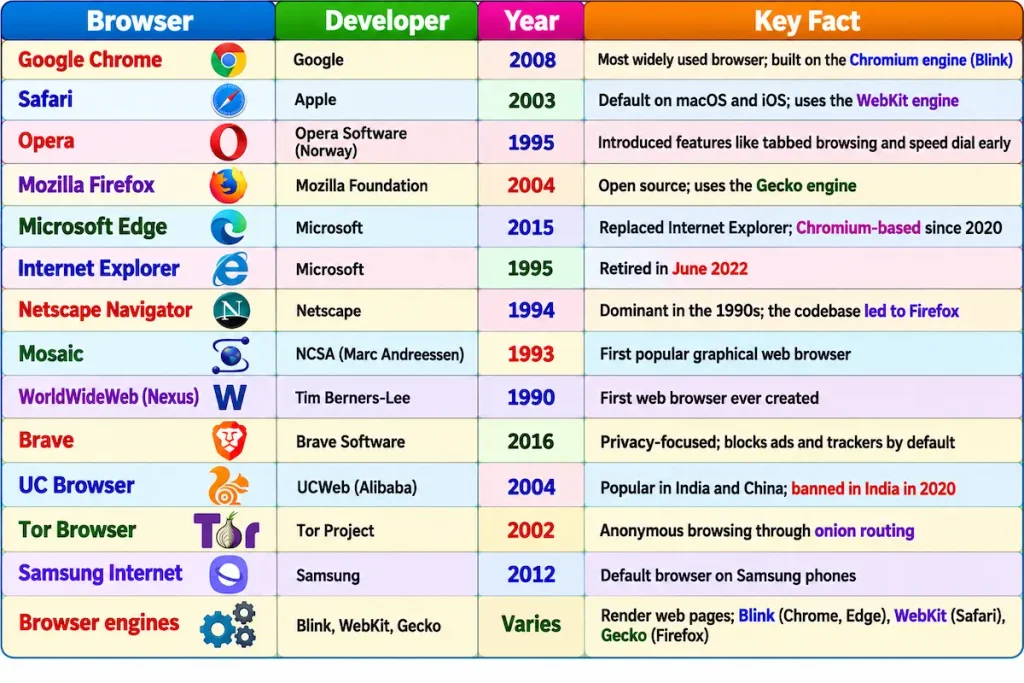
28. Intelsat satellite is used for –
( operated from 1964 to 2001 )
(A) radar communication
(B) radio communication
(C) Intercontinental communication
(D) None of the above
Answer: (C) Intercontinental communication
Explanation: Intelsat (International Telecommunications Satellite Organization) was set up in 1964 to provide global commercial satellite communication. Its geostationary satellites relay telephone, TV and data traffic between continents, for example across the Atlantic, Pacific and Indian Ocean regions. The first satellite, Intelsat I (Early Bird), was launched in 1965. Radar and radio communication are not its specific role, so intercontinental communication is the best answer.
Intelsat and International Satellite Organisations:
| Organisation / Satellite | Year | Key Fact |
|---|---|---|
| Intelsat | 1964 | Formed as an intergovernmental body; became a private company in 2001 |
| Intelsat I (Early Bird) | 1965 | First commercial geostationary communication satellite; 240 telephone circuits |
| Intelsat II | 1966-67 | Extended coverage to the Pacific region |
| Intelsat III | 1968-70 | First global coverage with Atlantic, Pacific and Indian Ocean satellites |
| Intelsat IV | 1971 | Higher capacity; carried TV and telephone traffic |
| Intelsat VI | 1989 | Large capacity; some satellites later serviced in orbit |
| Comsat | 1962 | US signatory to Intelsat; managed its operations early on |
| Inmarsat | 1979 | International Maritime Satellite Organization; ship, aircraft and land mobile links |
| Eutelsat | 1977 | European satellite operator; TV broadcasting across Europe |
| Arabsat | 1976 | Arab League satellite organisation |
| INSAT | 1983 | India’s domestic multipurpose satellite system |
| Asiasat | 1990 | Hong Kong operator; first private satellite company in Asia |
| SES | 1985 | Luxembourg; ASTRA satellites for direct-to-home TV |
| Telstar 1 | 1962 | First active communication satellite; live transatlantic TV |
| Syncom 3 | 1964 | First geostationary satellite; relayed the Tokyo Olympics |
29. Modem is a device used for –
(A) converting analog signals to digital signals
(B) modulating signals
(C) Either of the above
(D) None of the above
Answer: (C) Either of the above
Explanation: A modem (modulator-demodulator) converts digital signals from a computer into analog signals for transmission over telephone or cable lines (modulation), and converts incoming analog signals back to digital form (demodulation). Option (A) as written reverses the direction, and (B) describes only half of the job, but since the device handles signal conversion in both directions, the exam answer is “Either of the above”.
Modems and Network Devices:
| Device | Function | Key Fact |
|---|---|---|
| Modem | Modulates and demodulates signals | Name is short for Modulator-Demodulator |
| Dial-up modem | Uses telephone lines | Speeds up to 56 kbps |
| DSL / ADSL modem | Uses telephone lines with higher frequencies | Allows voice and data together; asymmetric speeds |
| Cable modem | Uses coaxial TV cable | Speeds up to hundreds of Mbps |
| Fibre modem (ONT) | Converts optical signals to electrical | Used in FTTH broadband |
| Wireless modem / dongle | Uses mobile networks | 3G, 4G or 5G data card |
| Router | Directs packets between networks | Often combined with a modem in one box |
| Switch | Connects devices in a LAN | Uses MAC addresses |
| Hub | Broadcasts data to all ports | Simple, less efficient |
| Repeater | Regenerates weak signals | Extends network range |
| Gateway | Connects different protocols | Protocol converter |
| Network Interface Card (NIC) | Connects a computer to a network | Has a unique MAC address |
| Access point | Provides Wi-Fi access | Connects wireless devices to a wired network |
| Modulation | Digital to analog conversion | Done by the transmitting modem |
| Demodulation | Analog to digital conversion | Done by the receiving modem |
| Baud rate | Signal changes per second | Bit rate may differ from baud rate |
30. Which one of the following displays is not the volatile television display ?
(A) Plasma
(B) Liquid Crystal Display
(C) Organic light Emitting Diode
(D) Cholesteric Display
Answer: (D) Cholesteric Display
Explanation: A cholesteric display (cholesteric liquid crystal display) is non-volatile: it keeps its image without power and needs electricity only when the image changes. Plasma, LCD and OLED displays are volatile, because the image disappears as soon as power is removed. Cholesteric displays are used in e-paper-type applications such as electronic signs and e-readers.
Volatile vs Non-Volatile Displays:
| Display | Volatile / Non-Volatile | Principle | Key Fact |
|---|---|---|---|
| Cholesteric LCD | Non-volatile | Bistable liquid crystal that reflects light in a stable state | Holds image with zero power; used in e-signs and reusable e-paper |
| E-ink / Electrophoretic | Non-volatile | Charged pigment particles move in microcapsules | Used in Kindle e-readers; power needed only to change the image |
| Electrowetting display | Non-volatile (bistable types) | Voltage changes the shape of coloured oil | Full-colour reflective e-paper |
| Gyricon (e-paper) | Non-volatile | Rotating two-colour balls | Early e-paper by Xerox PARC |
| Interferometric Modulator (Mirasol) | Non-volatile | Optical interference of reflected light | Qualcomm technology; very low power |
| Plasma | Volatile | Ionised gas lights phosphors | Needs constant power; discontinued around 2014 |
| LCD | Volatile | Liquid crystals control backlight | Image vanishes when power is cut |
| OLED | Volatile | Organic layers emit light | Self-emitting; needs continuous current |
| LED display | Volatile | Semiconductor p-n junctions emit light | Used in TVs and video walls |
| CRT | Volatile | Electron beam on phosphor | Image must be refreshed continuously |
| Refresh rate | Concept | How often the screen redraws, in Hz | Volatile displays must keep refreshing |
| Bistable display | Concept | Stable in two states without power | Basis of non-volatile e-paper |
31. Which one of the following computers is the world’s first commercial computer ?
(A) Feffanti Mark-1
(B) Mark-1 star
(C) UNIVAC-1 (USA in 1951)
(D) IBM-704
Answer: (C) UNIVAC-1 (USA in 1951)
Explanation: UNIVAC I (Universal Automatic Computer I) was the first commercially produced computer in the USA, delivered to the US Census Bureau in 1951. It was designed by J. Presper Eckert and John Mauchly, the creators of ENIAC. The Ferranti Mark 1 (1951, UK) is also described as the first commercially available general-purpose computer, but the exam answer key follows UNIVAC-1 given in the option.
Early Computers:
| Computer | Year | Developer / Country | Key Fact |
|---|---|---|---|
| Analytical Engine | 1837 (design) | Charles Babbage, UK | Conceptual design of a general-purpose mechanical computer; Babbage is the “Father of the Computer” |
| Z3 | 1941 | Konrad Zuse, Germany | First working programmable automatic computer |
| Atanasoff-Berry Computer (ABC) | 1942 | John Atanasoff and Clifford Berry, USA | First electronic digital computing device |
| Colossus | 1943-44 | Tommy Flowers, UK | Used to break German codes in World War II |
| Harvard Mark I | 1944 | Howard Aiken and IBM, USA | Electromechanical; first large automatic digital calculator |
| ENIAC | 1946 | Eckert and Mauchly, USA | First general-purpose electronic digital computer; about 18,000 vacuum tubes |
| EDSAC | 1949 | Maurice Wilkes, UK | First practical stored-program computer in regular use |
| Ferranti Mark 1 | 1951 | Ferranti and Manchester University, UK | First commercially available general-purpose computer (delivered February 1951) |
| UNIVAC I | 1951 | Eckert-Mauchly Computer Corp., USA | First commercial computer in the USA; predicted the 1952 US election result |
| IBM 701 | 1952 | IBM, USA | IBM’s first commercial scientific computer |
| IBM 704 | 1954 | IBM, USA | First mass-produced computer with floating-point hardware; ran FORTRAN |
| IBM 360 | 1964 | IBM, USA | Third-generation computer family using integrated circuits |
| Altair 8800 | 1975 | MITS, USA | First commercially successful personal computer kit |
| Apple II | 1977 | Apple, USA | Early mass-market personal computer |
| IBM PC | 1981 | IBM, USA | Set the standard for personal computers |
| TIFRAC | 1956 | TIFR, India | India’s first indigenously built computer |
| ISI-Calcutta computer | 1953 | Indian Statistical Institute | India’s first computer (imported HEC-2M from the UK) |
32. What frequency range of EM waves are used for commercial FM radio ?
(A) 88 MHz to 108 MHz
(B) 88 GHz to 108 GHz
(C) 88 kHz to 108 kHz
(D) None of these
Answer: (A) 88 MHz to 108 MHz
Explanation: Commercial FM radio broadcasting uses the 88 MHz to 108 MHz range, which lies in the VHF band. FM stations are spaced 200 kHz apart in this range, and the waves travel by line of sight, so the range of a station is limited to roughly 50 to 100 km. The GHz range is used for satellite and microwave links, and the kHz range is used for AM and navigation.
Radio Broadcasting Bands:
| Service | Frequency Range | Modulation | Key Fact |
|---|---|---|---|
| FM radio (commercial) | 88 – 108 MHz | Frequency modulation | Channel spacing 200 kHz; maximum deviation ±75 kHz; used in India and USA |
| FM radio (Japan) | 76 – 95 MHz | Frequency modulation | Different national allocation |
| AM radio (medium wave) | 535 – 1605 kHz | Amplitude modulation | Channel spacing 9 kHz in India (10 kHz in USA) |
| Shortwave radio | 3 – 30 MHz | Amplitude modulation | Sky wave propagation; international broadcasting |
| Long wave | 150 – 285 kHz | Amplitude modulation | Used in parts of Europe and Asia |
| VHF TV Band I | 47 – 68 MHz | VSB (video), FM (audio) | Lower VHF TV channels |
| VHF TV Band III | 174 – 230 MHz | VSB (video), FM (audio) | Higher VHF TV channels |
| UHF TV | 470 – 862 MHz | VSB (video), FM (audio) | Additional TV channels |
| Aircraft communication | 118 – 137 MHz | Amplitude modulation | Air traffic control voice links |
| Digital Audio Broadcasting (DAB) | 174 – 240 MHz | COFDM | Digital radio standard in Europe |
| DRM (Digital Radio Mondiale) | Below 30 MHz | Digital | Digital shortwave and mediumwave; used by All India Radio |
| All India Radio | Started 1936 | AM and FM | Named “Akashvani” in 1956; FM service began in 1977 in Chennai |
| FM Rainbow | 1993 | FM | AIR’s FM channel brand |
| Ham radio | Various bands | AM, FM, SSB | Amateur radio; licensed by the Wireless Planning and Coordination wing in India |
33. Which one of the following languages is not the scripting language ?
(A) Java scripts
(B) Pytheon
(C) Perl
(D) Lisp
Answer: (D) Lisp
Explanation: Lisp is not generally classed as a scripting language. It is a general-purpose, high-level language created by John McCarthy in 1958 and used mainly for artificial intelligence and symbolic processing. JavaScript, Python (spelt “Pytheon” in the option) and Perl are all well-known scripting languages, used for web pages, automation and text processing.
Scripting and Programming Languages:
| Language | Type | Year | Key Fact |
|---|---|---|---|
| Lisp | General-purpose, functional | 1958 | Created by John McCarthy; second-oldest high-level language still in use |
| JavaScript | Scripting | 1995 | Created by Brendan Eich at Netscape in 10 days; runs in browsers |
| Python | Scripting / general-purpose | 1991 | Created by Guido van Rossum; named after Monty Python |
| Perl | Scripting | 1987 | Created by Larry Wall; strong in text processing |
| PHP | Server-side scripting | 1995 | Created by Rasmus Lerdorf; powers WordPress |
| Ruby | Scripting | 1995 | Created by Yukihiro Matsumoto; Ruby on Rails framework |
| Bash / Shell | Scripting | 1989 | Command-line scripting on Unix and Linux |
| PowerShell | Scripting | 2006 | Microsoft’s automation and configuration language |
| VBScript | Scripting | 1996 | Microsoft; used in ASP and Windows scripting |
| Lua | Scripting | 1993 | Lightweight; used in game development |
| TypeScript | Superset of JavaScript | 2012 | Developed by Microsoft; adds static typing |
| C | Compiled, procedural | 1972 | Dennis Ritchie; system programming |
| C++ | Compiled, object-oriented | 1985 | Bjarne Stroustrup |
| Java | Compiled to bytecode | 1995 | James Gosling; “write once, run anywhere” |
| Prolog | Logic programming | 1972 | Used in AI and expert systems |
34. Who is referred to as the ‘Father of SMS’ ?
(A) Jamie Lannister
(B) Ross Bolton
(C) Matti Makkonen
(D) None of them
Answer: (C) Matti Makkonen
Explanation: Matti Makkonen, a Finnish engineer, is called the “Father of SMS” because he proposed the idea of the Short Message Service in 1984 and helped develop it as part of the GSM standard. The first SMS was sent in December 1992 by Neil Papworth, and SMS messages are limited to 160 characters. Jamie Lannister is a fictional character from Game of Thrones, and Ross Bolton is also a fictional character from the same story.
SMS and Mobile Messaging:
| Item / Person | Year | Key Fact |
|---|---|---|
| Matti Makkonen | 1984 | Finnish engineer; proposed SMS and is called the “Father of SMS”; died 2015 |
| Neil Papworth | 1992 | Sent the first SMS, “Merry Christmas”, from a computer to a Vodafone phone |
| Friedhelm Hillebrand | 1985 | German engineer who set the 160-character limit for SMS |
| Short Message Service (SMS) | 1992 | Text messaging on GSM networks; stored by the SMSC |
| SMSC | Network element | Short Message Service Centre; stores and forwards messages |
| MMS | 2002 | Multimedia Messaging Service; sends pictures, audio and video |
| Nokia 2010 | 1994 | First commercial phone to support sending SMS in GSM networks (Nokia 2010 used for text messaging) |
| 2009 | Founded by Brian Acton and Jan Koum; acquired by Facebook in 2014 | |
| Telegram | 2013 | Founded by Pavel Durov; cloud-based messaging |
| Signal | 2014 | Privacy-focused messenger with end-to-end encryption |
| RCS | 2007 onward | Rich Communication Services; the successor to SMS |
| 1971 | First network email sent by Ray Tomlinson | |
| Martin Cooper | 1973 | Made the first handheld mobile phone call |
| DND registry in India | 2007 | TRAI’s Do Not Disturb registry to block unwanted commercial SMS |
| Short code | Concept | Short numbers (such as 5 or 6 digits) used by businesses to send bulk SMS |
35. Who has created the high level programming language for the first time for computers ?
(A) Konord Lorenz
(B) Konard Zuse (1943-45)
(C) Mario Johnson
(D) Henry Gladstone
Answer: (B) Konard Zuse (1943-45)
Explanation: Konrad Zuse, a German engineer, created Plankalkül between 1943 and 1945, which is regarded as the first high-level programming language designed for computers. It included features such as assignment, subroutines, conditionals and even a chess program. It was not implemented on a computer until 1975, long after its design, so FORTRAN (1957) became the first high-level language widely used in practice.
Pioneers of Programming and Computing:
| Person | Year | Key Fact |
|---|---|---|
| Konrad Zuse | 1943-45 | Designed Plankalkül, the first high-level programming language; also built the Z3 (1941) |
| Ada Lovelace | 1843 | Wrote the first algorithm for Babbage’s Analytical Engine; the first programmer |
| Charles Babbage | 1837 | Designed the Analytical Engine; “Father of the Computer” |
| Grace Hopper | 1952 | Wrote the first compiler (A-0); contributed to COBOL (1959) |
| John Backus | 1957 | Led the IBM team that created FORTRAN, the first widely used high-level language |
| John McCarthy | 1958 | Created Lisp; coined the term “artificial intelligence” in 1956 |
| Alan Turing | 1936 | Proposed the Turing machine; “Father of Theoretical Computer Science” |
| John von Neumann | 1945 | Described the stored-program architecture used in modern computers |
| Dennis Ritchie | 1972 | Created the C language and co-created Unix |
| Niklaus Wirth | 1970 | Created Pascal |
| Bjarne Stroustrup | 1985 | Created C++ |
| James Gosling | 1995 | Created Java at Sun Microsystems |
| Guido van Rossum | 1991 | Created Python |
| Tim Berners-Lee | 1989 | Invented the World Wide Web at CERN |
| Claude Shannon | 1948 | “Father of Information Theory”; popularised the term “bit” |
36. Which one of the following computer scientists firstly used the term ‘ bits ‘ ?
(A) George Jonhansen
(B) Cliff Berry
(C) John Atanassoff
(D) Claude E Shannon
Answer: (D) Claude E Shannon
Explanation: Claude E. Shannon first used the term “bit” (binary digit) in print in his 1948 paper “A Mathematical Theory of Communication”, which founded information theory. He credited the word to his colleague John W. Tukey, who coined it. A bit is the basic unit of information and holds a value of 0 or 1. Shannon is called the “Father of Information Theory”.
Information Theory and Data Units:
| Item | Origin / Value | Key Fact |
|---|---|---|
| Bit | Binary digit; 1948 | Term popularised by Shannon; coined by John W. Tukey |
| Byte | 8 bits | Term coined by Werner Buchholz at IBM in 1956 |
| Nibble | 4 bits | Half of a byte |
| Kilobyte (KB) | 1024 bytes | 2^10 bytes |
| Megabyte (MB) | 1024 KB | 2^20 bytes |
| Gigabyte (GB) | 1024 MB | 2^30 bytes |
| Terabyte (TB) | 1024 GB | 2^40 bytes |
| Petabyte (PB) | 1024 TB | 2^50 bytes |
| Word | Group of bits | Size depends on the processor, e.g. 32 or 64 bits |
| Shannon | Unit of information | Equal to one bit |
| Shannon’s theorem | 1948 | Gives the maximum data rate of a noisy channel |
| Boolean algebra | George Boole, 1854 | Basis of digital logic circuits |
| Claude Shannon’s thesis | 1937 | Showed Boolean algebra could be used in switching circuits |
| ASCII | 1963 | 7-bit character code; 128 characters |
| Unicode | 1991 | Encodes characters from all languages |
| Binary system | Gottfried Leibniz, 1703 | Uses only 0 and 1 |
37. Which one of the following memories is not non-volatile computer memory ?
(A) PRAM
(B) SRAM
(C) Flash Memory
(D) Bubble Memory
Answer: (B) SRAM
Explanation: SRAM (Static RAM) is volatile memory: it keeps data only while power is supplied and loses it when power is switched off. The question asks which is not non-volatile, so SRAM is the answer. PRAM (phase-change RAM), flash memory and bubble memory all retain data without power. SRAM is faster than DRAM and is used for CPU cache memory.
Volatile and Non-Volatile Memory:
| Memory | Volatile / Non-Volatile | Key Fact |
|---|---|---|
| SRAM | Volatile | Uses flip-flops (6 transistors per cell); very fast; used for cache |
| DRAM | Volatile | Uses capacitors; needs periodic refreshing; used as main memory |
| SDRAM / DDR | Volatile | Synchronised with the system clock; DDR5 is the latest common version |
| PRAM (PCM) | Non-volatile | Phase-change material switches between amorphous and crystalline states |
| Flash memory | Non-volatile | Invented by Fujio Masuoka at Toshiba (1980s); used in USB drives and SSDs |
| NOR flash | Non-volatile | Fast random read; used for firmware and code storage |
| NAND flash | Non-volatile | High density; used in SSDs, memory cards and phones |
| Bubble memory | Non-volatile | Uses magnetic bubbles in thin film; popular in the 1970s-80s, now obsolete |
| ROM | Non-volatile | Read-only; stores permanent startup instructions |
| PROM / EPROM / EEPROM | Non-volatile | Programmable by user; EPROM erased by UV light, EEPROM electrically |
| FRAM (FeRAM) | Non-volatile | Uses a ferroelectric layer; low power and fast writes |
| MRAM | Non-volatile | Stores data using magnetic states; fast and durable |
| Hard disk | Non-volatile | Magnetic platters; secondary storage |
| Cache memory | Volatile | Small, fast memory between CPU and RAM; L1, L2, L3 levels |
| Registers | Volatile | Fastest memory inside the CPU |
WBCS Main Computer & Technology Question Paper – 2015
1. Which of the following laser types is used in a laser printer
(A) Dye laser
(B) Gas laser
(C) Semiconductor laser
(D) Excimer laser
Answer: (C) Semiconductor laser
Explanation: A laser printer uses a semiconductor (diode) laser. The laser beam is switched on and off according to the image data and sweeps across a rotating, electrically charged photoreceptor drum using a spinning mirror. Where the beam hits, the charge is removed, toner sticks to those spots, and heat and pressure then fuse the toner onto the paper. The semiconductor laser is small, cheap, efficient and easy to modulate, which suits printers.
Laser Types and Applications:
| Laser Type | Active Medium | Wavelength / Colour | Key Use |
|---|---|---|---|
| Semiconductor (diode) laser | p-n junction (e.g. GaAs, GaAlAs) | Infrared to visible | Laser printers, CD/DVD/Blu-ray players, barcode scanners, fibre optics, laser pointers |
| Gas laser (He-Ne) | Helium-neon gas mixture | 632.8 nm (red) | Barcode scanners (older), alignment, holography |
| CO2 laser | Carbon dioxide gas | 10.6 µm (infrared) | Industrial cutting, welding, surgery |
| Argon-ion laser | Argon gas | Blue-green | Eye surgery, light shows, research |
| Ruby laser | Ruby crystal | 694 nm (red) | First laser, built by Theodore Maiman in 1960 |
| Nd:YAG laser | Neodymium-doped crystal | 1064 nm (infrared) | Industrial marking, medical treatment, range-finders |
| Dye laser | Organic dye solution | Tunable range | Spectroscopy, skin treatment |
| Excimer laser | Noble gas and halogen mixture | Ultraviolet | LASIK eye surgery, semiconductor lithography |
| Fibre laser | Doped optical fibre | Infrared | Metal cutting and marking |
| Blu-ray laser | Gallium nitride diode | 405 nm (blue-violet) | Blu-ray disc reading and writing |
| DVD laser | Semiconductor diode | 650 nm (red) | DVD players and recorders |
| CD laser | Semiconductor diode | 780 nm (infrared) | CD players and recorders |
| LASER | Light Amplification by Stimulated Emission of Radiation | — | Principle proposed by Einstein (1917) |
| First laser | Ruby | 1960 | Theodore Maiman at Hughes Research Labs |
| Nobel Prize 1964 | Townes, Basov, Prokhorov | — | For work leading to masers and lasers |
2. A term associated with comparison of processing speed
(A) MPG
(B) CPS
(C) MIPS
(D) None of the above
Answer: (C) MIPS
Explanation: MIPS (Million Instructions Per Second) is the term used to compare the processing speed of computers. It measures how many millions of instructions a processor can execute in one second. It is useful only as a rough guide, because instructions differ in complexity between processor designs. MPG (miles per gallon) measures fuel efficiency, and CPS (characters per second) measures printer speed.
Computer Performance Measures:
| Term | Full Form / Meaning | Measures | Key Fact |
|---|---|---|---|
| MIPS | Million Instructions Per Second | Processor speed | Rough measure; depends on instruction mix |
| FLOPS | Floating Point Operations Per Second | Scientific computing speed | Used to rank supercomputers; teraflops, petaflops, exaflops |
| Clock speed | Cycles per second | CPU speed | Measured in Hz; GHz in modern CPUs |
| CPS | Characters Per Second | Printer speed | Used for dot-matrix and line printers |
| PPM | Pages Per Minute | Laser and inkjet printer speed | Common printer rating |
| DPI | Dots Per Inch | Print and scan resolution | Higher DPI gives finer quality |
| bps | Bits Per Second | Data transfer rate | Kbps, Mbps, Gbps |
| RPM | Revolutions Per Minute | Hard disk speed | Common values are 5400 and 7200 RPM |
| Access time | Time to read or write data | Memory and disk speed | Measured in nanoseconds (RAM) or milliseconds (disk) |
| Latency | Delay in response | Network and memory speed | Measured in milliseconds |
| IPC | Instructions Per Cycle | CPU efficiency | Higher IPC means more work per clock cycle |
| Benchmark | Standard test of performance | Overall system speed | Examples: SPEC, Geekbench |
| Word length | Bits processed at once | CPU capability | 32-bit or 64-bit |
| Cache size | Size of fast memory near the CPU | CPU performance | L1, L2 and L3 caches |
| Exascale | 10^18 FLOPS | Top supercomputers | Frontier (USA, 2022) was the first exascale system |
3. India’s ‘Silicon Valley’ is located in
(A) Kerala
(B) Rajasthan
(C) Karnataka
(D) Tamilnadu
Answer: (C) Karnataka
Explanation: Bengaluru in Karnataka is known as the “Silicon Valley of India”. It is India’s largest IT hub, home to Infosys, Wipro and many global technology firms, as well as ISRO, DRDO and HAL. The title comes from the concentration of IT companies and talent, as in California’s Silicon Valley.
IT Hubs and Technology Parks in India:
| Item | Location | Key Fact |
|---|---|---|
| Bengaluru | Karnataka | “Silicon Valley of India”; largest IT exporter city |
| Electronics City | Bengaluru | Established 1978; Infosys and Wipro campuses |
| Hyderabad (HITEC City) | Telangana | Called “Cyberabad”; Microsoft, Google, Amazon campuses |
| Pune (Hinjewadi) | Maharashtra | Rajiv Gandhi Infotech Park; major IT and auto-tech hub |
| Chennai (Tidel Park) | Tamil Nadu | Opened 2000; one of Asia’s largest IT parks then |
| Gurugram | Haryana | “Millennium City”; BPO and IT services hub |
| Noida | Uttar Pradesh | Electronics and software park; media and IT |
| Kolkata (Salt Lake Sector V) | West Bengal | Eastern India’s main IT hub; Rajarhat New Town |
| Kochi (Infopark) | Kerala | Major IT park in Kerala |
| Technopark | Thiruvananthapuram | Established 1990; India’s first technology park |
| Mohali (IT City) | Punjab | Emerging IT and electronics hub |
| Mysuru | Karnataka | Infosys training campus; known for IT training |
| STPI | 1991 | Software Technology Parks of India; promotes software exports |
| Infosys | Bengaluru (1981) | Founded by N. R. Narayana Murthy and others |
| Wipro | Bengaluru (1945) | Started as a vegetable oil company |
| TCS | Mumbai (1968) | India’s largest IT services company |
| Taiwan’s Hsinchu | Taiwan | Original “Silicon Valley of Asia” for chips |
| Silicon Valley | California, USA | Original home of Intel, Apple, Google |
4. ‘LASER Printer’ are an example of_____________
(A) Line printers
(B) Dot- Matrix printer
(C) Page Printer
(D) None of the above
Answer: (C) Page Printer
Explanation: A laser printer is a page printer because it processes and prints one complete page at a time. The page image is built in the printer’s memory, then transferred by the laser to the drum and onto the paper in a single pass. Line printers print one line at a time, and dot-matrix printers print character by character using a moving print head.
Printer Types:
5. Encoder is a
(A) Integrated circuit
(B) Digital circuit
(C) VLSI
(D) IC chips
Answer: (B) Digital circuit
Explanation: An encoder is a combinational digital circuit that converts 2^n input lines into an n-bit binary output code. Only one input is active at a time, and the circuit outputs the binary code for that input. For example, a 4-to-2 encoder turns four input lines into a 2-bit code. It may be built as an IC, but its basic nature is a digital circuit, and it is the reverse of a decoder.
Digital Logic Circuits:
| Circuit | Type | Inputs / Outputs | Key Fact |
|---|---|---|---|
| Encoder | Combinational | 2^n inputs, n outputs | Converts an active input line into a binary code |
| Decoder | Combinational | n inputs, 2^n outputs | Reverse of an encoder; used in memory address selection |
| Priority encoder | Combinational | Multiple inputs, binary output | Gives the code of the highest-priority active input |
| Multiplexer (MUX) | Combinational | Many inputs, one output | Data selector; select lines choose the input |
| Demultiplexer (DEMUX) | Combinational | One input, many outputs | Data distributor |
| Half adder | Combinational | 2 inputs, sum and carry | Adds two single bits |
| Full adder | Combinational | 3 inputs, sum and carry | Adds two bits plus a carry-in |
| Comparator | Combinational | Two numbers, three outputs | Shows greater than, less than or equal |
| Flip-flop | Sequential | 1-bit memory | Basic storage element; SR, D, JK and T types |
| Register | Sequential | Group of flip-flops | Stores multiple bits |
| Counter | Sequential | Clock input, count output | Used in timers and frequency division |
| Logic gates | Basic building blocks | AND, OR, NOT, NAND, NOR, XOR | NAND and NOR are universal gates |
| Boolean algebra | Mathematical basis | George Boole, 1854 | Used to design logic circuits |
| Combinational circuit | Category | Output depends only on current inputs | No memory |
| Sequential circuit | Category | Output depends on inputs and past state | Has memory; uses a clock |
6. What is the Galileo Project ?
(A) An inter-country Program of missile shield developed by the U.S.A
(B) A project developed by India with assistance from Canada
(C) An environmental protection project being developed by Japan
(D) A multi satellite navigation project developed by the European union
Answer: (D) A multi satellite navigation project developed by the European Union
Explanation: The Galileo Project is the European Union’s global navigation satellite system (GNSS), run by the European Space Agency and the European GNSS Agency. It is a civilian-controlled alternative to the US GPS, Russia’s GLONASS and China’s BeiDou. The first test satellite, GIOVE-A, was launched in 2005, and the system began offering initial services in 2016. It plans a constellation of 30 satellites (24 operational and 6 spares) in medium Earth orbit at about 23,222 km.
Global and Regional Navigation Systems:
| System | Country / Region | Satellites | Coverage | Key Fact |
|---|---|---|---|---|
| Galileo | European Union | 30 planned (24 + 6 spares) | Global | Civilian-controlled; named after Galileo Galilei; orbit about 23,222 km |
| GPS | USA | 31+ | Global | Oldest system; fully operational in 1995; run by the US Space Force |
| GLONASS | Russia | 24 | Global | Fully restored in 2011 |
| BeiDou | China | 35 | Global | Global service since 2020 |
| NavIC (IRNSS) | India | 7 | Regional (India + 1,500 km) | Developed by ISRO; first satellite launched in 2013 |
| QZSS | Japan | 4+ | Regional (Asia-Oceania) | Improves GPS accuracy in Japan |
| GAGAN | India | 3 (on GSAT satellites) | Indian airspace | GPS-aided augmentation for aviation; ISRO and AAI |
| WAAS | USA | Geostationary | North America | GPS augmentation for aviation |
| EGNOS | European Union | Geostationary | Europe | Augments GPS and Galileo for aviation |
| GIOVE-A | European Union | 1 | Test satellite | Launched 2005; first Galileo test satellite |
| Galileo Initial Services | European Union | — | Global | Declared in December 2016 |
| Galileo Search and Rescue | European Union | — | Global | Part of COSPAS-SARSAT; sends return link to confirm distress signal received |
| Galileo Public Regulated Service (PRS) | European Union | — | Government use | Encrypted service for authorised users |
| Galileo Open Service | European Union | — | Global | Free service for civilians; accuracy within about 1 m |
7. NASA’s Deep Impact Space Mission was employed to take detailed pictures of which comet nucleus?
(A) Halley’s comet
(B) Hale Bopp
(C) Hyakutake
(D) Tempel-1 (2005)
Answer: (D) Tempel-1 (2005)
Explanation: NASA’s Deep Impact mission, launched in January 2005, sent an impactor probe to hit the nucleus of comet Tempel 1 on 4 July 2005. The collision threw out material that the flyby spacecraft photographed and analysed, giving scientists a look at the comet’s interior. The mission showed the nucleus is made of a dusty, porous material with water ice beneath the surface. The flyby craft was later reused as EPOXI to visit comet Hartley 2 in 2010.
Comet and Space Probe Missions:
| Mission | Agency | Target / Year | Key Fact |
|---|---|---|---|
| Deep Impact | NASA | Comet Tempel 1; 2005 | Impactor struck the nucleus on 4 July 2005; first deliberate probe of a comet’s interior |
| EPOXI | NASA | Comet Hartley 2; 2010 | Extended mission of the Deep Impact flyby spacecraft |
| Giotto | ESA | Halley’s Comet; 1986 | First close-up images of a comet nucleus |
| Stardust | NASA | Comet Wild 2; 2004 | First sample return from a comet; samples reached Earth in 2006 |
| Rosetta | ESA | Comet 67P/Churyumov-Gerasimenko; 2014 | First orbiter of a comet; Philae lander touched down on the surface |
| Philae | ESA | Comet 67P; 2014 | First soft landing on a comet nucleus |
| Halley’s Comet | Natural | Returns every about 76 years | Last seen in 1986; next expected in 2061 |
| Hale-Bopp | Natural | 1997 | One of the brightest comets of the 20th century; visible to the naked eye for months |
| Hyakutake | Natural | 1996 | Passed very close to Earth; bright long tail |
| Comet Shoemaker-Levy 9 | Natural | 1994 | Broke apart and hit Jupiter |
| NEAR Shoemaker | NASA | Asteroid Eros; 2001 | First spacecraft to land on an asteroid |
| Hayabusa | JAXA | Asteroid Itokawa; 2005 | First asteroid sample return |
| OSIRIS-REx | NASA | Asteroid Bennu; 2023 | Returned samples to Earth in September 2023 |
| DART | NASA | Asteroid Dimorphos; 2022 | First test of changing an asteroid’s orbit by impact |
| Comet Interceptor | ESA | Planned | Aims to visit a pristine comet on its first approach |
8. Which one of the following is a spacecraft?
(A) Apohis
(B) Cassini
(C) Spitzer
(D) Tech sar
Answer: (B) Cassini
Explanation: Cassini (Cassini-Huygens) was a NASA, ESA and Italian Space Agency spacecraft launched in 1997 to study Saturn, its rings and moons. It entered Saturn’s orbit in 2004, released the Huygens probe that landed on Titan in January 2005, and ended its mission in September 2017 by plunging into Saturn’s atmosphere. Apophis is an asteroid, Spitzer is a space telescope rather than a planetary spacecraft, and TechSAR is an Israeli radar-imaging satellite.
Notable Spacecraft and Space Objects:
| Name | Type / Agency | Year | Key Fact |
|---|---|---|---|
| Cassini-Huygens | Saturn orbiter, NASA/ESA/ASI | Launched 1997; orbit 2004 | Discovered liquid methane lakes on Titan and water plumes on Enceladus |
| Apophis | Near-Earth asteroid | Discovered 2004 | Will pass within about 32,000 km of Earth on 13 April 2029 |
| Spitzer | Infrared space telescope, NASA | 2003 | Retired in January 2020 |
| TechSAR | Radar imaging satellite, Israel | 2008 | Launched by India’s PSLV-C10 |
| Voyager 1 | Interstellar probe, NASA | 1977 | Most distant human-made object; entered interstellar space in 2012 |
| Voyager 2 | Outer planets probe, NASA | 1977 | Only spacecraft to visit Uranus and Neptune |
| Pioneer 10 | Jupiter probe, NASA | 1972 | First spacecraft to cross the asteroid belt and reach Jupiter |
| Galileo | Jupiter orbiter, NASA | 1989; orbit 1995 | Found evidence of a subsurface ocean on Europa |
| Juno | Jupiter orbiter, NASA | 2011; orbit 2016 | Studies Jupiter’s gravity, magnetic field and atmosphere |
| New Horizons | Pluto flyby, NASA | 2006; flyby 2015 | First close-up images of Pluto |
| Hubble Space Telescope | Optical telescope, NASA/ESA | 1990 | Orbits Earth at about 540 km |
| James Webb Space Telescope | Infrared telescope, NASA/ESA/CSA | 2021 | Located at the Sun-Earth L2 point |
| Mangalyaan (MOM) | Mars orbiter, ISRO | 2013 | India’s first interplanetary mission |
| Chandrayaan-3 | Lunar lander, ISRO | 2023 | Landed near the lunar south pole |
| Parker Solar Probe | Sun probe, NASA | 2018 | Closest human-made object to the Sun |
9. An artificial satellite orbiting around the earth does not fall down because the attraction of earth
(A) does not exist in such distance
(B) Is neutralised by the attraction of the moon
(C) Provides the necessary speed for its steady motion
(D) Provides the necessary acceleration for its motion
Answer: (D) Provides the necessary acceleration for its motion
Explanation: An artificial satellite stays in orbit because it is in a state of perpetual free-fall toward the planet. When the satellite is launched, it is given a massive tangential (sideways) velocity.
- The Resulting Path: This acceleration doesn’t change the forward speed of the satellite in a stable circular orbit; instead, it constantly bends its direction. As a result, the satellite continuously falls around the curve of the Earth rather than falling down onto it.
- Role of Gravity: The Earth’s gravitational pull acts as a centripetal force.
- Directional Change: According to Newton’s Second Law of Motion (F=ma), this net gravitational force continuously provides a centripetal acceleration directed toward the center of the Earth.
10. ‘Eugenics’ is the of _______
(A) People of European origin
(B) Genetics of Plants
(C) Different races of mankind
(D) Altering human beings by changing their genetic components.
Answer: (D) Altering human beings by changing their genetic components.
Explanation: Eugenics is the study and practice of improving the genetic quality of the human population, either by encouraging reproduction among people with desired traits (positive eugenics) or by discouraging it among those with undesired traits (negative eugenics). The term was coined by Francis Galton in 1883. The movement is now widely discredited because of its links to forced sterilisation and Nazi racial policies. Modern gene editing debates sometimes revive the term.
Eugenics and Human Genetics:
| Item / Person | Year | Key Fact |
|---|---|---|
| Eugenics | 1883 | Term coined by Francis Galton, cousin of Charles Darwin; from Greek “well-born” |
| Positive eugenics | Concept | Encourages reproduction among people with desirable traits |
| Negative eugenics | Concept | Discourages or prevents reproduction of people with undesired traits |
| Euthenics | Concept | Improving human life through better environment, not genes |
| Euphenics | Concept | Treating genetic defects after birth |
| Indiana sterilisation law | 1907 | First compulsory sterilisation law in the USA |
| Nuremberg Laws | 1935 | Nazi racial laws based on eugenic ideas |
| Human Genome Project | 1990-2003 | Mapped all human genes; led by NIH and DOE |
| Recombinant DNA | 1973 | Stanley Cohen and Herbert Boyer; start of genetic engineering |
| Dolly the sheep | 1996 | First mammal cloned from an adult cell; Ian Wilmut, Roslin Institute |
| CRISPR-Cas9 | 2012 | Gene-editing tool by Jennifer Doudna and Emmanuelle Charpentier; Nobel Prize 2020 |
| He Jiankui | 2018 | Claimed to create the first gene-edited babies; widely condemned |
| Gene therapy | 1990 | First approved human trial treated ADA deficiency |
| PCPNDT Act | 1994 | Indian law banning sex selection and prenatal sex determination |
| DNA fingerprinting | 1984 | Developed by Alec Jeffreys; in India developed at CCMB, Hyderabad |
WBCS Main Computer & Technology Question Paper – 2014
1. The technique of MRI uses the phenomenon of
( Magnetic resonance imaging )
(A) Nuclear Magnetic Resonance
(B) Electron Cyclotron Resonance
(C) Optical Resonance
(D) Microwave Resonance
Answer: (A) Nuclear Magnetic Resonance
Explanation: MRI (Magnetic Resonance Imaging) works on the principle of Nuclear Magnetic Resonance (NMR). The patient is placed in a strong magnetic field, which aligns the spinning hydrogen nuclei (protons) in body water and fat. A radio-frequency pulse knocks them out of alignment, and as they relax back they emit signals that a computer converts into detailed images. MRI uses no ionising radiation, unlike X-rays and CT scans.
Medical Imaging Techniques:
| Technique | Principle | Key Use | Key Fact |
|---|---|---|---|
| MRI | Nuclear magnetic resonance of hydrogen nuclei | Brain, spinal cord, joints, soft tissue | Nobel Prize in Medicine 2003 to Paul Lauterbur and Peter Mansfield |
| NMR | Nuclei absorb and emit radio waves in a magnetic field | Chemical analysis | Isidor Rabi (Nobel 1944) described the phenomenon |
| fMRI | Detects blood-flow changes in the brain | Brain activity mapping | Uses the BOLD signal |
| X-ray | Ionising electromagnetic radiation | Bones, fractures, chest | Discovered by Wilhelm Röntgen in 1895; Nobel Prize in Physics 1901 |
| CT scan | Rotating X-ray beams and computer reconstruction | Cross-sectional body images | Developed by Godfrey Hounsfield and Allan Cormack |
| Ultrasound | High-frequency sound waves (above 20 kHz) | Pregnancy, abdominal organs | No ionising radiation; uses the piezoelectric effect |
| PET scan | Detects gamma rays from a radioactive tracer | Cancer, brain function | Commonly uses fluorine-18 labelled glucose |
| SPECT | Gamma rays from a radioactive tracer | Heart and bone imaging | Gives 3D images |
| ECG | Electrical activity of the heart | Heart rhythm | Invented by Willem Einthoven (Nobel 1924) |
| EEG | Electrical activity of the brain | Epilepsy, sleep studies | First recorded by Hans Berger in 1924 |
| Endoscopy | Fibre-optic light and camera | Internal organs | Uses total internal reflection |
| Mammography | Low-dose X-ray | Breast cancer screening | Early detection tool |
| Doppler ultrasound | Doppler effect on sound waves | Blood flow measurement | Used in heart and vascular studies |
| MRI contrast agent | Gadolinium compounds | Improves image clarity | Used in some scans |
2. In Bt Cotton, Bt stands for
(A) Bacillus thermoglucosidasius
(B) Bacillus thuringiensis
(C) Bacterium tenericutes
(D) Terminator Bacteria
Answer: (B) Bacillus thuringiensis
Explanation: In Bt cotton, “Bt” stands for Bacillus thuringiensis, a soil bacterium. Its cry genes (such as cry1Ac) code for crystal proteins that are toxic to bollworm larvae. The gene was transferred into cotton to give built-in resistance to bollworms. The protein is harmless to humans, and Bt cotton has been grown in India since 2002.
Bt Technology:
| Item | Detail | Key Fact |
|---|---|---|
| Bacillus thuringiensis | Gram-positive soil bacterium | First isolated by Shigetane Ishiwata (1901); named by Ernst Berliner (1911) |
| Cry proteins | Crystal (delta-endotoxin) proteins | Bind to gut receptors of insect larvae and burst the gut cells |
| cry1Ac | Gene in Bt cotton (Bollgard I) | Targets American bollworm |
| cry2Ab | Added in Bollgard II | Extra protection against bollworms and tobacco caterpillar |
| Bt cotton in India | 2002 | Approved by GEAC; first by Mahyco-Monsanto |
| Bollgard II | 2006 | Approved in India |
| GEAC | Genetic Engineering Appraisal Committee | Under the Ministry of Environment, Forest and Climate Change |
| Bt Brinjal | 2010 | Moratorium imposed by the Environment Ministry |
| Bt Maize | cry1Ab | Controls the European corn borer |
| Agrobacterium tumefaciens | Ti plasmid vector | Common tool for gene transfer into plants |
| Gene gun | Biolistics | Fires DNA-coated gold or tungsten particles into cells |
| Terminator technology | Seed sterility genes | Makes seeds sterile; not allowed in India |
| Pink bollworm | Pest of cotton | Has developed resistance to Bt cotton in parts of India |
| Cartagena Protocol | 2000 | Regulates trade in living modified organisms |
| Transgenic crop | Crop with a foreign gene | Bt cotton is India’s only commercial GM crop |
3. In computers, the storage medium which cannot usually be modified is known as
(A) ROM
(B) RAM
(C) Hard disk
(D) Flash drive
Answer: (A) ROM
Explanation: ROM (Read-Only Memory) is the storage medium that usually cannot be modified. Its contents are written during manufacture and hold permanent instructions, such as the startup program (BIOS/firmware) that runs when the computer is switched on. It is non-volatile, so data stays without power. RAM is read-write and volatile, and hard disks and flash drives can be rewritten freely.
Computer Memory and Storage:
| Memory / Storage | Type | Modifiable | Key Fact |
|---|---|---|---|
| ROM | Primary, non-volatile | No (read-only) | Stores permanent startup instructions; programmed at manufacture |
| PROM | Non-volatile | Once, by the user | Programmable ROM; can be written only one time |
| EPROM | Non-volatile | Yes, erased by UV light | Erasable PROM; has a quartz window |
| EEPROM | Non-volatile | Yes, erased electrically | Used for BIOS chips; byte-level erasing |
| Flash memory | Non-volatile | Yes, in blocks | Evolved from EEPROM; used in USB drives, SSDs, memory cards |
| RAM | Primary, volatile | Yes | Working memory; loses data when power is off |
| SRAM | Volatile | Yes | Fast; used for cache |
| DRAM | Volatile | Yes | Needs refreshing; used as main memory |
| Cache memory | Volatile | Yes | Small, fast memory between CPU and RAM |
| Hard disk (HDD) | Secondary, non-volatile | Yes | Magnetic platters; measured in RPM |
| SSD | Secondary, non-volatile | Yes | Uses NAND flash; no moving parts |
| CD-ROM | Optical, non-volatile | No | Read-only compact disc; about 700 MB |
| CD-R / CD-RW | Optical, non-volatile | Once / many times | Recordable and rewritable discs |
| Magnetic tape | Secondary, non-volatile | Yes | Used for archival backups; sequential access |
| BIOS | Firmware in ROM or flash | Rarely | Starts hardware and loads the OS |
4. The acronym CCD stands for
(A) charge coupled device
(B) control circuit device
(C) credit card device
(D) configuration control device
Answer: (A) charge coupled device
Explanation: CCD stands for Charge Coupled Device, a light-sensitive semiconductor chip that converts light into electrical charge. It is divided into a grid of tiny pixels, and the charge collected in each pixel is shifted out and read to build a digital image. CCDs are used in digital cameras, camcorders, scanners and telescopes. It was invented in 1969 by Willard Boyle and George Smith at Bell Labs, who shared the Nobel Prize in Physics in 2009.
Image Sensors and Imaging Devices:
| Term | Full Form / Type | Key Use | Key Fact |
|---|---|---|---|
| CCD | Charge Coupled Device | Digital cameras, astronomy, scanners | Invented 1969 at Bell Labs; Nobel Prize 2009 to Boyle and Smith |
| CMOS sensor | Complementary Metal Oxide Semiconductor | Smartphones, DSLRs | Cheaper and lower power than CCD; most common sensor today |
| Pixel | Picture element | Smallest unit of a digital image | Megapixel = one million pixels |
| Resolution | Pixels in width × height | Image sharpness | Full HD is 1920 × 1080 |
| Photodiode | Light-sensing semiconductor | Inside each sensor pixel | Converts photons to electrons |
| Bayer filter | Colour filter array | Colour capture in sensors | Uses red, green and blue filters; green is doubled |
| Hubble Space Telescope | CCD-based imaging | Space astronomy | Launched 1990 |
| Scanner | Uses CCD or CIS array | Digitising documents | Flatbed scanners often use CCD |
| Webcam | CMOS or CCD sensor | Video calls | Captures live video |
| Night vision | Image intensifier or thermal sensor | Low-light viewing | Thermal imaging uses infrared |
| LCD | Liquid Crystal Display | Display | Not an imaging sensor |
| LED | Light Emitting Diode | Light source and display | Reverse function of a photodiode |
| CRT | Cathode Ray Tube | Old display | Electron beam on phosphor |
| ADC | Analog to Digital Converter | Converts sensor output to digital | Used after the CCD readout |
| Digital camera | First built 1975 | Steven Sasson, Kodak | Used a CCD sensor; 0.01 megapixel |
5. The gas that India’s Mars Mission is looking for as evidence of life is
(A) oxygen
(B) methane
(C) carbon dioxide
(D) sulphur dioxide
Answer: (B) methane
Explanation: India’s Mars Orbiter Mission (Mangalyaan), launched in November 2013 and placed in Mars orbit in September 2014, carries a Methane Sensor for Mars (MSM) to look for methane in the Martian atmosphere. On Earth, most methane is produced by living organisms, so its presence on Mars could point to biological activity, though geological processes can also produce it. Oxygen, carbon dioxide and sulphur dioxide are not used as the key indicator of life for this mission.
Mars Orbiter Mission:
| Item | Detail | Key Fact |
|---|---|---|
| Mars Orbiter Mission (MOM) | Launched 5 Nov 2013 by PSLV-C25 | Entered Mars orbit on 24 Sep 2014; first attempt success |
| Cost | About Rs 450 crore | One of the cheapest interplanetary missions |
| Methane Sensor for Mars (MSM) | Payload | Measures methane in the Martian atmosphere |
| Mars Colour Camera (MCC) | Payload | Captures images of the Martian surface |
| Thermal Infrared Imaging Spectrometer (TIS) | Payload | Maps surface composition and mineralogy |
| Lyman Alpha Photometer (LAP) | Payload | Measures the deuterium-to-hydrogen ratio in the upper atmosphere |
| Mars Exospheric Neutral Composition Analyser (MENCA) | Payload | Studies the neutral composition of the exosphere |
| Mission duration | Designed for 6 months | Operated for about 8 years until contact was lost in 2022 |
| Methane on Mars | Detected by Curiosity and ESA’s Trace Gas Orbiter studies | Source still debated: biological or geological |
| Mars atmosphere | About 95% carbon dioxide | Very thin; surface pressure about 0.6% of Earth’s |
| Mars Pathfinder | NASA, 1997 | Sojourner was the first rover on Mars |
| Curiosity | NASA, 2012 | Landed in Gale Crater |
| Perseverance | NASA, 2021 | Landed in Jezero Crater; carried the Ingenuity helicopter |
| Tianwen-1 | China, 2021 | China’s first Mars mission with orbiter and Zhurong rover |
| First nation to reach Mars orbit on first try | India | Fourth space agency to reach Mars, after USSR, NASA and ESA |
6. Microwave ovens heat water in food because
(A) water is a polar molecule
(B) the heat capacity of water is high
(C) water flows easily
(D) water molecule is small
Answer: (A) water is a polar molecule
Explanation: Microwave ovens produce microwaves at about 2.45 GHz. Water molecules are polar, with a slightly positive hydrogen end and a slightly negative oxygen end, so they try to align with the rapidly changing electric field of the microwaves. This constant rotation causes friction between molecules, which produces heat. Fats and sugars also absorb microwaves to a lesser extent, while dry materials such as glass and ceramic mostly do not heat.
Microwave Oven:
| Item | Detail | Key Fact |
|---|---|---|
| Microwave oven | Heats food using microwaves | Invented by Percy Spencer (Raytheon) in 1945 after a chocolate bar melted in his pocket |
| Frequency | 2.45 GHz | Wavelength about 12 cm; same ISM band as Wi-Fi and Bluetooth |
| Magnetron | Vacuum tube that generates microwaves | Developed in the UK in 1940 for radar |
| Waveguide | Channels microwaves into the cooking chamber | Guides waves from the magnetron |
| Turntable / stirrer | Spreads microwaves evenly | Reduces hot and cold spots |
| Metal cavity (Faraday cage) | Reflects microwaves inside | Metal mesh on the door keeps waves from leaking |
| Polar molecule | Has unequal charge distribution | Water is polar; the molecule has a bent shape |
| Dielectric heating | Heating by rotation of polar molecules | Principle behind microwave cooking |
| Metal in a microwave | Reflects waves and can cause sparks | Should not be used inside the oven |
| Microwave penetration | About 1 to 2.5 cm into food | Deeper parts heat by conduction |
| Specific heat of water | 4.18 J/g°C | High, so water absorbs a lot of heat but this is not why microwaves heat it |
| Microwave radiation | Non-ionising | Does not make food radioactive |
| Microwave region | 300 MHz to 300 GHz | Between radio waves and infrared |
| Radar | Uses microwaves | Detects objects by reflected waves |
| Microwave pasteurization | Volumetric heating | Heats the whole volume evenly |
7. The abbreviation ‘http’ stands for
(A) HTML Transfer Technology Process
(B) Hyperspase Terms and Tech Protocol
(C) Hyperspace Techniques Tech Progress
(D) Hyper Text Transfer Protocol
Answer: (D) Hyper Text Transfer Protocol
Explanation: HTTP stands for Hyper Text Transfer Protocol. It is the application-layer protocol used by web browsers and servers to request and send web pages and other resources on the World Wide Web. It works on a request-response model and is stateless, meaning each request is treated independently. It uses port 80 by default, and its secure version, HTTPS, uses TLS encryption on port 443. Tim Berners-Lee developed HTTP at CERN around 1989-91.
Web Protocols and Terms:
| Term | Full Form | Key Fact |
|---|---|---|
| HTTP | Hyper Text Transfer Protocol | Web page transfer; port 80; stateless |
| HTTPS | Hyper Text Transfer Protocol Secure | Uses TLS/SSL encryption; port 443 |
| HTML | Hyper Text Markup Language | Standard language for structuring web pages; created by Tim Berners-Lee |
| URL | Uniform Resource Locator | Address of a web resource |
| WWW | World Wide Web | Invented by Tim Berners-Lee in 1989 at CERN |
| FTP | File Transfer Protocol | Transfers files between computers; ports 20 and 21 |
| SMTP | Simple Mail Transfer Protocol | Sends email; port 25 |
| POP3 | Post Office Protocol 3 | Downloads email from a server; port 110 |
| IMAP | Internet Message Access Protocol | Keeps email on the server; port 143 |
| TCP/IP | Transmission Control Protocol / Internet Protocol | Core protocol suite of the internet |
| DNS | Domain Name System | Converts domain names into IP addresses |
| DHCP | Dynamic Host Configuration Protocol | Assigns IP addresses automatically |
| SSL / TLS | Secure Sockets Layer / Transport Layer Security | Encrypts data between browser and server |
| Telnet | Teletype Network | Remote login protocol; port 23; unencrypted |
| SSH | Secure Shell | Encrypted remote login; port 22 |
| HTTP/3 | Latest HTTP version | Uses the QUIC protocol over UDP |
8. The following is not a programming language
(A) C++
(B) JAVA
(C) Office Suite
(D) Fortran
Answer: (C) Office Suite
Explanation: Office Suite is not a programming language. It is a bundle of application software (word processor, spreadsheet, presentation and database programs) such as Microsoft Office or LibreOffice. C++, Java and Fortran are all programming languages used to write software.
Programming Languages vs Software Suites:
| Item | Type | Year / Developer | Key Fact |
|---|---|---|---|
| C++ | Compiled, object-oriented language | 1985, Bjarne Stroustrup | Extension of C; used in games and system software |
| Java | Compiled to bytecode, object-oriented | 1995, James Gosling (Sun) | “Write once, run anywhere”; runs on the JVM |
| Fortran | Compiled, procedural language | 1957, John Backus (IBM) | First widely used high-level language; scientific computing |
| C | Compiled, procedural language | 1972, Dennis Ritchie | Used to write Unix |
| Python | Interpreted, general-purpose | 1991, Guido van Rossum | Popular in AI and data science |
| COBOL | Compiled, business language | 1959, Grace Hopper and others | Banking and government systems |
| BASIC | High-level language | 1964, Kemeny and Kurtz | Beginner-friendly |
| Pascal | Structured language | 1970, Niklaus Wirth | Used for teaching programming |
| Microsoft Office | Application software suite | Microsoft, 1990 | Word, Excel, PowerPoint, Outlook, Access |
| LibreOffice | Open-source office suite | The Document Foundation, 2010 | Free alternative to MS Office |
| Google Workspace | Cloud office suite | Docs, Sheets, Slides | |
| Compiler | Language translator | Concept | Converts the whole source code to machine code |
| Interpreter | Language translator | Concept | Executes code line by line |
| Assembler | Language translator | Concept | Converts assembly language to machine code |
| HTML | Markup language | 1991, Tim Berners-Lee | Describes web page structure; not a programming language |
9. The number of bits in a byte is
(A) 2
(B) 4
(C) 8
(D) 16
Answer: (C) 8
Explanation: A byte is a group of 8 bits. It is the basic unit used to measure computer memory and storage, and one byte can represent a single character, such as a letter or digit, in the ASCII code. It can hold 256 different values (2^8). The term “byte” was coined by Werner Buchholz at IBM in 1956.
Data Units:
| Unit | Size | Key Fact |
|---|---|---|
| Bit | 1 binary digit (0 or 1) | Smallest unit of data; term popularised by Claude Shannon |
| Nibble | 4 bits | Half a byte; one hexadecimal digit |
| Byte | 8 bits | Stores one character; 256 possible values |
| Word | 16, 32 or 64 bits | Depends on the processor architecture |
| Kilobyte (KB) | 1024 bytes | 2^10 bytes |
| Megabyte (MB) | 1024 KB | 2^20 bytes; a small photo or MP3 song |
| Gigabyte (GB) | 1024 MB | 2^30 bytes; a DVD holds about 4.7 GB |
| Terabyte (TB) | 1024 GB | 2^40 bytes; common hard disk size |
| Petabyte (PB) | 1024 TB | 2^50 bytes; used in data centres |
| Exabyte (EB) | 1024 PB | 2^60 bytes |
| Zettabyte (ZB) | 1024 EB | 2^70 bytes; global data is measured in zettabytes |
| Yottabyte (YB) | 1024 ZB | 2^80 bytes |
| ASCII | 7-bit code (128 characters) | Extended ASCII uses 8 bits (256 characters) |
| Unicode (UTF-8) | 1 to 4 bytes per character | Covers characters from all languages |
| Bit rate vs byte rate | Mbps vs MBps | 1 byte = 8 bits, so 8 Mbps = 1 MBps |
10. The mode in which a digital adder involving logic gates add data is
(A) binary
(B) octal
(C) decimal
(D) hexadecimal
Answer: (A) binary
Explanation: A digital adder built from logic gates works in the binary number system, because logic gates handle only two voltage levels, representing 0 and 1. A half adder adds two bits using an XOR gate for the sum and an AND gate for the carry. A full adder adds two bits plus a carry-in, and several full adders are chained to add multi-bit numbers.
Binary Addition and Adder Circuits:
| Item | Detail | Key Fact |
|---|---|---|
| Half adder | Inputs A, B; outputs Sum and Carry | Sum = A XOR B; Carry = A AND B |
| Full adder | Inputs A, B, Carry-in; outputs Sum and Carry-out | Built from two half adders and an OR gate |
| Ripple carry adder | Chain of full adders | Carry passes from one stage to the next; simple but slow |
| Carry look-ahead adder | Computes carries in advance | Faster than ripple carry |
| Binary addition rules | 0+0=0; 0+1=1; 1+0=1; 1+1=10 | 1+1 gives sum 0 and carry 1 |
| Half subtractor | Inputs A, B; outputs Difference and Borrow | Difference = A XOR B |
| Full subtractor | Handles a borrow-in as well | Used in multi-bit subtraction |
| ALU | Arithmetic Logic Unit | Contains adders and logic circuits inside the CPU |
| 2’s complement | Method to represent negative numbers | Lets the adder perform subtraction |
| Binary system | Base 2; digits 0 and 1 | Used by all digital computers |
| Octal system | Base 8; digits 0 to 7 | Each digit equals 3 binary bits |
| Decimal system | Base 10; digits 0 to 9 | Used in everyday arithmetic |
| Hexadecimal system | Base 16; digits 0 to 9 and A to F | Each digit equals 4 binary bits |
| Logic gates | AND, OR, NOT, NAND, NOR, XOR, XNOR | NAND and NOR are universal gates |
| BCD | Binary Coded Decimal | Each decimal digit stored as 4 bits |
11. MRI stands for
(A) Magnetic Resonance Imaging
(B) Magnetic Reflection Imaging
(C) Machine Readable Imaging
(D) Mechanical Reading Instrument
Answer: (A) Magnetic Resonance Imaging
Explanation: MRI stands for Magnetic Resonance Imaging. It is a medical imaging technique that uses a strong magnetic field and radio waves to produce detailed images of organs and soft tissues. It works on the principle of nuclear magnetic resonance of hydrogen nuclei and uses no ionising radiation. The 2003 Nobel Prize in Medicine went to Paul Lauterbur and Peter Mansfield for its development.
Medical Imaging Abbreviations:
| Term | Full Form | Key Fact |
|---|---|---|
| MRI | Magnetic Resonance Imaging | Uses magnetic field and radio waves; best for soft tissue |
| fMRI | Functional Magnetic Resonance Imaging | Maps brain activity through blood-flow changes |
| NMR | Nuclear Magnetic Resonance | Physical principle behind MRI; also used in chemical analysis |
| CT / CAT | Computed (Axial) Tomography | Uses X-rays; cross-sectional images; Hounsfield and Cormack |
| PET | Positron Emission Tomography | Uses a radioactive tracer; detects cancer and brain function |
| SPECT | Single Photon Emission Computed Tomography | Gamma-ray tracer imaging; heart and bone scans |
| X-ray | Röntgen rays | Discovered by Wilhelm Röntgen in 1895 |
| USG | Ultrasonography | High-frequency sound waves; safe in pregnancy |
| ECG / EKG | Electrocardiogram | Records the heart’s electrical activity |
| EEG | Electroencephalogram | Records the brain’s electrical activity |
| EMG | Electromyogram | Records electrical activity of muscles |
| DEXA | Dual-Energy X-ray Absorptiometry | Measures bone density |
| Angiography | X-ray imaging of blood vessels | Uses a contrast dye |
| Endoscopy | Fibre-optic inspection of internal organs | Uses total internal reflection |
| Tesla (T) | Unit of magnetic field strength | Clinical MRI machines are usually 1.5 T or 3 T |
Read more:
Source of questions: WBPSC official website