
Nobel Prize Winners list: The Nobel Prize is one of the most prestigious awards in the world. The prizes are given in the fields of Literature, Physics, Chemistry, Physiology or Medicine, Peace, and Economic Sciences. The first prizes were awarded in 1901, five years after Alfred Nobel’s death in 1896.
Alfred Nobel was a Swedish chemist and engineer best known for inventing dynamite in 1867, and he held 355 patents during his lifetime. The Nobel Prize was named after him because he funded and established the awards in his final will.
In 1888, when his brother Ludvig died, a French newspaper mistakenly published a scathing premature obituary for Alfred Nobel with the headline, “The Merchant of Death is Dead,” condemning him for getting rich by inventing ways to kill people faster. Deeply shocked by how history might view him, Alfred Nobel decided to redirect his fortune to leave behind a positive global legacy.
Selection Process for Nobel prize winners
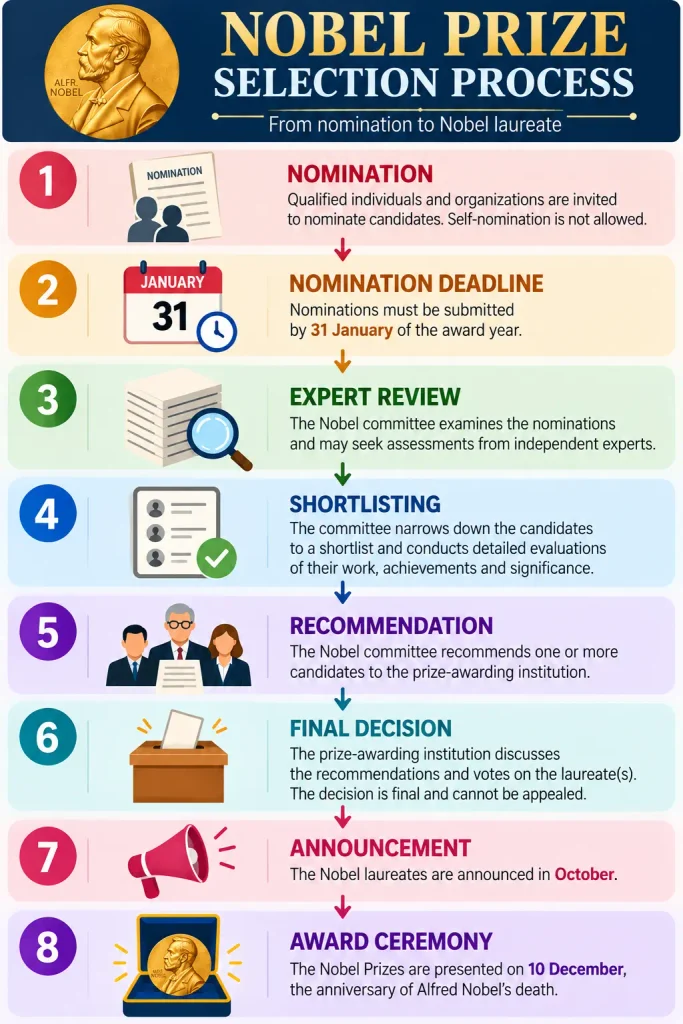
Who selects the Winners of Nobel Prize?
| Nobel Prize | Awarding Institution |
|---|---|
| Physics | Royal Swedish Academy of Sciences |
| Chemistry | Royal Swedish Academy of Sciences |
| Physiology or Medicine | Nobel Assembly at Karolinska Institutet |
| Literature | Swedish Academy |
| Peace | Norwegian Nobel Committee |
| Economic Sciences | Royal Swedish Academy of Sciences |
Nobel Prize Winners from India or of Indian Origin
| Year | Laureate | Subjects | Contribution |
|---|---|---|---|
| 1913 | Rabindranath Tagore | Literature | Poetry (Gitanjali) |
| 1930 | C. V. Raman | Physics | Light Scattering (The Raman Effect) |
| 1968 | Har Gobind Khorana | Physiology or Medicine | Genetics (Genetic Code & Protein Synthesis) |
| 1979 | Mother Teresa | Peace | Humanitarian Work (Missionaries of Charity) |
| 1983 | Subrahmanyan Chandrasekhar | Physics | Astrophysics (Evolution of Stars) |
| 1998 | Amartya Sen | Economic Sciences | Welfare Economics & Social Choice Theory |
| 2009 | Venkatraman Ramakrishnan | Chemistry | Molecular Biology (Structure of the Ribosome) |
| 2014 | Kailash Satyarthi | Peace | Social Reform (Child Rights & Education) |
| 2019 | Abhijit Banerjee | Economic Sciences | Development Economics (Global Poverty Alleviation) |
Nobel Prize Winners 2025
| Subject | Laureate | Contribution |
|---|---|---|
| Physics | John Clarke, Michel H. Devoret, John M. Martinis | Discovery of macroscopic quantum mechanical tunnelling and energy quantisation in an electric circuit |
| Chemistry | Susumu Kitagawa, Richard Robson, Omar M. Yaghi | Development of metal–organic frameworks (MOFs) |
| Physiology or Medicine | Mary E. Brunkow, Fred Ramsdell, Shimon Sakaguchi | Discoveries concerning peripheral immune tolerance |
| Literature | László Krasznahorkai | A visionary literary body of work that reaffirms the power of art amid apocalyptic terror |
| Peace | Maria Corina Machado | Work promoting democratic rights in Venezuela and a peaceful transition to democracy |
| Economic Sciences | Joel Mokyr, Philippe Aghion, Peter Howitt | Explanation of innovation-driven economic growth; technological progress and creative destruction |
Nobel Prize Winners 2024
| Subject | Laureate | Contribution |
|---|---|---|
| Physics | John J. Hopfield, Geoffrey Hinton | Foundational discoveries and inventions that enable machine learning with artificial neural networks |
| Chemistry | David Baker | Computational protein design |
| Chemistry | Demis Hassabis, John Jumper | Protein structure prediction |
| Physiology or Medicine | Victor Ambros, Gary Ruvkun | Discovery of microRNA and its role in post-transcriptional gene regulation |
| Literature | Han Kang | Intense poetic prose confronting historical traumas and exposing the fragility of human life |
| Peace | Nihon Hidankyo | Efforts toward a world free of nuclear weapons and testimony showing that nuclear weapons must never be used again |
| Economic Sciences | Daron Acemoglu, Simon Johnson, James A. Robinson | Studies of how institutions are formed and affect prosperity |
Top Questions on Nobel Prize Winners
1. Who established the Nobel Prize?
Answer: Alfred Nobel, the Swedish inventor, chemist, engineer and industrialist, established the Nobel Prizes through his will.
2. When were the first Nobel Prizes awarded?
Answer: The first Nobel Prizes were awarded in 1901.
3. What are the five original Nobel Prize categories?
Answer: Physics, Chemistry, Physiology or Medicine, Literature, and Peace.
4. Which Nobel Prize category was added later?
Answer: Economic Sciences was established in 1968 and the first prize was awarded in 1969.
5. Who was the first Indian Nobel Prize winner?
Answer: Rabindranath Tagore, who won the Nobel Prize in Literature in 1913 for Gitanjali.
6. Who was the first Indian Nobel laureate in Physics?
Answer: C. V. Raman, who won the Nobel Prize in Physics in 1930 for his work on the scattering of light and the discovery of the Raman Effect.
7. Where is the Nobel Peace Prize awarded?
Answer: The Nobel Peace Prize is awarded in Oslo, Norway. The other Nobel Prizes are awarded in Stockholm, Sweden.
8. When are the Nobel Prizes traditionally presented?
Answer: Nobel Prizes are presented on 10 December, the anniversary of Alfred Nobel’s death.
9. Who won the Nobel Prize in Literature in 2024?
Answer: Han Kang of South Korea won the 2024 Nobel Prize in Literature.
10. What are the main stages of the Nobel Prize selection process?
Answer: Nomination → Expert Review → Shortlisting → Committee Recommendation → Final Decision → Announcement → Award Ceremony.