
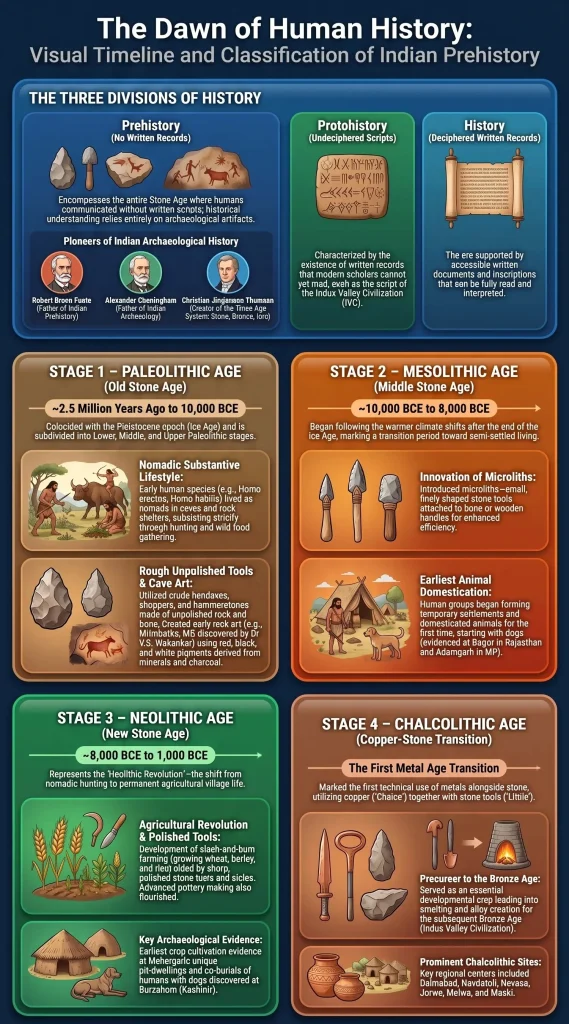
Indian history is broadly categorized into three major chronological divisions based on the presence, nature, and decipherability of written historical records:
- Prehistory: Characterized by a complete absence of written records or language. Historical understanding relies entirely on archaeological excavations, stone tools, pottery, and human/animal fossils. Example: The Stone Age (Paleolithic, Mesolithic, Neolithic).
- Protohistory: Periods for which written evidence exists, but the script remains undeciphered to date, or periods during which a culture lacked writing while contemporary neighboring cultures recorded them. Example: Indus Valley Civilization (Harappan Script).
- History: Periods where deciphered written records are available and can be studied alongside archaeological findings. Example: Vedic Period onwards (6th Century BCE to Modern Era).
| Sources of Prehistory Because prehistoric humans left behind no written inscriptions or literary texts, archaeologists reconstruct their lifestyle, diet, toolmaking skills, and migratory patterns entirely through physical remains—primarily stone implements, bone artifacts, rock paintings, hearths, and fossilized bones. |
1. Classification & Evolution of the Stone Age
The Stone Age represents the vast era during which stone was the primary raw material used for making tools and weapons. It is subdivided into three chronological phases based on technological advancements, tool types, and socioeconomic shifts:
- Paleolithic Age (Old Stone Age): From ~2.5 Million Years Ago (MYA) to 10,000 BCE. Subdivided into Lower, Middle, and Upper Paleolithic based on tool refinement and climatic phases.
- Mesolithic Age (Middle Stone Age): From ~10,000 BCE to 8,000 BCE. Characterized by the climate warming transition, miniature stone tools (microliths), and early animal domestication.
- Neolithic Age (New Stone Age): From ~8,000 BCE to 1,000 BCE. Defined by polished stone tools, agriculture revolution, settled village communities, and pottery creation.
- Chalcolithic Age (Copper-Stone Age): Transition phase where copper metal was used alongside stone tools, marking the dawn of metallurgy in India.
2. Phase-Wise Analysis
A. Paleolithic Age (Old Stone Age)
Etymology & Timeline: Derived from Greek words Paleo (Old/Ancient) and Lithic (Stone). Covers ~2.5 MYA to 10,000 BCE, coinciding largely with the Pleistocene Epoch (Ice Age).
Human Hominid Species: Early human species present during this era included Australopithecus, Homo habilis, Homo erectus, and Neanderthals, preceding the dominance of modern Homo sapiens in the Upper Paleolithic.
Subsistence & Lifestyle: Humans were nomadic hunter-gatherers. They relied on hunting wild animals and gathering edible wild plants, fruits, and roots. They lived in natural rock shelters, caves, and riverbanks.
Tool Technology: Rough, crude, unpolished stone tools made predominantly of quartzite. Main tool types included handaxes, choppers, cleavers, scraper tools, and hammerstones.
Sub-Divisions of the Paleolithic Age:
- Lower Paleolithic: Dominated by handaxe and chopper-chopping tool traditions (Soan River Valley, Bori in Maharashtra).
- Middle Paleolithic: Characterized by flake tool industry (scrapers, points, borers made on flakes). Key sites: Nevasa, Luni valley.
- Upper Paleolithic: Marked by blade and burin tools, appearance of modern Homo sapiens, and early cave art (Bhimbetka, Kurnool caves).
B. Mesolithic Age (Middle Stone Age)
Etymology & Timeline: Derived from Greek Meso (Middle) and Lithos (Stone). Spans ~10,000 BCE to 8,000 BCE. Coincided with the Holocene epoch—a warmer climate causing environmental shifts, floral/faunal growth, and increased water availability.
Microliths (Key Tool Innovation): Development of miniature stone tools called Microliths (1 cm to 5 cm in size). These geometric tools (blades, lunates, triangles, trapezes) were hafted onto bone or wooden handles to form composite weapons like spears, arrows, and sickles.
Domestication of Animals: The Mesolithic period saw the beginnings of animal domestication alongside hunting and fishing.
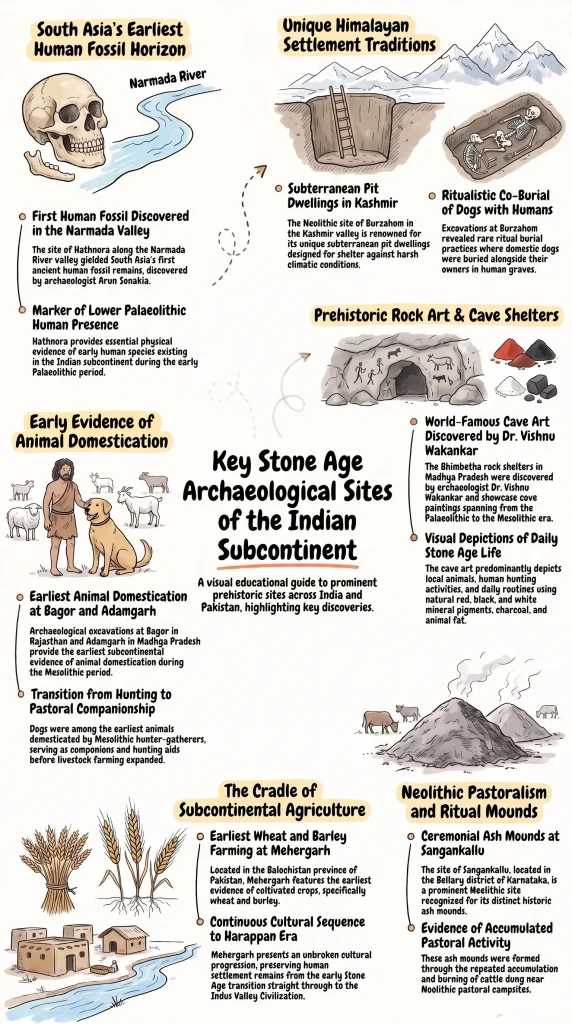
| Crucial Discovery: Earliest Evidence of Animal Domestication The earliest archaeological evidence of animal domestication in India comes from two prominent Mesolithic sites: 1. Bagor (Bhilwara district, Rajasthan) — Largest Mesolithic site in India. 2. Adamgarh (Hoshangabad district, Madhya Pradesh). The dog was the first animal domesticated by humans, followed by cattle, sheep, and goats. |
C. Neolithic Age (New Stone Age)
Etymology & Timeline: Derived from Greek Neo (New) and Lithic (Stone). Spans ~8,000 BCE to 1,000 BCE. Gordon Childe termed this phase the ‘Neolithic Revolution’ due to fundamental transformations in human existence.
The Agricultural Revolution & Settled Life: Humans transitioned from food gatherers to food producers. Cultivation of crops like barley, wheat, rice, and millets began. Settled life emerged with permanent mud-brick houses and village communities. Slash-and-burn farming was widely practiced.
Tool Technology & Pottery: Introduction of polished, ground, and smooth stone tools with sharp cutting edges. Specialized tools included celts, stone axes, adzes, querns, pestles, and sickles. Hand-made and wheel-made pottery emerged for storing grain and cooking.
Prominent Neolithic Sites in India:
- Mehergarh (Balochistan, Pakistan): Earliest agricultural site in South Asia (~7,000 BCE). Shows evidence of wheat/barley farming, mud-brick houses, and continuous cultural evolution into the Harappan Era.
- Burzahom (Kashmir, India): Famous for pit-dwellings (underground circular living structures), coarse grey pottery, and unique burials of dogs alongside their masters in human graves.
- Gufkral (Kashmir, India): Literally ‘Cave of the Potter’. Known for stone tools, bone implements, and agriculture-pastoral economy.
- Sangankallu, Maski, Piklihal, Hallur (Karnataka): South Indian Neolithic sites famous for Ash Mounds—large accumulated mounds resulting from burning accumulated cattle dung.
- Coldihwa & Mahagara (Uttar Pradesh): Provides earliest evidence of rice cultivation in the Ganges valley.
D. Chalcolithic Age (Copper-Stone Age)
Features & Significance: Marked the first usage of metals (Copper) in combination with stone implements. Rural regional cultures emerged, characterized by painted pottery (Black and Red Ware), copper axes, chisels, and beads. Key regional cultures include Ahar/Banas culture (Rajasthan), Malwa culture (MP), and Jorwe culture (Maharashtra).
3. Prehistoric Art & Cave Paintings
Prehistoric art provides priceless insights into the spiritual beliefs, social organization, hunting practices, and daily life of early humans:
- Rock Art & Wall Paintings: Cave walls and rock shelters were decorated with scenes of animal hunting, community dancing, child-rearing, sexual union, and ritualistic ceremonies.
- Pigments & Materials: Colors were derived from natural minerals—Red (hematite/geru), White (lime/chalk), Green (chalcedony), and Black (charcoal/manganese). Pigments were mixed with animal fat and water.
- Bhimbetka Cave Paintings (Raisen, Madhya Pradesh): UNESCO World Heritage site containing over 500 painted rock shelters spanning Upper Paleolithic to Mesolithic and historic periods. Discovered by archaeologist Dr. Vishnu Shridhar Wakankar in 1957.
- Petroglyphs: Images created by carving, engraving, picking, or incising rock surfaces.
4. Archaeological Discoveries & Personalities
Summary of key archaeological milestones, eminent personalities, and foundational institutions essential for competitive examinations:
| Field / Concept | Personality / Key Site | Context & Historical Significance |
| Father of Indian Prehistory | Robert Bruce Foote | Discovered the first Paleolithic stone tool (Pallavaram Handaxe near Chennai) in 1863. |
| Father of Indian Archaeology | Alexander Cunningham | First Director-General of Archaeological Survey of India (ASI) established in 1861. |
| Three-Age System (Stone, Bronze, Iron) | Christian Jürgensen Thomsen | Formulated classification of ancient artifacts at the National Museum of Denmark (Copenhagen). |
| First Ancient Human Fossil in India | Hathnora (Narmada Valley, MP) | Discovery of ‘Narmada Human’ (Homo erectus skull cap) by Dr. Arun Sonakia in 1982. |
| Discovery of Bhimbetka Rock Shelters | Dr. V.S. Wakankar | Identified the prehistoric cave paintings in Raisen district, MP in 1957. |
| Maximum Human Skeletons Site | Lekhahia Rock Shelter (Vindhyas) | Uncovered 17 human skeletons in Mesolithic layers (documented by Dr. J.N. Pandey). |
| National Museum of Human Mankind | IGRMS, Bhopal (Madhya Pradesh) | Indira Gandhi Rashtriya Manav Sangrahalaya under Union Ministry of Culture. |
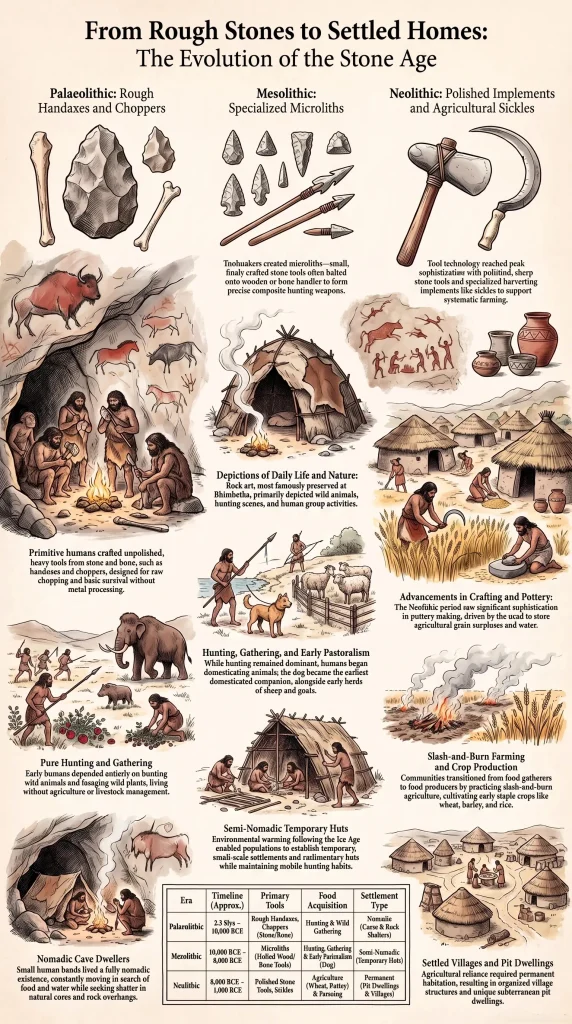
5. Comparative Summary Table: Stone Age Phases
| Feature | Paleolithic Age | Mesolithic Age | Neolithic Age |
| Meaning | Old Stone Age | Middle Stone Age | New Stone Age |
| Timeline | ~2.5 MYA – 10,000 BCE | 10,000 BCE – 8,000 BCE | 8,000 BCE – 1,000 BCE |
| Subsistence | Hunting & Plant Gathering | Hunting, Fishing & Early Domestication | Agriculture & Animal Husbandry |
| Lifestyle | Strictly Nomadic | Semi-Nomadic / Temporary Huts | Settled Village Life |
| Tool Tech | Rough Handaxes, Choppers (Quartzite) | Microliths (Hafted composite tools) | Polished celts, axes, sickles, pestles |
| Key Sites | Bhimbetka, Soan Valley, Attirampakkam | Bagor, Adamgarh, Lekhahia, Sarai Nahar Rai | Burzahom, Mehergarh, Sangankallu, Gufkral |
6. MCQ Quick-Reference Points
Q: Which period is known as the ‘Neolithic Revolution’?
A: The Neolithic Age, named by V. Gordon Childe due to the invention of agriculture and settled living.
Q: Where is the earliest evidence of rice cultivation found in India?
A: Coldihwa and Mahagara in the Belan Valley, Uttar Pradesh.
Q: What is unique about Burzahom Neolithic site?
A: Evidence of pit dwellings and dog burials with human masters.
Q: Which site is famous for South Indian Neolithic Ash Mounds?
A: Sangankallu, Maski, Piklihal, and Utnur.
Q: What material was predominantly used for making Paleolithic tools in India?
A: Quartzite (hence Paleolithic humans are often called ‘Quartzite Men’).
Q: Who discovered the Bhimbetka caves?
A: Dr. Vishnu Shridhar Wakankar in 1957.
Q: What was the first animal domesticated by prehistoric humans?
A: The Dog, during the Mesolithic Age.
Read more: