
WBCS Prelims Static GK Question – 2024
1. Which of the following is not part of Israel’s Missile defence system ?
(A) Iron dome
(B) Thaad
(C) David’s sling
(D) Tomahawk
Answer: (D) Tomahawk
Explanation: Iron Dome, David’s Sling and Arrow are the layers of Israel’s multi-tier air defence. THAAD is a US-made system that was deployed in Israel in 2024 to support its defence. Tomahawk is not a defence system at all. It is a US-made long-range subsonic cruise missile launched from ships and submarines, used for attack.
Israel’s Multi-Layered Missile Defence System and the Tomahawk (Offensive Missile):
| System | Range / Role | Key points |
|---|---|---|
| Iron Dome | Short range (about 4 to 70 km) | Intercepts rockets, artillery and mortars; developed by Rafael with US support; operational since 2011 |
| David’s Sling | Medium range | Counters cruise missiles, aircraft and short to medium-range ballistic missiles; developed by Rafael and Raytheon |
| Arrow 2 and Arrow 3 | Long range | Arrow 3 intercepts ballistic missiles outside the atmosphere (exo-atmospheric) |
| THAAD | US-made, deployed in Israel in 2024 | Terminal High Altitude Area Defense; by Lockheed Martin; supports Israel’s defence but is a US system |
| Tomahawk | Offensive weapon | US long-range subsonic cruise missile (Raytheon); fired from ships and submarines; not a defence system |
2. Which currency is known as ‘vehicle currency’?
(A) Euro
(B) Yen
(C) Pound
(D) None of the above
Answer: (D) None of the above
Explanation: A vehicle currency is a currency widely used to settle trade and financial transactions between two parties, neither of whom is based in the country that issues it. Historically, the US Dollar has been the main vehicle currency of the world. It is used in the majority of foreign exchange transactions, in invoicing of international trade (such as oil) and in central bank reserves. Euro, Yen and Pound are also international currencies, but they are not called the vehicle currency in the standard sense. Since the US Dollar is not among the options, the answer is none of the above.
Vehicle Currency: Meaning, Features and Major International Currencies:
| Topic | Key points |
|---|---|
| Vehicle currency | Currency used as an intermediary in foreign exchange and trade between two other countries |
| Main vehicle currency | US Dollar (USD) |
| Why the dollar is preferred | Deep and liquid markets, economic size, political stability, wide acceptance in trade and reserves |
| Reserve currency | Currency held in large amounts by central banks; USD is the largest, followed by Euro, Yen and Pound |
| IMF SDR basket | US Dollar, Euro, Chinese Yuan, Japanese Yen, British Pound |
| Petrodollar | Pricing and trading of oil in US Dollars |
| Related term | Dollarisation: a country adopting the US Dollar as its official currency |
3. The script of Santhal language is
(A) Tirhutta
(B) Devnagiri
(C) Olchiki
(D) Chisoi
Answer: (C) Olchiki
Explanation: Santhali is written in the Ol Chiki script (also spelled Ol Chemet), which was created by Pandit Raghunath Murmu in 1925. It is a purely alphabetic script, written from left to right, and was designed specifically for Santhali rather than adapted from any other script. Santhali was added to the Eighth Schedule of the Indian Constitution by the 92nd Constitutional Amendment Act, 2003. Tirhutta (Mithilakshar) is an old script of Maithili, Devanagari is used for Hindi, Sanskrit, Marathi and others, and Chisoi is not a standard script of any recognised Indian language, so these are incorrect.
Santhali Language, Ol Chiki Script and Scripts of Other Indian Languages:
| Topic | Key points |
|---|---|
| Santhali script | Ol Chiki (Ol Chemet), created by Pandit Raghunath Murmu in 1925 |
| Language family | Austroasiatic (Munda branch) |
| Eighth Schedule | Added by the 92nd Constitutional Amendment Act, 2003, along with Bodo, Dogri and Maithili |
| Main regions | Jharkhand, West Bengal, Odisha, Assam, Bihar; also spoken in Bangladesh and Nepal |
| Sahitya Akademi | Santhali recognised for the Sahitya Akademi award in 2005 |
| Tirhutta / Mithilakshar | Traditional script of Maithili |
| Devanagari | Hindi, Sanskrit, Marathi, Nepali, Konkani, Bodo, Dogri |
| Other scripts | Gurmukhi for Punjabi, Bengali-Assamese script for Bengali and Assamese, Meitei Mayek for Manipuri |
| Santhal tribe | One of the largest tribal communities of India; Santhal Hul (rebellion) took place in 1855 under Sidhu and Kanhu Murmu |
4. Sex Ratio in a population is defined as
(A) the number of females per 1000 males
(B) the number of boys born to a couple in their lifetime
(C) the number of infant girls per 1000 females
(D) the number of males minus the number of females in a population
Answer: (A) the number of females per 1000 males
Explanation: In India, the sex ratio is defined as the number of females per 1000 males in a population. This differs from the international convention, where it is usually expressed as the number of males per 100 females. The Census of India calculates it every ten years. Option B describes fertility, option C describes the child sex ratio in a different (and incorrect) form, and option D is simply a difference in numbers and has no use as a ratio.
Sex Ratio:
| Topic | Key points |
|---|---|
| Sex ratio (India) | Number of females per 1000 males |
| International convention | Number of males per 100 females |
| Child sex ratio | Number of girls per 1000 boys in the 0 to 6 age group |
| Sex ratio at birth (SRB) | Number of female births per 1000 male births |
| Census 2011 (India) | Overall sex ratio 943; child sex ratio 919 |
| Highest sex ratio (Census 2011) | Kerala (1084) |
| Lowest sex ratio (Census 2011) | Haryana (879) among states; Daman and Diu (618) among UTs |
| Highest among UTs | Puducherry (1037) |
| Related scheme | Beti Bachao Beti Padhao (2015), launched at Panipat, Haryana, to improve the child sex ratio |
| Related law | Pre-Conception and Pre-Natal Diagnostic Techniques (PCPNDT) Act, 1994, bans sex determination tests |
| West Bengal (Census 2011) | Sex ratio 950 |
5. “My two fingers on a typewriter have never connected with my brain. My hand on a pen does. A fountain pen, of course”,— Graham Greene. Which one of the following is a manufacturer of Fountain Pens?
(A) Voltas
(B) Sailor
(C) Hundai
(D) Kirloskar
Answer: (B) Sailor
Explanation: Sailor Pen Co. is a Japanese company, founded in 1911 in Kure, Hiroshima, and is one of the best known makers of fountain pens in the world. Voltas is an Indian air conditioner and cooling products company (a Tata group company), Hyundai (spelt Hundai in the option) is a South Korean automobile maker, and Kirloskar is an Indian engineering company known for pumps, engines and generators. None of these three makes fountain pens.
Fountain Pen Manufacturers and the Companies Named in the Options:
| Company | Country / Origin | Known for |
|---|---|---|
| Sailor | Japan (founded 1911, Kure, Hiroshima) | Fountain pens; among the oldest Japanese pen makers |
| Pilot | Japan | Fountain pens, Namiki brand |
| Platinum | Japan | Fountain pens |
| Parker | USA (founded 1888, now owned by Newell Brands) | Fountain pens, Jotter ball pens |
| Montblanc | Germany | Luxury fountain pens, Meisterstück |
| Waterman | France | Fountain pens; Lewis Waterman patented a practical fountain pen in 1884 |
| Cross | USA | Pens and writing instruments |
| Camlin, Hero, Wality | India | Indian pen and stationery brands |
| Voltas | India (Tata group) | Air conditioners and cooling products |
| Hyundai | South Korea | Automobiles |
| Kirloskar | India | Pumps, engines, generators |
| Graham Greene | English novelist | Author of The Power and the Glory, The Quiet American and Brighton Rock |
6. Which three African countries have withdrew themselves from the International Criminal Court?
(A) Burkina Faso, Mali, Niger
(B) Congo, Gabon, Togo
(C) Ethiopia, Somalia, Kenya
(D) Nigeria, Ghana, Sudan
Answer: (A) Burkina Faso, Mali, Niger
Explanation: In September 2025, the three Sahel states of Burkina Faso, Mali and Niger announced their withdrawal from the Rome Statute, the treaty that created the ICC. They are military-led governments and members of the Alliance of Sahel States (AES). They called the court a tool of neo-colonial repression that selectively targets Africans. Under Article 127 of the Rome Statute, a withdrawal takes effect one year after written notification to the UN Secretary-General. The other options are incorrect because Congo, Gabon, Togo, Ethiopia, Somalia, Kenya, Nigeria, Ghana and Sudan have not withdrawn as a group.
International Criminal Court (ICC):
| Topic | Key points |
|---|---|
| ICC | Permanent international court to try individuals for the gravest crimes; headquarters at The Hague, Netherlands |
| Treaty | Rome Statute, adopted in 1998; came into force on 1 July 2002 |
| Crimes covered | Genocide, crimes against humanity, war crimes, crime of aggression |
| Jurisdiction | Individuals (not states); acts as a court of last resort, complementary to national courts |
| Withdrawal rule | Article 127: effective one year after notification to the UN Secretary-General |
| Burkina Faso, Mali, Niger | Announced withdrawal in September 2025; members of the Alliance of Sahel States (AES) |
| Burundi | First African country to withdraw; effective October 2017 |
| Philippines | Withdrew with effect from March 2019 |
| Hungary | Announced withdrawal in April 2025 |
| South Africa and Gambia | Announced withdrawal in 2016 but later revoked it |
| India | Not a member of the ICC |
| ICC vs ICJ | ICC tries individuals; ICJ (the principal judicial organ of the UN, also at The Hague) settles disputes between states |
| Arrest warrants (examples) | Vladimir Putin (2023) and Benjamin Netanyahu (2024) |
7. Who founded Himalayan Institute of Alternatives ( HIAL )? Why is it famous for?
(A) Tenzing Norgey, Holistic development of Himalayan Area.
(B) Sonam Wangchuk & Gitanjali J. Angmo, HIAL desires to address the educational and developmental challenges unique to Ladakh’s exceptional geographical and cultural context.
(C) Phunsukh Wangdu, Cultural development of Leh region
(D) None of the above
Answer: (B) Sonam Wangchuk & Gitanjali J. Angmo, HIAL desires to address the educational and developmental challenges unique to Ladakh’s exceptional geographical and cultural context.
Explanation: The Himalayan Institute of Alternatives, Ladakh (HIAL) was founded by the educationist and innovator Sonam Wangchuk together with Gitanjali J. Angmo. It is a university-level institution at Phyang, near Leh, built around learning that suits the mountain environment and culture of Ladakh, with a focus on sustainable, experiential and practical education. Sonam Wangchuk is also known for SECMOL (Students’ Educational and Cultural Movement of Ladakh), the Ice Stupa artificial glacier technique and the Ramon Magsaysay Award in 2018. Tenzing Norgay was the Sherpa mountaineer who first climbed Everest with Edmund Hillary in 1953, and he has no link with HIAL. Phunsukh Wangdu is the fictional character in the film 3 Idiots, who was inspired by Sonam Wangchuk. So options A and C are incorrect, and option D is not needed.
Himalayan Institute of Alternatives, Ladakh (HIAL) and Sonam Wangchuk:
| Topic | Key points |
|---|---|
| HIAL | Himalayan Institute of Alternatives, Ladakh; located at Phyang, near Leh, Ladakh |
| Founders | Sonam Wangchuk and Gitanjali J. Angmo |
| Aim | Education and development suited to Ladakh’s geography and culture; sustainable and experiential learning |
| SECMOL | Students’ Educational and Cultural Movement of Ladakh, founded in 1988 by Sonam Wangchuk and others; its campus is solar-heated and runs on renewable energy |
| Ice Stupa | Artificial glacier in the shape of a cone, built to store winter water for use in spring; invented by Sonam Wangchuk |
| Awards | Ramon Magsaysay Award (2018), Rolex Award for Enterprise (2016) |
| 3 Idiots (2009) | Character Phunsukh Wangdu, played by Aamir Khan, was inspired by Sonam Wangchuk |
| Tenzing Norgay | Sherpa mountaineer; first ascent of Mount Everest with Edmund Hillary on 29 May 1953 |
| Ladakh | Became a Union Territory on 31 October 2019, after separation from Jammu and Kashmir; capital is Leh and Kargil |
8. The film ‘Ek Ruka Hua Faisla’ (1986) directed by Sri Basu Chatterjee was adopted from a 1957 American film ’12 Angry Men’. Recently it was adopted as a play in Bengali language. Which group has adopted it and what is the name of the play?
(A) Nandikar, Ek Theke Baro
(B) Sayak, Kundubabu
(C) Rangakarmee, Rudali
(D) Natasena, Fata Gopal
Answer: (A) Nandikar, Ek Theke Baro
Explanation: Ek Theke Baro (meaning “One to Twelve”) is the Bengali stage adaptation of the story of 12 Angry Men, staged by the Kolkata theatre group Nandikar. The story is about twelve jurors who must decide the fate of a young man accused of murder, and one juror’s doubt slowly forces the others to re-examine the case. Option B, Kundubabu, is a Sayak production based on a different work, and option C, Rudali, is a play based on Mahasweta Devi’s story about professional mourners. Option D, Fata Gopal, is not associated with this story. I could not verify the exact production year from memory, so students should treat the group and title as the key points to remember.
12 Angry Men and Its Indian Adaptations:
| Topic | Key points |
|---|---|
| 12 Angry Men (1957) | American courtroom drama directed by Sidney Lumet; screenplay by Reginald Rose, based on his 1954 television play |
| Ek Ruka Hua Faisla (1986) | Hindi adaptation directed by Basu Chatterjee; cast includes Pankaj Kapur, Annu Kapoor, Subhash Udgate and M. K. Raina |
| Basu Chatterjee | Director known for middle-class comedies such as Chhoti Si Baat, Rajnigandha and Chitchor |
| Ek Theke Baro | Bengali stage adaptation by Nandikar |
| Nandikar | Kolkata theatre group founded in 1960 by Ruma Guha Thakurta, Ajitesh Bandyopadhyay and others; Rudraprasad Sengupta is a leading figure |
| Rudali | Play based on a Mahasweta Devi story about women paid to mourn; adapted into a 1993 Hindi film by Kalpana Lajmi |
| Mahasweta Devi | Bengali writer and activist; Jnanpith Award (1996), Ramon Magsaysay Award (1997) |
| Theme | Reasonable doubt, justice and the jury system |
9. What is the Full Form of BRICS ? How many Members are there in BRICS?
(A) Brazil, Russia, Indonesia, Chile & Spain. It is an intergovernmental organization comprising of fourteen countries.
(B) Britain, Romania, India, China and Sri Lanka. It is an intergovernmental organization comprising of five countries.
(C) Brazil, Russia, India, China & South Africa. It is an intergovernmental organization comprising of eleven countries.
(D) None of the above
Answer: (C) Brazil, Russia, India, China & South Africa. It is an intergovernmental organization comprising of eleven countries.
Explanation: Its count of eleven also matches the commonly cited membership: the five founders, plus Egypt, Ethiopia, Iran and the UAE (joined 1 January 2024), Indonesia (joined January 2025), and Saudi Arabia, which was invited and is usually counted among the eleven although its formal status has stayed unclear. Option A names the wrong countries and option B is also incorrect. Official membership lists have varied between ten and eleven depending on how Saudi Arabia is treated, so check the latest figure from official BRICS sources before the exam.
BRICS:
| Topic | Key points |
|---|---|
| Full form | Brazil, Russia, India, China, South Africa |
| Origin of the term | BRIC coined in 2001 by economist Jim O’Neill of Goldman Sachs |
| First summit | 2009, Yekaterinburg, Russia (as BRIC) |
| South Africa joined | 2010; the group became BRICS |
| New members | Egypt, Ethiopia, Iran, UAE joined on 1 January 2024 |
| Indonesia | Joined in January 2025 |
| Saudi Arabia | Invited; usually counted as the eleventh member, but formal status unclear |
| New Development Bank (NDB) | Founded by BRICS in 2014 (agreement signed at Fortaleza, Brazil); headquarters at Shanghai, China |
| Contingent Reserve Arrangement (CRA) | Financial safety net for member countries, set up in 2014 |
| 2024 summit | Kazan, Russia (October 2024) |
| 2025 summit | Rio de Janeiro, Brazil |
| Nature | Intergovernmental forum with no permanent secretariat or charter |
10. What is the study and analysis of Coins known as?
(A) Coinography
(B) Epigraphy
(C) Numismatics
(D) Calligraphy
Answer: (C) Numismatics
Explanation: Numismatics is the study and collection of coins, and also of paper money, tokens and medals. The word comes from the Greek and Latin words for coin. Epigraphy is the study of inscriptions on stone, metal and other hard surfaces. Calligraphy is the art of beautiful handwriting. Coinography is not an established term.
Numismatics and Related Branches of Historical Study:
| Term | Meaning |
|---|---|
| Numismatics | Study and collection of coins, currency, tokens and medals |
| Epigraphy | Study of inscriptions on stone, copper plates, pillars and walls |
| Palaeography | Study of ancient handwriting and manuscripts |
| Calligraphy | Art of decorative, beautiful handwriting |
| Philately | Study and collection of postage stamps |
| Archaeology | Study of the past through material remains |
| Punch-marked coins | Earliest coins of India (about 6th century BCE), made of silver, also called Karshapanas |
| Indo-Greek rulers | First to issue gold coins in India that can be definitely attributed to them |
| Kushanas | Issued the largest number of gold coins in early India |
| Guptas | Issued many gold coins, called Dinaras |
| Sher Shah Suri | Introduced the silver Rupaya (rupee) |
| Brahmi script | Deciphered by James Prinsep in 1837 |
11. Among the following indices which one is not used for the construction of Human Development Index ?
(A) Health Index
(B) Price Index
(C) Education Index
(D) Income Index
Answer: (B) Price Index
Explanation: The Human Development Index (HDI) is a composite index built from three dimensions: health (a long and healthy life), education (knowledge) and standard of living (income). These are measured through the Health Index (life expectancy at birth), the Education Index (mean years of schooling and expected years of schooling) and the Income Index (GNI per capita, PPP in US dollars). A Price Index measures changes in prices, as in inflation (CPI, WPI), and is not a component of the HDI. The HDI is the geometric mean of the three dimension indices, and its value ranges from 0 to 1.
Human Development Index (HDI):
| Topic | Key points |
|---|---|
| HDI | Composite index measuring average achievement in health, education and standard of living |
| Published by | United Nations Development Programme (UNDP), in the Human Development Report |
| Health dimension | Life expectancy at birth |
| Education dimension | Mean years of schooling (adults aged 25 and above) and expected years of schooling (children) |
| Income dimension | Gross National Income (GNI) per capita, in PPP US dollars |
| Calculation | Geometric mean of the three dimension indices; value between 0 and 1 |
| Categories | Very high, high, medium and low human development |
| Originators | Mahbub ul Haq (Pakistan) and Amartya Sen; first report in 1990 |
| Other UNDP indices | Inequality-adjusted HDI (IHDI), Gender Development Index (GDI), Multidimensional Poverty Index (MPI) |
| Price Index | Measures change in prices (CPI, WPI); used to calculate inflation, not part of the HDI |
| India’s rank | Around 130 out of 193 countries in the 2025 report (medium human development) |
12. Under what authority the President of United States of America can impose tariffs?
(A) Congress passed laws allowing the President to impose tariffs unilaterally for national security reasons
(B) The Constitution of United States authorizes the President to impose tariff subject to some restrictions
(C) The President of United Sates has sweeping powers to impose tariffs to correct the trade imbalance
(D) None of the above
Answer: (A) Congress passed laws allowing the President to impose tariffs unilaterally for national security reasons
Explanation: The US Constitution (Article I, Section 8) gives the power to lay and collect taxes, duties and imports to Congress, not to the President. So option B is wrong. The President can impose tariffs only when Congress has delegated that power through a statute. The best known example is Section 232 of the Trade Expansion Act, 1962, which allows tariffs on imports that threaten national security (used for steel and aluminium). Option C is wrong because the President’s power is limited to what Congress has delegated. On 20 February 2026, in Learning Resources v. Trump, the US Supreme Court struck down the IEEPA tariffs. It ruled 6-3 that the International Emergency Economic Powers Act (IEEPA) does not authorize the President to impose tariffs. The ruling does not affect tariffs under other statutes. Option A is therefore the closest correct choice, even though the word “unilaterally” is loose, since each delegation comes with legal limits.
Presidential Power to Impose Tariffs in the USA:
| Topic | Key points |
|---|---|
| Constitutional position | Article I, Section 8: power to impose taxes, duties and tariffs belongs to Congress |
| Source of presidential power | Delegation by Congress through laws |
| Section 232, Trade Expansion Act 1962 | Tariffs on imports that threaten national security; investigation by Department of Commerce |
| Section 301, Trade Act 1974 | Action against unfair trade practices of other countries; investigation by the US Trade Representative |
| Section 201, Trade Act 1974 | Safeguard tariffs when imports cause serious injury to domestic industry |
| Section 122, Trade Act 1974 | Temporary tariff of up to 15 percent for up to 150 days to deal with balance of payments problems |
| IEEPA (1977) | International Emergency Economic Powers Act; a sanctions law |
| Learning Resources v. Trump | Decided 20 February 2026; Supreme Court held 6-3 that IEEPA does not authorize tariffs |
| Effect of the ruling | Reciprocal tariffs and fentanyl-related tariffs under IEEPA were struck down; Section 232 tariffs (steel, aluminium, copper) were not affected |
| After the ruling | A global 10 percent tariff was announced under Section 122 |
| Tariff | Tax on imported goods, paid by the importer |
| Protectionism | Use of tariffs and quotas to protect domestic industry |
13. Which of the following is a reason that driving rapid growth of data centres in India?
(A) Lax environmental enforcement
(B) Strict data localization regulations (DPDP Act 2023)
(C) Cheap electricity
(D) Deterioration in Indo-US relation
Answer: (B) Strict data localization regulations (DPDP Act 2023)
Explanation: Data localisation rules push companies to store and process the data of Indian users inside India, which increases demand for domestic data centres. The Digital Personal Data Protection (DPDP) Act, 2023 is the main data law, and sector rules such as the RBI’s 2018 directive on storing payment data only in India add to this demand. Other drivers are rising internet use, cloud adoption, AI workloads and government support. Option A is wrong because weak environmental enforcement is not a recognised driver of data centre growth. Option C is wrong because electricity in India is not especially cheap, and power supply and cost are in fact challenges for data centres. Option D is wrong because Indo-US relations have no direct link to data centre growth. Note that the DPDP Act itself is not a strict localisation law, as it allows cross-border data transfer except to countries restricted by the government. Even so, among the given options, B is the intended answer.
Data Centres in India:
| Topic | Key points |
|---|---|
| Data centre | Facility that houses servers, storage and networking equipment for storing and processing data |
| DPDP Act, 2023 | Digital Personal Data Protection Act; India’s first comprehensive law on personal data, passed in August 2023 |
| Cross-border transfer under DPDP | Allowed, except to countries the Central Government restricts |
| Data Protection Board of India | Body set up under the DPDP Act to handle complaints and enforce the law |
| Data localisation | Requirement to store data within the country; RBI’s 2018 circular requires payment data to be stored only in India |
| Main growth drivers | Data localisation rules, digital payments, 5G and internet growth, cloud adoption, AI demand, government support |
| Major hubs | Mumbai, Chennai, Hyderabad, Pune, Delhi NCR, Bengaluru |
| IndiaAI Mission | Approved in March 2024 with about Rs 10,372 crore; aims to build AI computing capacity (GPUs) in India |
| Challenges | Power supply and cost, water use for cooling, land and environmental concerns |
| Digital India | Programme launched in 2015 to make government services available digitally |
WBCS Prelims Static GK Question – 2023
1. In the world in Postal Services India ranks
(A) Third
(B) Second
(C) First
(D) Fourth
Answer: (C) First
Explanation: India has the largest postal network in the world. It has about 1.64 lakh post offices, and most of them (over 1.5 lakh) are in rural areas. The network is run by India Post, which comes under the Department of Posts, Ministry of Communications. No other country has such a large number of post offices, so the other ranks (third, second, fourth) are incorrect.
India Post: World’s Largest Postal Network and Key Postal Facts
| Topic | Key points |
|---|---|
| India’s rank | First in the world in the number of post offices (about 1.64 lakh) |
| Rural share | Over 90 percent of post offices are in rural areas |
| Administration | Department of Posts, Ministry of Communications |
| First post office in Calcutta | Established in 1774 by Warren Hastings |
| Indian Post Office Act | 1854, during the time of Lord Dalhousie; the Department of Posts was formed in 1854 |
| First postage stamp in India | Scinde Dawk (1852), introduced in Sindh by Sir Bartle Frere |
| PIN code | Introduced on 15 August 1972 by Shriram Bhikaji Velankar; 6 digits; 9 zones (8 regional zones and 1 for the Army Postal Service) |
| India Post Payments Bank (IPPB) | Launched on 1 September 2018 |
| Universal Postal Union (UPU) | Founded in 1874; headquarters at Bern, Switzerland; a specialised agency of the UN |
| World Post Day | 9 October (to mark the founding of the UPU) |
| National Postal Week | 9 to 15 October; National Postal Day is on 10 October |
| Speed Post | Launched in 1986 |
2. NEAT 3.0 is a platform associated with which Union Ministry of India?
(A) Ministry of Education
(B) Ministry of Health and Family Welfare
(C) Ministry of Commerce and Industry
(D) Ministry of Corporate Affairs
Answer: (A) Ministry of Education
Explanation: NEAT stands for National Educational Alliance for Technology. It is an initiative of the Ministry of Education (earlier the Ministry of Human Resource Development), implemented through the All India Council for Technical Education (AICTE). The platform works as a single window that brings Ed-Tech companies and learners together. Ed-Tech companies offer their technology-based courses, and a share of the free courses is given to economically weaker students. NEAT 3.0 is the third version of this platform, launched in 2023. The Ministries of Health, Commerce and Corporate Affairs have no connection with it.
NEAT Platform and Digital Education Initiatives of the Ministry of Education:
| Topic | Key points |
|---|---|
| NEAT | National Educational Alliance for Technology; Ministry of Education with AICTE |
| Launched | 2017 (as NEAT 1.0); NEAT 3.0 launched in 2023 |
| Purpose | Single platform to make quality Ed-Tech solutions available to learners, with personalised and adaptive learning using AI |
| Free coupons | Part of the courses is offered free to economically backward learners |
| AICTE | All India Council for Technical Education; statutory body set up in 1945 and given statutory status by the AICTE Act, 1987; headquarters in New Delhi |
| SWAYAM | Online platform for free courses (MOOCs), launched in 2017 |
| DIKSHA | Digital platform for school education, launched in 2017 |
| PM eVidya | Programme of digital education announced in 2020 |
| National Digital Library of India | Digital repository of learning resources, run by IIT Kharagpur |
| Academic Bank of Credits (ABC) | Digital storehouse of academic credits earned by students under the NEP 2020 |
| National Education Policy 2020 | Approved by the Union Cabinet on 29 July 2020; 5+3+3+4 structure |
3. When is ‘International Customs Day 2023′ observed?
(A) January 25
(B) January 26
(C) January 27
(D) January 28
Answer: (B) January 26
Explanation: International Customs Day is observed every year on 26 January. It was started by the World Customs Organization (WCO) to recognise the role of customs officials and customs agencies in border security, trade facilitation and revenue collection. The date marks the first session of the Customs Co-operation Council (now the WCO), held in Brussels on 26 January 1953. Each year the WCO chooses a theme for the day. The other dates in the options (25, 27 and 28 January) are not linked with this day.
International Customs Day, World Customs Organization (WCO) and Customs in India:
| Topic | Key points |
|---|---|
| International Customs Day | Observed on 26 January every year |
| Why 26 January | First session of the Customs Co-operation Council held on 26 January 1953 |
| World Customs Organization (WCO) | Intergovernmental body; headquarters at Brussels, Belgium |
| WCO history | Established in 1952 as the Customs Co-operation Council; renamed WCO in 1994 |
| Purpose of the day | Honour customs officials and highlight their role in trade facilitation, border security and revenue |
| WCO theme for 2023 | Nurturing the next generation: promoting a culture of knowledge sharing and professional pride in Customs |
| Customs in India | Run by the Central Board of Indirect Taxes and Customs (CBIC), Department of Revenue, Ministry of Finance |
| Customs Act, 1962 | Main law governing import and export duties in India |
| Central Excise Day (India) | 24 February |
| Harmonised System (HS) | International system for naming and coding traded goods; maintained by the WCO |
| 26 January in India | Also Republic Day; the Constitution came into effect in 1950 |
4. Which among the following countries is associated with the ‘Terminator Tank Support System – the BMPT’?
(A) China
(B) Israel
(C) Russia
(D) USA
Answer: (C) Russia
Explanation: BMPT stands for Boyevaya Mashina Podderzhki Tankov, which means “Tank Support Fighting Vehicle”. The Terminator series is developed by the Russian firm Uralvagonzavod and is built on a tank chassis (T-72 or T-90). It is meant to protect main battle tanks in urban combat by dealing with infantry, anti-tank teams and low-flying helicopters. It carries 30 mm automatic cannons, anti-tank guided missiles, grenade launchers and machine guns, and has a crew of five. The Russian Army has used it in Ukraine. China, Israel and the USA do not have any system by this name.
Terminator Tank Support Vehicle (BMPT) and Other Important Russian Military Systems:
| Topic | Key points |
|---|---|
| BMPT Terminator | Tank support fighting vehicle; developed by Uralvagonzavod, Russia |
| Full form | Boyevaya Mashina Podderzhki Tankov |
| Chassis | Based on T-72 or T-90 tank hull |
| Armament | Two 30 mm automatic cannons, anti-tank guided missiles, grenade launchers, machine gun |
| Crew | Five |
| Role | Protects tanks from infantry, anti-tank teams and low-flying aircraft, mainly in urban warfare |
| S-400 Triumf | Russian long-range air defence system; India signed a deal to buy it in 2018 |
| T-90 Bhishma | Russian-origin main battle tank used by the Indian Army |
| Su-30MKI | Russian-origin fighter jet built in India by HAL |
| BrahMos | Supersonic cruise missile; joint venture of India (DRDO) and Russia (NPO Mashinostroyeniya) |
| AK-203 | Rifle made in India at Korwa, Amethi (Indo-Russian Rifles Pvt. Ltd.) |
| Indian Army tank | Arjun (DRDO) is India’s indigenous main battle tank |
5. Meaning of Man — Land ratio is
(A) the ratio between the total population and the actual utilization of land in a country .
(B) the ratio between total land and total population of a country.
(C) the ratio between the total plain land and mature population of a country.
(D) the ratio between total agricultural land and total male population.
Answer: (B) the ratio between total land and total population of a country.
Explanation: The man-land ratio shows how much land is available for each person in a country. It compares the total land area with the total population, so it is expressed as land per person (for example, hectares per person). It is the reverse of population density, which is population per unit of land. A high man-land ratio means more land is available per person, and a low ratio means population pressure on land. Option A is wrong because it uses only the land that is actually utilised, not the total land. Option C is wrong because it uses only plain land and the mature population. Option D is wrong because it takes only agricultural land and the male population. If your class notes define the ratio the other way round (population to land), remember that it then becomes the same idea as density; the option B wording is the standard one for this question.
Man-Land Ratio, Population Density and Related Population Concepts:
| Term | Meaning |
|---|---|
| Man-land ratio | Total land area compared with total population; land available per person |
| Population density | Number of persons per square kilometre of land area |
| Density of India (Census 2011) | 382 persons per sq km |
| Most densely populated state (Census 2011) | Bihar (1106 persons per sq km) |
| Least densely populated state (Census 2011) | Arunachal Pradesh (17 persons per sq km) |
| Physiological density | Total population divided by net cultivated area |
| Agricultural density | Agricultural population divided by net cultivated area |
| Carrying capacity | Maximum population an area can support with its resources |
| Optimum population | Population size that gives the highest standard of living with the available resources |
| Overpopulation | Population is too large for the available resources |
| Census of India | Held every 10 years; first complete census in 1881 under Lord Ripon |
| Census 2011 population of India | 121.08 crore |
6. Which city is the Headquarter of ‘BIMSTEC ‘?
(A) New Delhi
(B) Colombo
(C) Dhaka
(D) Jakarta
Answer: (C) Dhaka
Explanation: BIMSTEC stands for Bay of Bengal Initiative for Multi-Sectoral Technical and Economic Cooperation. Its permanent Secretariat is in Dhaka, Bangladesh, and was formally opened in 2014. India supports the Secretariat financially. The group has seven members: Bangladesh, Bhutan, India, Myanmar, Nepal, Sri Lanka and Thailand. New Delhi, Colombo and Jakarta are not its headquarters. Jakarta is the headquarters of ASEAN, which is a different group.
BIMSTEC:
| Topic | Key points |
|---|---|
| Full form | Bay of Bengal Initiative for Multi-Sectoral Technical and Economic Cooperation |
| Headquarters | Dhaka, Bangladesh (Secretariat opened in 2014) |
| Formed | 6 June 1997 through the Bangkok Declaration |
| Original name | BIST-EC (Bangladesh, India, Sri Lanka, Thailand Economic Cooperation) |
| Myanmar joined | December 1997; name became BIMST-EC |
| Nepal and Bhutan joined | 2004; name became BIMSTEC |
| Members | Bangladesh, Bhutan, India, Myanmar, Nepal, Sri Lanka, Thailand (7 members) |
| Link between regions | Connects South Asia and Southeast Asia |
| BIMSTEC Charter | Adopted at the 5th Summit in Colombo, Sri Lanka (2022) |
| 6th Summit | Held in Bangkok, Thailand (April 2025) |
| Non-members of BIMSTEC | Pakistan and Maldives are not members; it does not include SAARC members such as Pakistan |
| SAARC headquarters | Kathmandu, Nepal |
| ASEAN headquarters | Jakarta, Indonesia |
| India’s policy link | Seen as important for Neighbourhood First and Act East policies |
7. Which Indian state has declared Malakhamb as its state sport?
(A) Kerala
(B) Assam
(C) Madhya Pradesh
(D) Rajasthan
Answer: (C) Madhya Pradesh
Explanation: Madhya Pradesh declared Mallakhamb (also spelt Malkhamb) as its state sport in 2013. Mallakhamb is a traditional Indian sport in which a gymnast performs aerial yoga, gymnastics and wrestling-style postures on a vertical wooden pole, a hanging rope or cane. The name comes from “malla” (wrestler) and “khamb” (pole). The sport originated in Maharashtra, and it is also popular in Madhya Pradesh, especially at Ujjain. Kerala, Assam and Rajasthan have not declared it as their state sport.
Mallakhamb:
| Topic | Key points |
|---|---|
| Mallakhamb | Traditional sport where gymnasts perform postures and manoeuvres on a vertical pole or rope |
| Meaning of name | Malla means wrestler; khamb means pole |
| Origin | Maharashtra; an early reference is found in the 12th century text Manasollasa |
| Revival | Balambhatta Dada Deodhar revived it in the early 19th century, during the time of Peshwa Baji Rao II |
| State sport | Declared the state sport of Madhya Pradesh in 2013 |
| Types | Pole Mallakhamb, hanging Mallakhamb and rope Mallakhamb |
| Who can play | Both men and women |
| Gatka | Traditional martial art of the Sikhs, played with sticks |
| Kalaripayattu | Martial art of Kerala; one of the oldest fighting systems in the world |
| Thang-Ta | Martial art of Manipur |
| Silambam | Stick-fighting art of Tamil Nadu |
| Khelo India Games | Mallakhamb, Gatka, Kalaripayattu, Thang-Ta and Yogasana have been included as traditional sports |
WBCS Prelims Static GK Question – 2022
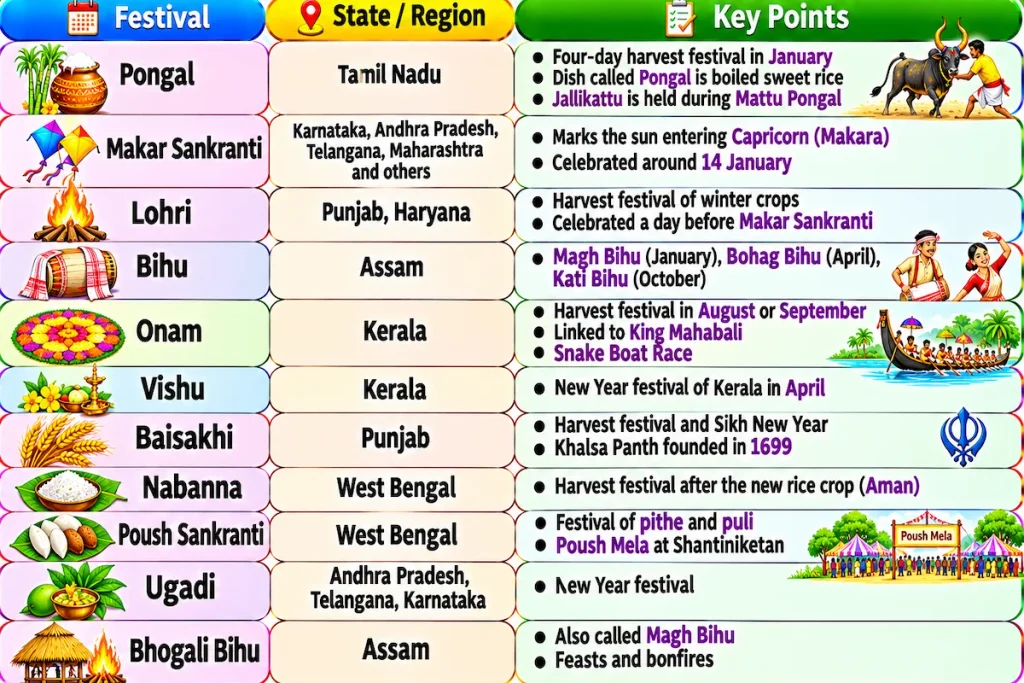
1. ‘Pongol’ is the main festival of (harvest festival)
(A) Tamilnadu
(B) Karnataka
(C) Kerala
(D) Andhra Pradesh
Answer: (A) Tamilnadu
Explanation: Pongal is the main harvest festival of Tamil Nadu. It is celebrated in mid-January, usually from 14 to 17 January, and marks the end of the harvest season and the sun’s northward journey (Uttarayan). The word “Pongal” means “to boil over” in Tamil. The festival is thanksgiving to the Sun God, nature and farm animals. It lasts four days: Bhogi, Thai Pongal, Mattu Pongal and Kaanum Pongal. Karnataka celebrates Makar Sankranti, Kerala is known for Onam and Vishu, and Andhra Pradesh celebrates Sankranti, so these options are incorrect.
Pongal and Harvest Festivals of Different Indian States:
2. Who was elected as the President of India for the second time ?
(A) Rajendra Prasad
(B) Sarvapalli Radhakrishnan
(C) V.V. Giri
(D) Sankar Dayal Sharma
Answer: (A) Rajendra Prasad
Explanation: Dr. Rajendra Prasad is the only person in India’s history to be elected President twice, in 1952 and 1957. He was the first President of India and held office for about 12 years, from 26 January 1950 to 13 May 1962. Article 57 of the Constitution allows a person to be re-elected, but no one else has served more than one term as an elected President. Sarvepalli Radhakrishnan (1962 to 1967), V.V. Giri (1969 to 1974) and Shankar Dayal Sharma (1992 to 1997) each served a single term.
Presidents of India:
| Topic | Key points |
|---|---|
| Rajendra Prasad | First President (1950 to 1962); only President elected twice (1952 and 1957); President of the Constituent Assembly; Bharat Ratna in 1962 |
| Sarvepalli Radhakrishnan | Second President (1962 to 1967); first Vice President (1952 to 1962); Teachers’ Day is observed on his birthday, 5 September |
| Zakir Husain | Third President (1967 to 1969); first Muslim President; died in office |
| V.V. Giri | Fourth President (1969 to 1974); also served as Acting President before being elected |
| Neelam Sanjiva Reddy | Sixth President (1977 to 1982); youngest to become President (at 64); elected unopposed |
| Pratibha Patil | Twelfth President (2007 to 2012); first woman President |
| Droupadi Murmu | Fifteenth President (took office in July 2022); first tribal woman President |
| Article 52 | There shall be a President of India |
| Article 54 | Election by an electoral college of elected members of Parliament and State Legislative Assemblies (including Delhi and Puducherry) |
| Method of election | Proportional representation by single transferable vote through secret ballot |
| Article 56 | Term of five years |
| Article 57 | Eligible for re-election |
| Article 58 | Qualifications: Indian citizen, at least 35 years old, eligible to be a member of the Lok Sabha |
| Article 61 | Impeachment of the President for violation of the Constitution |
WBCS Prelims Static GK Question – 2021
1. ‘Letters from Burma’ is a book of essays penned by ( published in 1991 )
(A) Aung San Suu Kyi
(B) Rashbehari Bose
(C) Sarat Chandra Chattopadhyay
(D) Subhas Chandra Bose
Answer: (A) Aung San Suu Kyi
Explanation: Letters from Burma is a collection of essays by Aung San Suu Kyi, the Burmese democracy leader and Nobel Peace Prize winner. The essays were first written as fortnightly letters for a Japanese newspaper (Mainichi Daily News) in 1995 and 1996, and were later published as a book (Penguin, 1997). They describe everyday life, culture and politics in Burma under military rule. The 1991 date in the question is a mix-up: 1991 is the year she won the Nobel Peace Prize, and her book Freedom from Fear also dates from that period. The other options are wrong. Rashbehari Bose was a revolutionary who worked in Japan, Sarat Chandra Chattopadhyay was a Bengali novelist who lived in Burma for some years, and Subhas Chandra Bose was imprisoned in Mandalay jail, but none of them wrote this book.
Aung San Suu Kyi, Myanmar (Burma) and Indian Links with Burma:
| Topic | Key points |
|---|---|
| Aung San Suu Kyi | Born 19 June 1945 in Rangoon; daughter of General Aung San, the independence hero of Burma |
| Party | National League for Democracy (NLD), founded in 1988 |
| Nobel Peace Prize | 1991, for her non-violent struggle for democracy and human rights |
| Sakharov Prize | 1990 (European Parliament) |
| Jawaharlal Nehru Award | 1992, for International Understanding (India) |
| Book | Letters from Burma; essays on life and politics in Burma |
| Other works | Freedom from Fear |
| Position | State Counsellor of Myanmar (2016 to 2021) |
| Military coup | February 2021; she was detained by the army |
| Name of the country | Burma was renamed Myanmar in 1989 by the military government |
| Capital | Naypyidaw (earlier Yangon/Rangoon) |
| Subhas Chandra Bose | Held in Mandalay jail, Burma (1925 to 1927) |
| Sarat Chandra Chattopadhyay | Bengali novelist (Devdas, Pather Dabi); lived in Burma for several years |
| Rashbehari Bose | Indian revolutionary; helped set up the Indian Independence League in Japan |
| Bahadur Shah Zafar | Last Mughal emperor; exiled to Rangoon in 1858 after the Revolt of 1857, died there in 1862 |
| Burma separated from British India | 1937 |
| Independence of Burma | 4 January 1948 |
2. How many new Government Medical Colleges have become functional in West Bengal during the last ten years ?
(A) 8
(B) 6
(C) 5
(D) 3
Answer: (A) 8
Explanation: This multiple-choice question originally appeared in the WBCS Prelims 2021 official exam paper. According to the official answer key for that exam, 8 new Government Medical Colleges became functional in West Bengal during the ten-year period leading up to 2021.
Key Context & Subsequent Updates:
- 2011–2021 Period (Exam Reference): Eight state-run medical colleges became operational during this decade, significantly expanding district-level healthcare and MBBS seats.
- Post-2021 Expansion: Following the 2021 exam, West Bengal established several more institutions—including six new government medical colleges in 2022 at Arambagh, Tamluk, Barasat, Jhargram, Uluberia, and Jalpaiguri. According to updates from the West Bengal Health & Family Welfare Department, a total of 11 new state government medical colleges have been established under the Centrally Sponsored Scheme across three phases.
3. Sabooj-Sathi is a scheme for distribution of Bicycles to students of Government/Government Aided Schools/Madrasahs reading in ( Oct 2015 )
(A) Classes IX to X
(B) Classes X to XI
(C) Classes XI to XII
(D) Classes IX to XII
Answer: (D) Classes IX to XII
Explanation: Sabooj Sathi is a scheme of the Government of West Bengal, started in 2015, that gives free bicycles to students of classes IX to XII in government and government-aided schools and madrasahs. Its main aims are to keep students, especially girls, in school and to improve their access to school in rural areas. Because it covers all four classes from IX to XII, options A, B and C, which cover only two classes, are incomplete.
Sabooj Sathi and Other Student Welfare Schemes of West Bengal:
| Scheme | Key points |
|---|---|
| Sabooj Sathi | Free bicycles for students of classes IX to XII in government and government-aided schools and madrasahs; started in 2015 |
| Aim of Sabooj Sathi | Reduce school dropout, especially among girls; improve access to school |
| Kanyashree Prakalpa | Conditional cash transfer for girls to delay marriage and continue education; launched in 2013; won the UN Public Service Award in 2017 |
| Sikshashree | Scholarship for Scheduled Caste students of classes V to VIII |
| Taruner Swapna | Scheme to give tablets or smartphones to students of classes XI and XII |
| Rupashree Prakalpa | One-time financial grant to the families of girls at the time of marriage, started in 2018 |
| Gatidhara | Scheme for self-employment through commercial vehicles for unemployed youth, started in 2014 |
| Mid-Day Meal Scheme | National scheme started in 1995; renamed PM POSHAN in 2021 |
| Chief Minister of West Bengal | Mamata Banerjee has held the post since 2011 |
| Government and aided schools | Schools run or funded by the state under the Department of School Education |
4. Shanti Swarup Bhatnagar Prize is awarded in the field of (CSIR, 1958)
(A) Peace
(B) and Technology
(C) Medicine
(D) Economics
Answer: (B) Science and Technology
Explanation: The Shanti Swarup Bhatnagar (SSB) Prize for Science and Technology is given by the Council of Scientific and Industrial Research (CSIR) for outstanding contributions to science and technology. It was instituted in 1957 in memory of Dr. Shanti Swarup Bhatnagar, the first Director General of CSIR, and was first awarded in 1958. It is given for work in fields such as biological, chemical, earth and planetary, engineering, mathematical, medical and physical sciences. It is not given for peace, medicine alone or economics. In your question paper, option B appears as “and Technology” because the word “Science” is missing in the text, but the intended option is Science and Technology.
Shanti Swarup Bhatnagar Prize and Other Important Science Awards of India:
| Topic | Key points |
|---|---|
| SSB Prize | Shanti Swarup Bhatnagar Prize for Science and Technology; awarded by CSIR |
| Instituted | 1957; first awarded in 1958 |
| Named after | Dr. Shanti Swarup Bhatnagar (1894 to 1955), first Director General of CSIR and founder of several national laboratories |
| Fields | Biological, chemical, earth, atmosphere, ocean and planetary, engineering, mathematical, medical and physical sciences |
| Age limit | Scientists up to 45 years of age |
| CSIR | Council of Scientific and Industrial Research; established in 1942; headquarters in New Delhi |
| Rashtriya Vigyan Puraskar | New national science awards from 2022 to 2023: Vigyan Ratna, Vigyan Shri, Vigyan Yuva-Shanti Swarup Bhatnagar and Vigyan Team |
| Vigyan Yuva-SSB | Continues the SSB Prize for young scientists under the new award system |
| Bharat Ratna | Highest civilian award of India, started in 1954 |
| Nobel Prize in Peace | Awarded by the Norwegian Nobel Committee in Oslo |
| Nobel Prize in Economics | Officially the Sveriges Riksbank Prize in Economic Sciences in Memory of Alfred Nobel; first awarded in 1969 |
| Kalinga Prize | UNESCO award for popularisation of science |
5. The following coastal area of India was affected by ‘Hudhud Cyclone’ ( October 2014 )
(A) Chennai coast
(B) Kerala coast
(C) Andhra coast
(D) Bengal coast
Answer: (C) Andhra coast
Explanation: Cyclone Hudhud was a very severe cyclonic storm that made landfall near Visakhapatnam in Andhra Pradesh on 12 October 2014. It caused heavy damage in Visakhapatnam and nearby districts, and also affected parts of Odisha. The name Hudhud was suggested by Oman. It is named after a bird, the hoopoe. The Chennai coast, Kerala coast and Bengal coast were not the main areas hit.
Hudhud Cyclone and Cyclone Naming in the North Indian Ocean:
| Topic | Key points |
|---|---|
| Hudhud | Very severe cyclonic storm of October 2014 in the Bay of Bengal |
| Landfall | Near Visakhapatnam, Andhra Pradesh, on 12 October 2014 |
| Name given by | Oman; Hudhud is the Arabic name of the hoopoe bird |
| Areas affected | Visakhapatnam and nearby districts of Andhra Pradesh; also parts of Odisha |
| Naming system | World Meteorological Organization (WMO) panel for the North Indian Ocean; names are given by member countries in a fixed list |
| India Meteorological Department (IMD) | Regional Specialised Meteorological Centre for tropical cyclones over the North Indian Ocean; headquarters at New Delhi |
| Phailin | Cyclone of October 2013 that hit Odisha (Gopalpur) |
| Aila | Cyclone of May 2009 that hit West Bengal and Bangladesh |
| Amphan | Super cyclonic storm of May 2020 that hit West Bengal (Sundarbans) and Bangladesh |
| Fani | Cyclone of May 2019 that hit Odisha (Puri) |
| Yaas | Cyclone of May 2021 that hit Odisha and West Bengal |
| Cyclone season | Pre-monsoon (April to June) and post-monsoon (October to December) |
| National Disaster Management Authority (NDMA) | Apex body for disaster management in India; set up under the Disaster Management Act, 2005 |
6. What is the maximum Government Subsidy that can be availed by a beneficiary under the Gatidhara Scheme ? ( Aug 2014 )
(A) Rs. 50,000
(B) Rs. 1,00,000
(C) Rs. 2,00,000
(D) Rs. 5,00,000
Answer: (B) Rs. 1,00,000
Explanation: Gatidhara is a self-employment scheme of the Government of West Bengal, launched in August 2014. It helps unemployed youth buy a commercial vehicle, such as a passenger or goods vehicle, and earn a living with it. The government gives a subsidy of 30 percent of the project cost, subject to a maximum of Rs. 1,00,000. The rest of the cost is met through a bank loan and the beneficiary’s own contribution. Rs. 50,000, Rs. 2,00,000 and Rs. 5,00,000 are not the limit under the scheme.
Gatidhara Scheme of West Bengal and Other State Self-Employment Schemes:
| Topic | Key points |
|---|---|
| Gatidhara | Self-employment scheme of the Government of West Bengal; launched in August 2014 |
| Purpose | Help unemployed youth buy commercial vehicles for self-employment |
| Subsidy | 30 percent of project cost, maximum Rs. 1,00,000 |
| Rest of the cost | Bank loan and beneficiary’s own contribution |
| Karma Sathi Prakalpa | Self-employment scheme for youth of West Bengal; subsidy support on bank loans |
| Kanyashree Prakalpa | Cash benefit for girls to continue education; launched in 2013 |
| Sabooj Sathi | Free bicycles for students of classes IX to XII; launched in 2015 |
| Swami Vivekananda Self-Employment Scheme | Earlier state scheme for self-employment of youth |
| PMEGP | Prime Minister’s Employment Generation Programme; central credit-linked subsidy scheme for new micro enterprises |
| Stand-Up India | Launched in 2016; bank loans for SC, ST and women entrepreneurs |
| MUDRA Yojana | Launched in 2015; loans up to Rs. 10 lakh for small businesses (Shishu, Kishore and Tarun categories) |
7. The new station constructed and established by India in March, 2012 for scientific research in Antarctica is called
(A) Priyadarshini
(B) Bharati
(C) Maitri
(D) Dakshin Gangotri
Answer: (B) Bharati
Explanation: Bharati is India’s third research station in Antarctica. It was commissioned in March 2012 at Larsemann Hills in East Antarctica, and it works alongside Maitri, the second station. Its design is different from the earlier stations, as it is built from prefabricated container units that can withstand the harsh climate. Maitri (1989) is located at Schirmacher Oasis. Dakshin Gangotri (1983 to 84) was India’s first station, and it was later buried under ice and abandoned. Priyadarshini is not a station but a freshwater lake near Maitri.
India’s Research Stations in Antarctica and the Arctic:
| Station | Year | Key points |
|---|---|---|
| Dakshin Gangotri | 1983 to 84 | India’s first Antarctic station; later buried in ice and abandoned (1990) |
| Maitri | 1989 | Second station; located at Schirmacher Oasis; still functional |
| Bharati | March 2012 | Third station; located at Larsemann Hills, East Antarctica; prefabricated container-based design |
| Himadri | 2008 | India’s Arctic research station at Ny-Alesund, Svalbard, Norway |
| Priyadarshini | Not a station | Freshwater lake near Maitri |
| Indian Antarctic Programme | 1981 | First expedition in December 1981, led by Dr. S. Z. Qasim |
| Antarctic Treaty | 1959 | India became a member in 1983; the treaty keeps Antarctica for peaceful and scientific use |
| Implementing agency | Not applicable | National Centre for Polar and Ocean Research (NCPOR), Goa, under the Ministry of Earth Sciences |
| Indian Antarctic Act | 2022 | Law to regulate Indian activities in Antarctica |
| Antarctica | Not applicable | Fifth largest continent; coldest, driest and windiest continent |
8. Family Income Ceiling for Kanyashree Scheme is not applicable if ( 8 Mar 2013 )
(A) the girl is physically challenged.
(B) the girl is an inmate of JJ Home.
(C) the girl has lost both parents.
(D) All of the above
Answer: (D) All of the above
Explanation: Kanyashree Prakalpa is a conditional cash transfer scheme of the Government of West Bengal, launched on 8 March 2013, to encourage girls to continue their education and to delay their marriage until the age of 18. Under the scheme, there is a family income limit for the benefit, but the limit does not apply to certain categories of girls. These are girls who are physically challenged, girls who live in a JJ (Juvenile Justice) Home, and girls who have lost both parents. Since all three cases are exempt, the correct option is all of the above.
Kanyashree Prakalpa:
| Topic | Key points |
|---|---|
| Launched | 8 March 2013 by the Government of West Bengal |
| Aim | Keep girls in school and prevent child marriage |
| Eligibility | Unmarried girls aged 13 to 18 enrolled in education; income limit applies |
| Income limit exemption | Physically challenged girls, girls in JJ Homes, and orphan girls (lost both parents) |
| K1 (annual scholarship) | Rs. 1,000 per year for girls aged 13 to 18 studying in classes VIII to XII |
| K2 (one-time grant) | Rs. 25,000 for girls who turn 18, are unmarried and are still studying |
| K3 | Added later for girls pursuing postgraduate studies |
| Recognition | UN Public Service Award in 2017 (first prize in the category of reaching the poorest and most vulnerable through inclusive services and participation) |
| Prohibition of Child Marriage Act (PCMA) | 2006; minimum age of marriage is 18 for girls and 21 for boys |
| Sabooj Sathi | Bicycles for students of classes IX to XII, started in 2015 |
| Rupashree Prakalpa | One-time grant for the marriage of girls from poor families, started in 2018 |
| Kanyashree Day | 14 August |
9. The Hindi film ‘Padman’ released in 2018 was inspired by the true life story of ( Coimbatore, Tamil Nadu )
(A) Arunachalam Muruganantham
(B) R. Balki
(C) Akshay Kumar
(D) Bindeshwar Pathak
Answer: (A) Arunachalam Muruganantham
Explanation: Padman (2018) is based on the life of Arunachalam Muruganantham, a social entrepreneur from Coimbatore, Tamil Nadu. He invented a low-cost machine to make sanitary pads and spread menstrual hygiene awareness among rural women. He was awarded the Padma Shri in 2016. The film was directed by R. Balki, and Akshay Kumar played the lead role, a character named Lakshmikant Chauhan, which was inspired by Muruganantham. Bindeshwar Pathak is the founder of Sulabh International, known for low-cost sanitation and toilets. So the other options are not correct.
Padman, Arunachalam Muruganantham and Menstrual Hygiene Awareness:
| Topic | Key points |
|---|---|
| Padman (2018) | Hindi film directed by R. Balki; stars Akshay Kumar, Sonam Kapoor and Radhika Apte |
| Inspiration | Life of Arunachalam Muruganantham of Coimbatore, Tamil Nadu |
| Film character | Lakshmikant Chauhan (played by Akshay Kumar) |
| Muruganantham | Inventor of a low-cost sanitary pad making machine; Padma Shri (2016) |
| Short film | The Period. End of Sentence. (2018) won the Academy Award for Best Documentary Short Subject in 2019; set in Hapur, Uttar Pradesh |
| Menstrual Hygiene Day | 28 May |
| Suvidha | Oxo-biodegradable sanitary napkins sold at Rs. 1 each under Jan Aushadhi Kendras (2018) |
| Bindeshwar Pathak | Founder of Sulabh International Social Service Organisation (1970); Padma Bhushan (2003) |
| Swachh Bharat Mission | Launched on 2 October 2014 |
| Related film on sanitation | Toilet: Ek Prem Katha (2017) |
| Balki | Director of films such as Cheeni Kum, Paa, Ki & Ka and Pad Man |
WBCS Prelims Static GK Question – 2020
1. International Day of the Tropics is observed every year on
(A) 23rd March
(B) 4th July
(C) 22nd September
(D) 26th June
Answer: 29th June ( is not listed among the four options provided )
2. Teachers’ Day is observed every year In India on
(A) September, 5
(B) October, 2
(C) November, 6
(D) December, 25
Answer: (A) September, 5
Explanation: Teachers’ Day is observed in India on 5 September, the birthday of Dr. Sarvepalli Radhakrishnan. He was a philosopher, the first Vice President of India (1952 to 1962) and the second President (1962 to 1967). When his students asked to celebrate his birthday, he suggested that it be observed as a day to honour all teachers, and the day has been observed since 1962. 2 October is Gandhi Jayanti, 6 November is not linked with this day, and 25 December is Christmas. World Teachers’ Day is a different day, observed on 5 October.
Teachers’ Day in India and Dr. Sarvepalli Radhakrishnan:
| Topic | Key points |
|---|---|
| Teachers’ Day (India) | 5 September; birthday of Dr. Sarvepalli Radhakrishnan; observed since 1962 |
| World Teachers’ Day | 5 October; observed by UNESCO since 1994 |
| Dr. S. Radhakrishnan | Born 5 September 1888 at Tiruttani, Tamil Nadu; died 17 April 1975 |
| Positions held | First Vice President (1952 to 1962); second President of India (1962 to 1967) |
| Bharat Ratna | Awarded in 1954 (one of the first recipients, along with C. Rajagopalachari and C. V. Raman) |
| Famous books | Indian Philosophy, The Hindu View of Life, An Idealist View of Life |
| Academic career | Taught at Mysore, Calcutta and Oxford; Vice Chancellor of Andhra University and Banaras Hindu University |
| Gandhi Jayanti | 2 October; also International Day of Non-Violence |
| National Education Day | 11 November; birthday of Maulana Abul Kalam Azad, first Education Minister of India |
| National Youth Day | 12 January; birthday of Swami Vivekananda |
| Children’s Day (India) | 14 November; birthday of Jawaharlal Nehru |
3. Who established the Atomic Energy Commission (AEC) of India in 1948?
(A) P.K. Iyengar
(B) M.R. Srinivasan
(C) Vikram Sarabhai
(D) Homi Bhabha
Answer: (D) Homi Bhabha
Explanation: The Atomic Energy Commission of India was set up in August 1948 under the leadership of Dr. Homi Jehangir Bhabha, who became its first Chairman. It was formed under the Atomic Energy Act, 1948, with the support of Prime Minister Jawaharlal Nehru. Bhabha is called the father of India’s nuclear programme. Later, the Department of Atomic Energy (DAE) was set up in 1954 and the AEC was placed under it. Vikram Sarabhai is known as the father of India’s space programme, and P. K. Iyengar and M. R. Srinivasan were later chairmen of the AEC, so they did not establish it.
Atomic Energy Commission and Homi Bhabha:
| Topic | Key points |
|---|---|
| Atomic Energy Commission (AEC) | Established in August 1948; first Chairman was Homi J. Bhabha |
| Homi J. Bhabha | Born 30 October 1909 in Mumbai; died 24 January 1966 in an air crash near Mont Blanc; father of the Indian nuclear programme |
| Department of Atomic Energy (DAE) | Set up in 1954; headed by the Prime Minister directly; headquarters in Mumbai |
| Tata Institute of Fundamental Research (TIFR) | Founded in 1945 by Bhabha with support from the Tata Trust |
| Bhabha Atomic Research Centre (BARC) | Established in 1954 at Trombay as the Atomic Energy Establishment; renamed BARC in 1967 after Bhabha’s death |
| Three-stage nuclear power programme | Formulated by Bhabha; uses uranium, plutonium and thorium |
| Apsara | Asia’s first nuclear reactor, started in 1956 at Trombay |
| Tarapur | India’s first nuclear power station, started in 1969 |
| Pokhran-I | First nuclear test, 18 May 1974 (Smiling Buddha) |
| Pokhran-II | Nuclear tests of 11 and 13 May 1998; 11 May is observed as National Technology Day |
| Vikram Sarabhai | Founder of the Indian Space Research Organisation (ISRO) in 1969; father of India’s space programme |
| Atomic Energy Regulatory Board (AERB) | Set up in 1983 to regulate nuclear safety |
4. National Institute of Disaster Management or NIDM was previously named as:
(A) National Centre of Disaster Management
(B) National Council of Disaster Management
(C) National Committee for Disaster Management
(D) National Task Force on Disaster Management
Answer: (A) National Centre of Disaster Management
Explanation: NIDM was earlier known as the National Centre for Disaster Management (NCDM). The NCDM was set up in 1995 at the Indian Institute of Public Administration (IIPA), New Delhi, and was upgraded and renamed the National Institute of Disaster Management in 2003. The Disaster Management Act, 2005 later gave it statutory status, with the job of training, research, documentation and capacity building in disaster management. Options B, C and D are not names that the institute has ever carried.
National Institute of Disaster Management (NIDM) and the Disaster Management Framework of India:
| Topic | Key points |
|---|---|
| Earlier name | National Centre for Disaster Management (NCDM) |
| NCDM set up | 1995, at the Indian Institute of Public Administration (IIPA), New Delhi |
| Renamed NIDM | 2003, when it became a national institute |
| Statutory status | Disaster Management Act, 2005 (Section 42) |
| Functions | Training, research, documentation and capacity building in disaster management |
| Ministry | Ministry of Home Affairs |
| Headquarters | New Delhi |
| Disaster Management Act, 2005 | Enacted after the 2004 Indian Ocean tsunami; provides for the National, State and District Disaster Management Authorities |
| NDMA | National Disaster Management Authority; headed by the Prime Minister; set up in 2005 |
| NDRF | National Disaster Response Force; set up under the 2005 Act (formed in 2006); has battalions drawn from the central armed police forces |
| SDMA | State authority headed by the Chief Minister |
| DDMA | District authority headed by the District Magistrate or Collector |
| Sendai Framework | UN framework for disaster risk reduction (2015 to 2030), adopted at Sendai, Japan |
| National Disaster Management Plan | First released in 2016 |
5. India celebrated / will celebrate its 70th Constitution Day in
(A) 2020
(B) 2018
(C) 2017
(D) 2019
Answer: (D) 2019
Explanation: The Constituent Assembly adopted the Constitution of India on 26 November 1949. Adding 70 years gives 26 November 2019, so the 70th anniversary of its adoption fell in 2019. The Constitution came into effect on 26 January 1950, and that date is Republic Day. Strictly, Constitution Day has been observed only since 2015, so the 2019 observance was only the fifth one. The question uses “70th” in the sense of the 70th anniversary of the adoption of the Constitution.
Constitution Day (Samvidhan Divas):
| Topic | Key points |
|---|---|
| Constitution adopted | 26 November 1949 |
| Constitution came into force | 26 January 1950 (Republic Day) |
| 70th anniversary of adoption | 26 November 2019 |
| Constitution Day (Samvidhan Divas) | Observed on 26 November; declared by the Government of India in 2015 and first observed in 2015 |
| Why 2015 | Year of the 125th birth anniversary of Dr. B. R. Ambedkar |
| Earlier name | National Law Day |
| Constituent Assembly | First met on 9 December 1946; Dr. Sachchidananda Sinha was the temporary chairman |
| Permanent President of the Constituent Assembly | Dr. Rajendra Prasad (elected 11 December 1946) |
| Drafting Committee | Set up on 29 August 1947; Chairman was Dr. B. R. Ambedkar |
| Time taken | 2 years, 11 months and 18 days |
| Original Constitution | Handwritten and calligraphed by Prem Behari Narain Raizada; beautified by artists of Shantiniketan, led by Nandalal Bose |
| Signed by the members | 24 January 1950 |
| Original Constitution contained | 395 Articles, 22 Parts and 8 Schedules |
6. Samvidhan Divas or Constitution Day is celebrated in India on
(A) 3rd December
(B) 25th October
(C) 5th January
(D) 26th November
Answer: (D) 26th November
Explanation: Samvidhan Divas, also called Constitution Day, is observed in India on 26 November every year. It marks the day in 1949 when the Constituent Assembly adopted the Constitution of India. The Government of India declared it Constitution Day in 2015, the year of the 125th birth anniversary of Dr. B. R. Ambedkar, the Chairman of the Drafting Committee. Before that, 26 November was known as National Law Day. The other options are not linked with this day: 3 December is the birth anniversary of Dr. Rajendra Prasad, 25 October is not linked with the Constitution, and 5 January is also unrelated.
Samvidhan Divas (Constitution Day):
| Topic | Key points |
|---|---|
| Samvidhan Divas | 26 November; marks the adoption of the Constitution in 1949 |
| Declared as Constitution Day | 2015, by the Government of India (notification by the Ministry of Social Justice and Empowerment) |
| Reason for 2015 | 125th birth anniversary of Dr. B. R. Ambedkar |
| Earlier name | National Law Day |
| Republic Day | 26 January; the Constitution came into force in 1950 |
| Date chosen for Republic Day | 26 January 1930 was observed as Purna Swaraj Day after the Lahore Congress Session of 1929 |
| Rajendra Prasad | Born 3 December 1884; first President of India; President of the Constituent Assembly |
| B. R. Ambedkar | Chairman of the Drafting Committee; first Law Minister of independent India |
| Constituent Assembly strength | 389 members at first (296 after partition) |
| Constitution Preamble words | Sovereign, Socialist, Secular, Democratic, Republic; Socialist and Secular added by the 42nd Amendment, 1976 |
| Constitution Hall | Central Hall of Parliament (old building), where the Constituent Assembly met |
7. In 2006 NIDM was established. Which one of the following is correct ? (Founded: 1995)
(A) False
(B) True
(C) By the Ministry of Human Resource
(D) By the External Affairs Ministry
Answer: (A) False
Explanation: The statement is false because NIDM was not established in 2006. Its origin goes back to 1995, when the National Centre for Disaster Management (NCDM) was set up at the Indian Institute of Public Administration (IIPA), New Delhi. It was upgraded and renamed the National Institute of Disaster Management in 2003, and the Disaster Management Act, 2005 gave it statutory status. It works under the Ministry of Home Affairs, so options C (Ministry of Human Resource) and D (External Affairs Ministry) are wrong. Option B is wrong because the statement is not true.
Establishment and Status of the National Institute of Disaster Management (NIDM):
| Topic | Key points |
|---|---|
| Origin | National Centre for Disaster Management (NCDM), set up in 1995 at IIPA, New Delhi |
| Upgraded and renamed NIDM | 2003 |
| Statutory status | Disaster Management Act, 2005 (Section 42) |
| Ministry | Ministry of Home Affairs |
| Headquarters | New Delhi |
| Functions | Training, research, documentation, policy advice and capacity building in disaster management |
| Disaster Management Act | Passed in 2005 after the 2004 Indian Ocean tsunami |
| Three-tier structure | NDMA (national, headed by the Prime Minister), SDMA (state, headed by the Chief Minister), DDMA (district, headed by the District Magistrate) |
| National Executive Committee | Headed by the Union Home Secretary under the 2005 Act |
| NDRF | National Disaster Response Force; formed in 2006 under the 2005 Act |
| Nodal ministry for disaster management | Ministry of Home Affairs |
| Ministry of Human Resource Development | Renamed the Ministry of Education in 2020 |
| Ministry of External Affairs | Handles India’s foreign relations |
8. PCMA (2006) is the abbreviated version of
(A) Prohibition of Child Marriage Act
(B) Parent-Child Maintenance Act
(C) Pollution Control and Monitoring Act
(D) Parental Care and Maintenance Act
Answer: (A) Prohibition of Child Marriage Act
Explanation: PCMA stands for the Prohibition of Child Marriage Act, 2006. It replaced the Child Marriage Restraint Act, 1929 (the Sarda Act) and came into force on 1 November 2007. It sets the minimum age of marriage at 18 years for girls and 21 years for boys. A child marriage under this Act is voidable at the option of the party who was a child at the time of marriage, and it is a punishable offence. The Act provides for Child Marriage Prohibition Officers to stop such marriages. The other three options are not names of any Indian law.
Prohibition of Child Marriage Act (PCMA), 2006 and Laws on Marriage Age:
| Topic | Key points |
|---|---|
| PCMA | Prohibition of Child Marriage Act, 2006; came into force on 1 November 2007 |
| Replaced | Child Marriage Restraint Act, 1929 (Sarda Act) |
| Minimum age of marriage | 18 years for girls and 21 years for boys |
| Status of child marriage | Voidable at the option of the party who was a child at the time of marriage |
| Punishment | Rigorous imprisonment up to 2 years or fine up to Rs. 1 lakh, or both, for adult male marrying a child and for those who perform or promote it |
| Child Marriage Prohibition Officers | Appointed by the State Government to prevent child marriages and spread awareness |
| Sarda Act, 1929 | Named after Harbilas Sarda; set the minimum age at 14 for girls and 18 for boys |
| Prohibition of Child Marriage (Amendment) Bill, 2021 | Proposed to raise the minimum age of marriage of women to 21; introduced in Parliament in December 2021 |
| Kanyashree Prakalpa | West Bengal scheme (2013) to delay the marriage of girls |
| Protection of Children from Sexual Offences (POCSO) Act | Enacted in 2012 |
| Juvenile Justice (Care and Protection of Children) Act | 2015 |
9. ‘Chancellor’ of the State-run Universities in West Bengal is
(A) Governor of the State
(B) Chief Minister of the State
(C) Education Minister of the State
(D) Chief Justice of Calcutta High Court
Answer: (A) Governor of the State
Explanation: In West Bengal, the Governor is the ex-officio Chancellor of the state-aided universities. This follows the university laws of the state, and it is the usual practice in most Indian states, where the Governor acts as the head of the universities. In 2022, the West Bengal Assembly passed bills to replace the Governor with the Chief Minister as Chancellor. The Governor reserved them for the President, and in December 2025 the President withheld assent. So the Governor continues as Chancellor under the existing law. The Chief Minister, the Education Minister and the Chief Justice of Calcutta High Court do not hold this post.
Chancellor of State Universities in West Bengal and the Governor’s Role in Higher Education:
| Topic | Key points |
|---|---|
| Chancellor of state-aided universities | Governor of West Bengal (ex-officio) |
| Role of the Chancellor | Head of the university; appoints the Vice Chancellor; presides over the convocation |
| 2022 bills | West Bengal University Laws (Amendment) Bill, Aliah University (Amendment) Bill and West Bengal University of Health Sciences (Amendment) Bill, passed to make the Chief Minister Chancellor |
| Outcome | Governor reserved the bills for the President in April 2024; the President withheld assent in December 2025, so the Governor continues |
| Reason for dispute | Education is in the Concurrent List; question of the Governor’s role as Chancellor |
| Visitor | Head of a central university; the President of India is the Visitor of central universities |
| Chancellor of Visva-Bharati | Prime Minister of India (a central university) |
| Punchhi Commission | Commission on Centre-State relations (2007 to 2010); gave recommendations on the role of Governors |
| Governor | Appointed by the President under Article 155; term of office is five years (Article 156) |
| Article 153 | There shall be a Governor for each State |
| First Vice Chancellor of the University of Calcutta | Sir Ashutosh Mukherjee served as Vice Chancellor for four terms; the University of Calcutta was established in 1857 |
10. The first Indian to receive Nobel Prize in Economics is
(A) Professor Abhijit Vinayak Banerjee
(B) Professor Amartya Kumar Sen
(C) Professor V. K. R.V. Rao
(D) Professor T. N. Srinivasan
Answer: (B) Professor Amartya Kumar Sen
Explanation: Amartya Sen won the Nobel Memorial Prize in Economic Sciences in 1998, becoming the first Indian and also the first Asian to receive it. He was honoured for his contributions to welfare economics, including his work on famines, poverty, social choice theory and human development. Born in Santiniketan, West Bengal, in 1933, he studied at Presidency College, Kolkata, and Trinity College, Cambridge. Abhijit Banerjee won the prize later, in 2019, as an Indian-born American citizen. V. K. R. V. Rao and T. N. Srinivasan were noted economists but did not win the Nobel Prize.
Amartya Sen and Indian Nobel Laureates:
| Topic | Key points |
|---|---|
| Amartya Sen | Born 3 November 1933 at Santiniketan; Nobel Prize in Economic Sciences, 1998 |
| Work recognised | Welfare economics, social choice theory, famines and poverty |
| Famous books | Poverty and Famines (1981), Development as Freedom (1999), The Argumentative Indian (2005), The Idea of Justice (2009) |
| Bharat Ratna | Awarded in 1999 |
| Human Development Index | Developed with Mahbub ul Haq in 1990 |
| Abhijit Banerjee | Indian-born American; shared the 2019 Nobel Prize in Economics with Esther Duflo and Michael Kremer for work on alleviating global poverty |
| Nobel Prize in Economics | Officially the Sveriges Riksbank Prize in Economic Sciences in Memory of Alfred Nobel; first awarded in 1969 |
| Rabindranath Tagore | First Indian and first Asian Nobel laureate (Literature, 1913) for Gitanjali |
| C. V. Raman | Physics, 1930 (Raman effect); first Asian in science |
| Hargobind Khorana | Medicine, 1968 (Indian-origin American) |
| Mother Teresa | Peace, 1979 |
| Subrahmanyan Chandrasekhar | Physics, 1983 |
| Kailash Satyarthi | Peace, 2014, shared with Malala Yousafzai |
| Venkatraman Ramakrishnan | Chemistry, 2009 (Indian-origin) |
WBCS Prelims Static GK Question – 2019
1. Who was the Prime Minister of Israel during the Munich Massacre ?
(A) Golda Meir
(B) David Ben-Gurion
(C) Levi Eshkol
(D) Shimon Peres
Answer: (A) Golda Meir
Explanation: The Munich Massacre took place on 5 and 6 September 1972 at the Munich Olympic Games in West Germany. Eight Palestinian militants of the group Black September took 11 members of the Israeli Olympic team hostage, and all the hostages were killed, along with a West German police officer. Golda Meir was Prime Minister of Israel at that time, from 1969 to 1974. She was the first and so far the only woman to hold the post. Israel responded with Operation Wrath of God, a campaign to track down those held responsible. David Ben-Gurion was the first Prime Minister (1948 to 1954, 1955 to 1963), Levi Eshkol served from 1963 to 1969, and Shimon Peres held the post later, so none of them was in office in 1972.
Munich Massacre (1972) and Prime Ministers of Israel:
| Topic | Key points |
|---|---|
| Munich Massacre | 5 to 6 September 1972, Munich Olympics (West Germany); 11 Israeli athletes and coaches killed by Black September |
| Prime Minister at the time | Golda Meir (1969 to 1974) |
| Golda Meir | Born in Kyiv in 1898; first woman Prime Minister of Israel; also faced the Yom Kippur War (October 1973) |
| Israeli response | Operation Wrath of God, a covert Mossad operation against those linked to the attack |
| Black September | Palestinian militant group named after the events of September 1970 in Jordan |
| David Ben-Gurion | First Prime Minister of Israel; declared the State of Israel on 14 May 1948 |
| Levi Eshkol | Prime Minister from 1963 to 1969; in office during the Six-Day War (1967) |
| Shimon Peres | Prime Minister in 1984 to 1986 and 1995 to 1996; later the ninth President of Israel (2007 to 2014) |
| Yitzhak Rabin | Prime Minister in 1974 to 1977 and 1992 to 1995; assassinated in 1995 |
| Iron Lady of Israel | Popular title of Golda Meir |
| 1972 Olympic Games | Host city Munich; the first Games in Germany since the 1936 Berlin Games |
2. Who was Sikkim’s last sovereign king ?
(A) Phuntsog Namgyal
(B) Tensung Namgyal
(C) Tashi Namgyal
(D) Palden Namgyal
Answer: (D) Palden Namgyal
Explanation: Palden Thondup Namgyal was the 12th and last Chogyal (king) of Sikkim. He ruled from 1963 until 1975, when Sikkim became a part of India. In April 1975, a referendum in Sikkim voted overwhelmingly to end the monarchy and join India, and Sikkim became the 22nd state of India on 16 May 1975 by the 36th Constitutional Amendment. Phuntsog Namgyal was the first Chogyal, crowned in 1642 at Yuksom. Tensung Namgyal was the second Chogyal, and Tashi Namgyal was the father of Palden Thondup and ruled from 1914 to 1963, so they were not the last king.
Sikkim:
| Topic | Key points |
|---|---|
| Last Chogyal | Palden Thondup Namgyal (ruled 1963 to 1975); 12th Chogyal |
| First Chogyal | Phuntsog Namgyal, crowned in 1642 at Yuksom by three lamas |
| Second Chogyal | Tensung Namgyal; shifted the capital from Yuksom to Rabdentse |
| Tashi Namgyal | 11th Chogyal (1914 to 1963); father of Palden Thondup Namgyal |
| Protectorate status | Became a protectorate of India in 1950 through a treaty, with India responsible for defence and foreign affairs |
| Associate State | 1974, by the 35th Constitutional Amendment |
| Full statehood | 16 May 1975, as the 22nd state, by the 36th Constitutional Amendment |
| Referendum | April 1975; vote in favour of merging with India |
| First Chief Minister | Kazi Lhendup Dorjee, leader of the Sikkim Congress |
| Capital | Gangtok |
| Chogyal’s wife | Hope Cooke, an American, who became Queen of Sikkim |
| Sikkim Day | 16 May |
| Kanchenjunga | Third highest peak in the world; on the Sikkim and Nepal border |
| Organic state | Sikkim became India’s first fully organic state in 2016 |
3. Where is Vansda National Park Located ?
(A) Uttar Pradesh
(B) Gujarat
(C) Rajasthan
(D) Madhya Pradesh
Answer: (B) Gujarat
Explanation: Vansda National Park is in the Navsari district of southern Gujarat, in the Dang region, close to the border with Maharashtra. It was declared a national park in 1979. It is a forest of moist deciduous type with teak, bamboo and other trees, and it is known for the Bengal tiger’s habitat in the past, as well as leopards, hyenas, jackals, and a variety of birds and reptiles. The Ambika river flows through the park. It is a different park from the national parks of Uttar Pradesh, Rajasthan and Madhya Pradesh.
National Parks of Gujarat and Related Facts:
| Topic | Key points |
|---|---|
| Vansda National Park | Navsari district, Gujarat; declared in 1979; moist deciduous forest |
| Gir National Park | Junagadh district, Gujarat; the only home of the Asiatic lion; established in 1965 |
| Blackbuck National Park | Velavadar, Bhavnagar district; known for the blackbuck |
| Marine National Park | Gulf of Kutch, Jamnagar district; the first marine national park of India (1982) |
| Number of national parks in Gujarat | Four: Gir, Vansda, Blackbuck (Velavadar) and Marine National Park (Gulf of Kutch) |
| Little Rann of Kutch | Wild Ass Sanctuary in Gujarat; home of the Indian wild ass |
| Kanha National Park | Madhya Pradesh |
| Ranthambore National Park | Rajasthan |
| Jim Corbett National Park | Uttarakhand; India’s first national park (1936), earlier named Hailey National Park |
| Kaziranga National Park | Assam; known for the one-horned rhinoceros |
| Sundarbans National Park | West Bengal; home of the Royal Bengal tiger; UNESCO World Heritage Site |
| Wildlife Protection Act | 1972; led to the establishment of national parks and sanctuaries |
4. What is the currency of Iran ?
(A) Iranian Rial
(B) Iranian Rubel
(C) Iranian Diner
(D) Iranian Dollar
Answer: (A) Iranian Rial
Explanation: The official currency of Iran is the Iranian rial (code IRR). The central bank of Iran issues it, and its value has fallen sharply over the years because of sanctions and inflation. In everyday speech, Iranians often quote prices in toman, where one toman equals ten rials. A law to remove four zeros from the currency and rename it the toman has been approved in Iran, with a gradual transition, but I have not verified the latest status, so for the exam remember the rial as the standard answer. Rubel, Diner and Dollar are not Iran’s currency. The rubel (ruble) is the currency of Russia, the dinar is used in Iraq, Kuwait, Jordan and other countries, and the dollar is used in the USA and many other countries.
Currencies of Iran and Other West Asian and Neighbouring Countries:
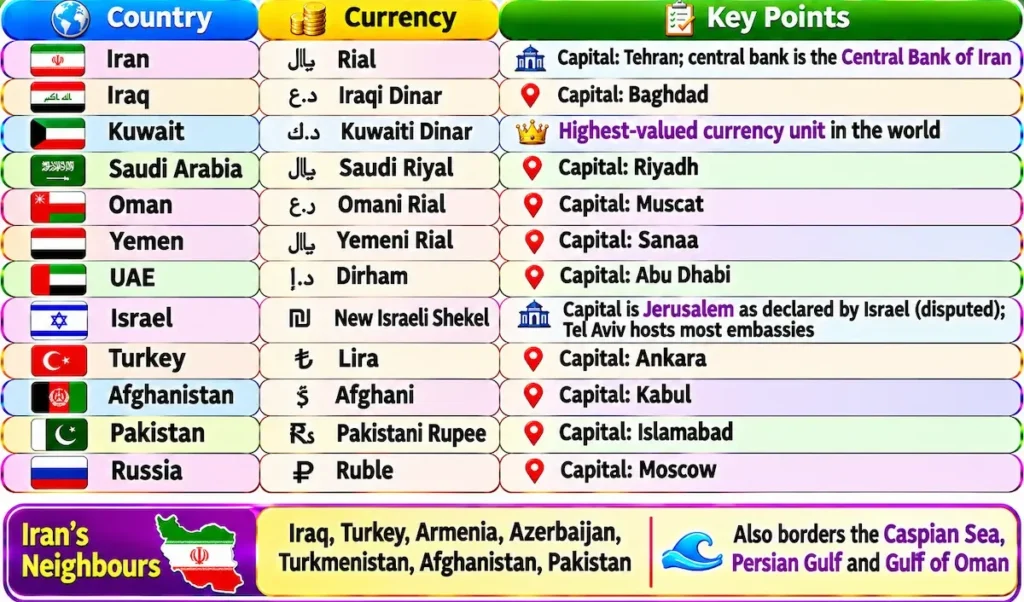
5. Which date is marked as the World Day for War Orphans ?
(A) January 3
(B) January 4
(C) January 5
(D) January 6
Answer: (D) January 6
Explanation: The World Day for War Orphans is observed on 6 January every year. The day was started in 2002 by the French non-governmental organisation Fondation Enfants Orphelins de Guerre (Children War Orphans Foundation) to draw attention to the situation of children who have lost their parents in conflicts and to support their protection and education. It is an awareness day started by an organisation, and it is not an official UN day. The other options (3, 4 and 5 January) are not linked with this day. Note that 4 January is World Braille Day, which is a UN-recognised day.
World Day for War Orphans and Important Days in January:
| Day | Date | Key points |
|---|---|---|
| World Day for War Orphans | 6 January | Started in 2002 by a French organisation to raise awareness about children orphaned by war |
| World Braille Day | 4 January | Birth anniversary of Louis Braille (born 1809); UN-recognised since 2019 |
| World Hindi Day | 10 January | Marks the first World Hindi Conference held in Nagpur in 1975 |
| Pravasi Bharatiya Diwas | 9 January | Marks the return of Mahatma Gandhi from South Africa in 1915 |
| National Youth Day | 12 January | Birth anniversary of Swami Vivekananda |
| Army Day (India) | 15 January | Marks Field Marshal K. M. Cariappa taking over as the first Indian Commander-in-Chief in 1949 |
| National Voters’ Day | 25 January | Founding day of the Election Commission of India (1950) |
| International Customs Day | 26 January | Observed by the World Customs Organization |
| Republic Day (India) | 26 January | Constitution came into force in 1950 |
| Martyrs’ Day (India) | 30 January | Death anniversary of Mahatma Gandhi |
| International Holocaust Remembrance Day | 27 January | Marks the liberation of Auschwitz in 1945 |
| World Leprosy Day | Last Sunday of January | Observed worldwide to raise awareness about leprosy |
6. Who among the following never became the President of United State of America ?
(A) Herbert Hoover
(B) Geraldin Ford
(C) Calvin Coolidge
(D) James Buchanan
Answer: (B) Geraldin Ford
Explanation: Herbert Hoover (31st President, 1929 to 1933), Calvin Coolidge (30th President, 1923 to 1929) and James Buchanan (15th President, 1857 to 1861) all held the office. The 38th President was Gerald Ford, and the option spells the name “Geraldin”, which is not his name. No person named Geraldin Ford was ever President, so option B is the one that “never became” President. If the name had been spelt correctly, all four options would be Presidents, so this is a spelling trap, and in the exam you should read the names letter by letter.
Presidents of the USA:
| President | Number and term | Key points |
|---|---|---|
| James Buchanan | 15th (1857 to 1861) | Only President who never married; his term came just before the Civil War |
| Calvin Coolidge | 30th (1923 to 1929) | Became President after the death of Warren Harding; a Republican |
| Herbert Hoover | 31st (1929 to 1933) | President when the Great Depression began after the 1929 stock market crash |
| Gerald Ford | 38th (1974 to 1977) | Became President after Richard Nixon resigned over the Watergate scandal; the only person to serve as both Vice President and President without being elected to either office |
| George Washington | 1st (1789 to 1797) | The only President elected unanimously |
| Abraham Lincoln | 16th (1861 to 1865) | Issued the Emancipation Proclamation; assassinated in 1865 |
| Franklin D. Roosevelt | 32nd (1933 to 1945) | Only President elected four times |
| Grover Cleveland | 22nd and 24th | Only President to serve two non-consecutive terms |
| Joe Biden | 46th (2021 to 2025) | Oldest person to be inaugurated as President (at 78 years) |
| Donald Trump | 45th (2017 to 2021) and 47th (2025 onwards) | Second President to serve non-consecutive terms |
| Term limit | 22nd Amendment (1951) | Limits a person to two elected terms as President |
WBCS Prelims Static GK Question – 2018
1. Which day is celebrated every year on 5th of December by Food and Agriculture Organization(FAO) of the United Nations?
(A) World Soil Day
(B) World Health Day
(C) World Irrigation Day
(D) World Anti-Starvation Day
Answer: (A) World Soil Day
Explanation: World Soil Day is observed every year on 5 December to raise awareness about the importance of healthy soil and the sustainable management of soil resources. The International Union of Soil Sciences recommended the day in 2002, and the FAO supported it. The UN General Assembly formally designated 5 December as World Soil Day in 2013, and it was first observed on 5 December 2014. The date was chosen because it is the birthday of King Bhumibol Adulyadej of Thailand, who supported soil conservation work. World Health Day is on 7 April, and World Irrigation Day (observed by the International Commission on Irrigation and Drainage) is on 11 July. World Anti-Starvation Day is not an established UN day.
World Soil Day, FAO and Important Food and Agriculture Days:
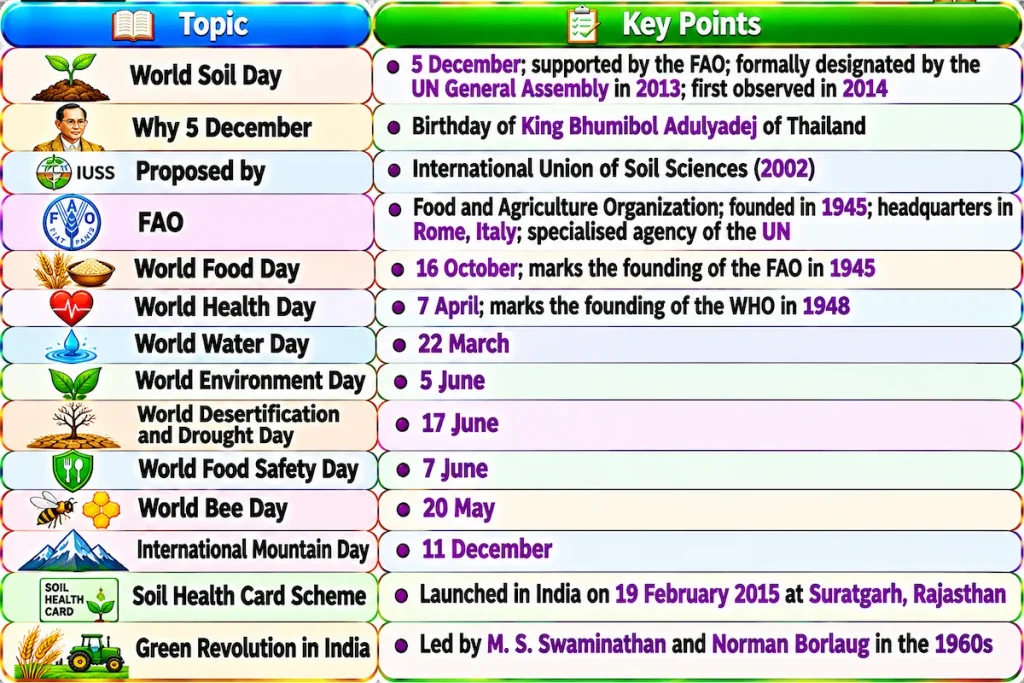
2. The headquarter of the Eastern Railway is located at
(A) Ranchi
(B) Kharagpur
(C) Dispur
(D) Kolkata
Answer: (D) Kolkata
Explanation: The headquarters of the Eastern Railway is at Fairlie Place in Kolkata, West Bengal. The Eastern Railway was formed on 14 April 1952 by merging the East Indian Railway with parts of the Bengal Nagpur Railway. It is one of the oldest railway zones in India. Kharagpur is a railway town known for its long platform and for being a division of the South Eastern Railway, but it is not the Eastern Railway’s headquarters. Ranchi is a division of the South Eastern Railway, and Dispur is the capital of Assam, whose railway zone is the Northeast Frontier Railway, headquartered at Maligaon, Guwahati.
Eastern Railway Zone and Railway Zones with Headquarters in Kolkata:
| Topic | Key points |
|---|---|
| Eastern Railway | Headquarters at Fairlie Place, Kolkata; formed on 14 April 1952 |
| Formation | Merger of the East Indian Railway with parts of the Bengal Nagpur Railway |
| Divisions | Howrah, Sealdah, Asansol and Malda |
| South Eastern Railway | Headquarters at Garden Reach, Kolkata; divisions include Kharagpur, Adra, Ranchi and Chakradharpur |
| Metro Railway, Kolkata | Headquarters at Kolkata; India’s first metro, with the first section (Esplanade to Bhowanipore) opened in 1984; became a separate zone in 2010 |
| Northeast Frontier Railway | Headquarters at Maligaon, Guwahati |
| Kharagpur Railway Station | Has one of the longest railway platforms in the world (about 1,072 m) |
| Longest railway platform | Shri Siddharoodha Swamiji Hubballi Junction (Karnataka) has the longest platform in India, at about 1,507 m, after Gorakhpur lost the top place |
| First train in India | 16 April 1853, from Bori Bunder (Mumbai) to Thane |
| First train in eastern India | 15 August 1854, from Howrah to Hooghly |
| Indian Railways | One of the largest railway networks in the world; Railway Board has its headquarters in New Delhi |
| Number of railway zones | 18 zones, including the proposed South Coast Railway |
3. The importance of ‘Ring Road’ for New Delhi :
(A) it avoid the main city centre
(B) heavy vehicles can avoid city centre
(C) Both (A) and (B)
(D) None of the above
Answer: (C) Both (A) and (B)
Explanation: A ring road is a road that goes around a city. Its main benefit is that traffic which has no reason to enter the city can bypass the centre. This reduces congestion and pollution in the core area. Heavy vehicles such as trucks, which are often banned from the city centre, can use the ring road to avoid it. So both statements (A) and (B) are true, and the answer is both. The Ring Road of Delhi is a major route around the city, and the Outer Ring Road and the Eastern and Western Peripheral Expressways add to this system.
Ring Roads and Peripheral Expressways around Delhi:
| Topic | Key points |
|---|---|
| Ring road | Road built around a city so that through traffic can avoid the city centre |
| Benefits | Reduces traffic jams and pollution in the centre; lets heavy vehicles bypass the city; shortens travel time |
| Ring Road, Delhi | Inner Ring Road, about 50 km long, built in the 1970s and 80s, with several flyovers |
| Outer Ring Road, Delhi | Longer road around the outer parts of the city, about 75 km |
| Eastern Peripheral Expressway (EPE) | Also called Kundli-Ghaziabad-Palwal Expressway; about 135 km; opened in 2018; diverts traffic that does not need to enter Delhi |
| Western Peripheral Expressway | Part of the same Kundli-Manesar-Palwal ring around Delhi |
| Inauguration of EPE | 27 May 2018 by Prime Minister Narendra Modi |
| Delhi-Mumbai Expressway | India’s longest expressway project, linking Delhi and Mumbai; also called the Delhi-Vadodara-Mumbai Expressway |
| National Highways Authority of India (NHAI) | Set up in 1988; responsible for national highways; headquarters in New Delhi |
| Golden Quadrilateral | Links Delhi, Mumbai, Chennai and Kolkata; part of the National Highways Development Project |
| Bypass | Road that goes around a town or village to avoid congestion |
4. At present the JNNURM project of the Central Govt. (AMRUT)
(A) funds development in cities for transport only
(B) funds development in rural areas for transport only
(C) funds projects in cities and villages for transport, housing and environmental protection
(D) limitedly funds road development for villages
Answer: (C) funds projects in cities and villages for transport, housing and environmental protection
Explanation: Option C is the closest of the four, but I could not find the commission’s marked answer, so please confirm it against the official key. JNNURM (Jawaharlal Nehru National Urban Renewal Mission) was launched in December 2005 to fund urban infrastructure, including water supply, sewerage, drainage, solid waste management, urban transport and housing and basic services for the urban poor. Its infrastructure components ended in March 2014, and it was succeeded in 2015 by AMRUT (Atal Mission for Rejuvenation and Urban Transformation) and the Smart Cities Mission. This is the point of the “(AMRUT)” note in your paper. Options A, B and D are too narrow, because they limit funding to transport or roads. Option C is the broadest and covers transport, housing and the environment. The word “villages” in C is not accurate, since both JNNURM and AMRUT are urban missions, so treat this as the best available option and not as a perfect statement.
JNNURM, AMRUT and the Smart Cities Mission:
| Topic | Key points |
|---|---|
| JNNURM | Jawaharlal Nehru National Urban Renewal Mission; launched in December 2005; seven-year mission |
| Components | Urban Infrastructure and Governance (UIG), Urban Infrastructure Development Scheme for Small and Medium Towns (UIDSSMT), Basic Services to the Urban Poor (BSUP), Integrated Housing and Slum Development Programme (IHSDP) |
| Funding | Grants from the Central and State Governments, passed on through the nodal agencies |
| Not funded under JNNURM | Power, telecom, education, health and wage employment projects |
| End of infrastructure components | UIG and UIDSSMT ended on 31 March 2014 |
| AMRUT | Atal Mission for Rejuvenation and Urban Transformation; launched on 25 June 2015 for about 500 cities |
| AMRUT focus | Water supply, sewerage, drainage, urban transport and green spaces |
| Smart Cities Mission | Launched on 25 June 2015; aims at 100 smart cities |
| Pradhan Mantri Awas Yojana (Urban) | Launched in 2015 under the slogan Housing for All by 2022 |
| Swachh Bharat Mission (Urban) | Launched on 2 October 2014 |
| HRIDAY | Heritage City Development and Augmentation Yojana; launched in January 2015 |
| Ministry | Ministry of Housing and Urban Affairs |
WBCS Prelims Static GK Question – 2017
1. Which of the following states does not have veto power in the U.N Security Council ?
(A) United America
(B) United kingdom
(C) Canada
(D) France
Answer: (C) Canada
Explanation: Only the five permanent members of the UN Security Council have veto power. They are the United States, the United Kingdom, France, Russia and China. A negative vote by any one of them blocks a substantive resolution, even if all the other members vote in favour. Canada is not a permanent member of the Security Council, so it has no veto. In the question, “United America” is a careless way of writing the United States of America, which does hold the veto, as do the United Kingdom and France.
UN Security Council:
| Topic | Key points |
|---|---|
| Permanent members (P5) | USA, UK, France, Russia (successor of the USSR) and China |
| Veto power | A negative vote by any permanent member blocks a substantive resolution; an abstention does not block it |
| Total members | 15: 5 permanent and 10 non-permanent |
| Non-permanent members | Elected by the General Assembly for a two-year term; five are elected each year; they have no veto |
| Voting | Substantive decisions need 9 affirmative votes, including those of all five permanent members (no veto) |
| Procedural matters | Need 9 votes; no veto applies |
| Seat of the UN | New York, USA; the UN was founded on 24 October 1945 |
| UN Charter | Signed on 26 June 1945 in San Francisco; the Security Council is covered in Chapter V |
| Primary responsibility | Maintenance of international peace and security |
| China’s seat | The Republic of China held the seat until 1971; the People’s Republic of China took it by General Assembly Resolution 2758 (1971) |
| India’s position | Seeks a permanent seat; part of the G4 (India, Brazil, Germany, Japan); India was a non-permanent member in 2021 to 2022 |
| Presidency | Rotates monthly among the 15 members in English alphabetical order |
2. The International Day for preservation of ozone layer is observed on
(A) 12-Sep
(B) 14-Sep
(C) 16-Sep
(D) 20-Sep
Answer: (C) 16-Sep
Explanation: The International Day for the Preservation of the Ozone Layer, also called World Ozone Day, is observed on 16 September every year. The UN General Assembly designated the day in 1994 to commemorate the signing of the Montreal Protocol on 16 September 1987. The Montreal Protocol is the international treaty that phases out substances that damage the ozone layer, such as chlorofluorocarbons (CFCs). It is the first treaty in UN history to be ratified by every country. The other dates in the options (12, 14 and 20 September) are not linked with this day.
World Ozone Day, Montreal Protocol and Ozone Layer Protection:
| Topic | Key points |
|---|---|
| World Ozone Day | 16 September; designated by the UN General Assembly in 1994 |
| Reason for the date | Montreal Protocol was signed on 16 September 1987 |
| Montreal Protocol | Treaty to phase out ozone-depleting substances (ODS) such as CFCs, halons and carbon tetrachloride; came into force on 1 January 1989 |
| Vienna Convention | 1985; the framework agreement for protecting the ozone layer |
| Kigali Amendment | 2016; aims to phase down hydrofluorocarbons (HFCs); came into force on 1 January 2019 |
| Ozone layer | Layer of ozone in the stratosphere, about 15 to 35 km above the Earth; absorbs harmful ultraviolet-B (UV-B) radiation |
| Cause of ozone depletion | Chlorine and bromine released from CFCs and other man-made chemicals |
| Ozone hole | First observed over Antarctica; reported by British scientists in 1985 |
| Unit of measurement | Dobson Unit (DU) |
| India’s role | Signed the Montreal Protocol in 1992; Ozone Cell set up in the Ministry of Environment, Forest and Climate Change |
| World Environment Day | 5 June |
| Earth Day | 22 April |
3. The Headquarter of the World Bank is in
(A) New York
(B) Washington DC
(C) Vienna
(D) Brussels
Answer: (B) Washington DC
Explanation: The World Bank has its headquarters in Washington DC, USA. It was set up in 1944 at the Bretton Woods Conference as the International Bank for Reconstruction and Development (IBRD), and it began operations in 1946. The International Monetary Fund (IMF) is also headquartered in Washington DC. New York is the seat of the United Nations, Vienna is the seat of organisations such as the International Atomic Energy Agency (IAEA) and OPEC, and Brussels is the seat of NATO and the main institutions of the European Union.
World Bank Group:
| Topic | Key points |
|---|---|
| World Bank headquarters | Washington DC, USA |
| Founded | 1944 (Bretton Woods Conference); began operations in 1946 |
| Original institution | International Bank for Reconstruction and Development (IBRD) |
| World Bank Group members | IBRD, International Development Association (IDA), International Finance Corporation (IFC), Multilateral Investment Guarantee Agency (MIGA) and International Centre for Settlement of Investment Disputes (ICSID) |
| World Bank proper | Consists of the IBRD and the IDA |
| IDA | Set up in 1960; gives interest-free credits and grants to the poorest countries |
| IFC | Set up in 1956; lends to the private sector |
| IMF | Headquarters in Washington DC; began in 1945 (formed in 1944 at Bretton Woods) |
| WTO | Headquarters in Geneva, Switzerland; established on 1 January 1995 |
| United Nations | Headquarters in New York |
| NATO | Headquarters in Brussels, Belgium |
| IAEA and OPEC | Headquarters in Vienna, Austria |
| World Bank President | By convention an American is nominated by the United States, the largest shareholder |
WBCS Prelims Static GK Question – 2016
1. Darwin and Wallace were both strongly influenced by the book “An Essay on the Principle of Population” written by :
(A) Erasmus
(B) Malthus
(C) Volthus
(D) Lamarck
Answer: (B) Malthus
Explanation: “An Essay on the Principle of Population” was written by Thomas Robert Malthus and first published in 1798. Malthus argued that human population grows faster than the food supply, so it is held in check by famine, disease and war. Charles Darwin read the essay in 1838 and Alfred Russel Wallace read it around 1858. Both used the idea of a struggle for existence to develop the theory of natural selection. Erasmus Darwin was Charles Darwin’s grandfather and a naturalist, and Lamarck proposed the theory of inheritance of acquired characters. “Volthus” is not a real name.
Malthus, Darwin, Wallace and Theories of Evolution:
| Topic | Key points |
|---|---|
| Thomas Robert Malthus | English economist and clergyman (1766 to 1834); wrote An Essay on the Principle of Population (1798) |
| Malthusian theory | Population grows in geometric progression (1, 2, 4, 8) while food supply grows in arithmetic progression (1, 2, 3, 4) |
| Checks on population | Positive checks (famine, disease, war) and preventive checks (moral restraint, late marriage) |
| Charles Darwin | Wrote On the Origin of Species (1859); theory of natural selection; voyage on HMS Beagle (1831 to 1836) |
| Alfred Russel Wallace | Independently developed the theory of natural selection; wrote to Darwin from the Malay Archipelago in 1858 |
| Joint presentation | Darwin and Wallace’s papers were presented together to the Linnean Society in London in 1858 |
| Lamarck | Jean-Baptiste Lamarck; theory of inheritance of acquired characters; wrote Philosophie Zoologique (1809) |
| Erasmus Darwin | Grandfather of Charles Darwin; wrote Zoonomia |
| Wallace Line | Boundary between the animal life of Asia and Australasia, named after Wallace |
| Gregor Mendel | Father of genetics; experiments on pea plants |
| Hugo de Vries | Proposed the mutation theory of evolution |
| Natural selection | Also called survival of the fittest, a phrase coined by Herbert Spencer |
WBCS Prelims Static GK Question – 2015
1. Which is the following gets its name from a river in the Democratic Republic of Congo ?
(A) Chikungunia virus
(B) Lassa fever
(C) Salmonella bacteria
(D) Ebola virus
Answer: (D) Ebola virus
Explanation: The Ebola virus is named after the Ebola River in the Democratic Republic of Congo (then Zaire). The disease was first identified in 1976 in a village near this river, during a simultaneous outbreak in Yambuku, in the DRC, and another in Sudan. Ebola causes a severe and often fatal haemorrhagic fever, and it spreads through direct contact with the blood or body fluids of infected people or animals. Chikungunya is named from a word of the Makonde language of Tanzania and Mozambique, Lassa fever is named after the town of Lassa in Nigeria, and Salmonella is named after the American veterinary scientist Daniel Salmon.
Diseases Named After Places and People, with Ebola Facts:
| Disease or organism | Named after | Key points |
|---|---|---|
| Ebola virus | Ebola River, Democratic Republic of Congo | First identified in 1976; haemorrhagic fever; the largest outbreak was in West Africa in 2014 to 2016 |
| Lassa fever | Town of Lassa, Borno State, Nigeria | First described in 1969; spread by contact with rats of the Mastomys species |
| Chikungunya | Makonde word meaning “that which bends up” | First described in Tanzania in 1952; spread by Aedes mosquitoes |
| Salmonella | Daniel E. Salmon | American veterinarian; causes typhoid and food poisoning |
| Zika virus | Zika Forest, Uganda | Spread by Aedes mosquitoes; linked to microcephaly in infants |
| Marburg virus | Marburg, Germany | First identified in 1967; related to Ebola |
| West Nile virus | West Nile district, Uganda | Spread by Culex mosquitoes |
| Hantavirus | Hantan River, South Korea | Spread by rodents |
| Alzheimer’s disease | Alois Alzheimer | German physician |
| Parkinson’s disease | James Parkinson | English physician |
| Ebola vaccine | Ervebo | First licensed Ebola vaccine, approved in 2019 |
| WHO | World Health Organization | Headquarters at Geneva; established on 7 April 1948 |
2. World Cancer Day was observed in 2015 across the world on
(A) 10th January
(B) 4th February
(C) 5th June
(D) 15th July
Answer: (B) 4th February
Explanation: World Cancer Day is observed every year on 4 February. It was started in 2000 at the World Summit Against Cancer for the New Millennium held in Paris. The day is led by the Union for International Cancer Control (UICC) and aims to raise awareness, improve education and push governments and individuals to act against cancer. The date is fixed every year, so in 2015 it also fell on 4 February. The theme for 2015 was “Not Beyond Us”. The other dates in the options (10 January, 5 June and 15 July) are not linked with this day. 5 June is World Environment Day.
World Cancer Day and Cancer Awareness Days:
| Topic | Key points |
|---|---|
| World Cancer Day | 4 February every year; first observed in 2000 |
| Started at | World Summit Against Cancer for the New Millennium, Paris (2000) |
| Led by | Union for International Cancer Control (UICC), based in Geneva |
| Theme for 2015 | Not Beyond Us |
| World No Tobacco Day | 31 May; observed by the WHO |
| National Cancer Awareness Day (India) | 7 November; birth anniversary of Marie Curie |
| World Health Day | 7 April |
| Marie Curie | Polish-French scientist; discovered polonium and radium; won Nobel Prizes in Physics (1903) and Chemistry (1911) |
| Tata Memorial Centre | Cancer centre in Mumbai; founded in 1941 |
| Cancer day in October | Breast Cancer Awareness Month; pink ribbon is its symbol |
| Cancer in India | Leading causes include oral, breast, cervical and lung cancers |
| HPV vaccine | Helps prevent cervical cancer |
3. The real name of Gulzar, the noted poet and lyricist, is
(A) Sampooran Singh Kalra
(B) Sadanand Sing Kalia
(C) Surjeet Singh Kohli
(D) Probodh Chandra Bhatia
Answer: (A) Sampooran Singh Kalra
Explanation: Gulzar’s real name is Sampooran Singh Kalra. He was born on 18 August 1934 in Dina, in Punjab (now in Pakistan), and moved to India after Partition. He is a poet, lyricist, writer and film director, and he began his film career as a lyricist with the film Bandini (1963), directed by Bimal Roy. He directed films such as Mere Apne, Aandhi, Mausam, Ijaazat and Maachis. He won the Dadasaheb Phalke Award in 2013, the Padma Bhushan in 2004, the Sahitya Akademi Award for Urdu in 2002 and an Academy Award for Best Original Song for “Jai Ho” (Slumdog Millionaire) in 2009. The other names in the options are not his name.
Gulzar:
| Topic | Key points |
|---|---|
| Real name | Sampooran Singh Kalra |
| Born | 18 August 1934, Dina, Punjab (now in Pakistan) |
| First film as lyricist | Bandini (1963), with the song “Mora Gora Ang Lai Le” |
| Films directed | Mere Apne (1971), Koshish, Parichay, Aandhi (1975), Mausam, Angoor, Ijaazat (1987), Lekin, Maachis (1996), Hu Tu Tu |
| TV serial | Mirza Ghalib (1988) |
| Dadasaheb Phalke Award | 2013 (for 2013 Indian cinema contribution); highest award in Indian cinema |
| Padma Bhushan | 2004 |
| Sahitya Akademi Award | 2002 for his Urdu short story collection Dhuan |
| Academy Award | 2009, Best Original Song, “Jai Ho” from Slumdog Millionaire (shared with A. R. Rahman) |
| Jnanpith Award | 2023 (Urdu), along with Jagadguru Rambhadracharya |
| Dadasaheb Phalke Award | Instituted in 1969 by the Government of India; first recipient Devika Rani |
| Wife | Actress Raakhee |
| Daughter | Meghna Gulzar, film director (Raazi, Talvar) |
Read more:
- WBCS Main Static GK Questions and Answers (Previous Year Paper)
- WBCS Prelims Biology & Environmental Science Questions and Answers (Previous Year Paper)
Source of questions: WBPSC official website